Quick Answer
No direct textual link exists between Göbekli Tepe and Sumerian mythology — the two are separated by roughly six thousand years, and the language of Göbekli Tepe’s builders is unknown. But the site’s symbolic vocabulary reveals a complex belief system that prefigures key elements of later Mesopotamian religion. Pillar-beings with human traits, animal helper spirits, multi-layered cosmology, ritual feasting, and a skull cult all appear at Göbekli Tepe in forms that would later crystallise into the structured pantheons and temple practices of Sumer and Babylon.
At a Glance
- Chronological gap: ~6,000 years between Göbekli Tepe (~9600 BCE) and the first Sumerian temples
- Key framework: Dietrich 2023 — Göbekli Tepe meets the majority of archaeological criteria for shamanism
- Pillar-beings: anthropomorphic T-shaped figures → structural ancestors of Mesopotamian temple-image tradition
- Animal symbolism: foxes, snakes, vultures, boars, leopards → prefigures deity-animal attribute pairings (Inanna/lion, Enki/serpent, Ninurta/Imdugud)
- Cosmic architecture: axis mundi → later expressed in the ziggurat
- Ritual economy: feasting with aurochs and gazelle → precursor to temple sacrifice
- Not a claim: no continuous textual lineage, no direct cult transmission — structural parallels only
When visitors ask me where Mesopotamian mythology began, I do not point them toward the ruins of Uruk or the ziggurats of Ur. I bring them here — to a limestone ridge in southeastern Turkey, where carved pillars older than any known civilisation stand in silent enclosures open to the sky.
This is not to say that Göbekli Tepe is Mesopotamia. It predates Sumerian civilisation by more than six thousand years, and whatever language its builders spoke has been lost beyond recovery. But in my twenty-five years of guiding groups through this region — from the great enclosures of Göbekli Tepe to the cuneiform collections of the Şanlıurfa Museum — I have come to see this site as the deep root system from which the mythological traditions of Mesopotamia eventually grew.
The connection is not simple, and it is not proven. But it is, I believe, real.
Before the Gods: A World Full of Persons
To understand what the builders of Göbekli Tepe believed, we need to set aside our modern assumptions about religion. These people did not have churches, scriptures, or a formal priesthood — at least not in any sense we would recognise. What they had, according to the best current scholarship, was something closer to what anthropologists call an animistic ontology: a worldview in which the boundary between human and non-human persons is fluid, permeable, and charged with meaning.
Oliver Dietrich, the German archaeologist who has led much of the recent analytical work on Göbekli Tepe’s iconography, published a landmark study in 2023 examining whether the site’s imagery is consistent with shamanic belief systems. His approach was methodical. He compiled a comprehensive list of archaeological indicators for shamanism drawn from ethnographic parallels — particularly from Siberian, Arctic, and northern Asian cultures where shamanic traditions have been extensively documented — and then tested each indicator against the evidence from Göbekli Tepe.
The results were striking. Of the dozens of criteria Dietrich examined — ranging from naturalistic animal imagery and human-animal transformation scenes to depictions of helper spirits, references to multi-layered cosmology, and evidence for altered states of consciousness — Göbekli Tepe showed positive or probable matches for the overwhelming majority. The site’s carved reliefs depict animals with extraordinary naturalistic detail, emphasising agency and danger. Human-animal composite figures appear on multiple pillars. Masks with combined animal and human features have been identified. And the architecture itself — circular enclosures with central pillars that may represent an axis connecting different cosmic realms — suggests a cosmological framework remarkably similar to shamanic worldviews documented in living cultures.
What this means, in plain terms, is that the builders of Göbekli Tepe inhabited a world they understood as populated by non-human persons — animals, spirits, perhaps ancestors — with whom they maintained complex relationships of reciprocity, negotiation, and power. This is not “primitive religion.” It is a sophisticated metaphysical framework, and it contains the seeds of everything that would later become Mesopotamian mythology.
The Pillar-Beings: Ancestors of the Gods?
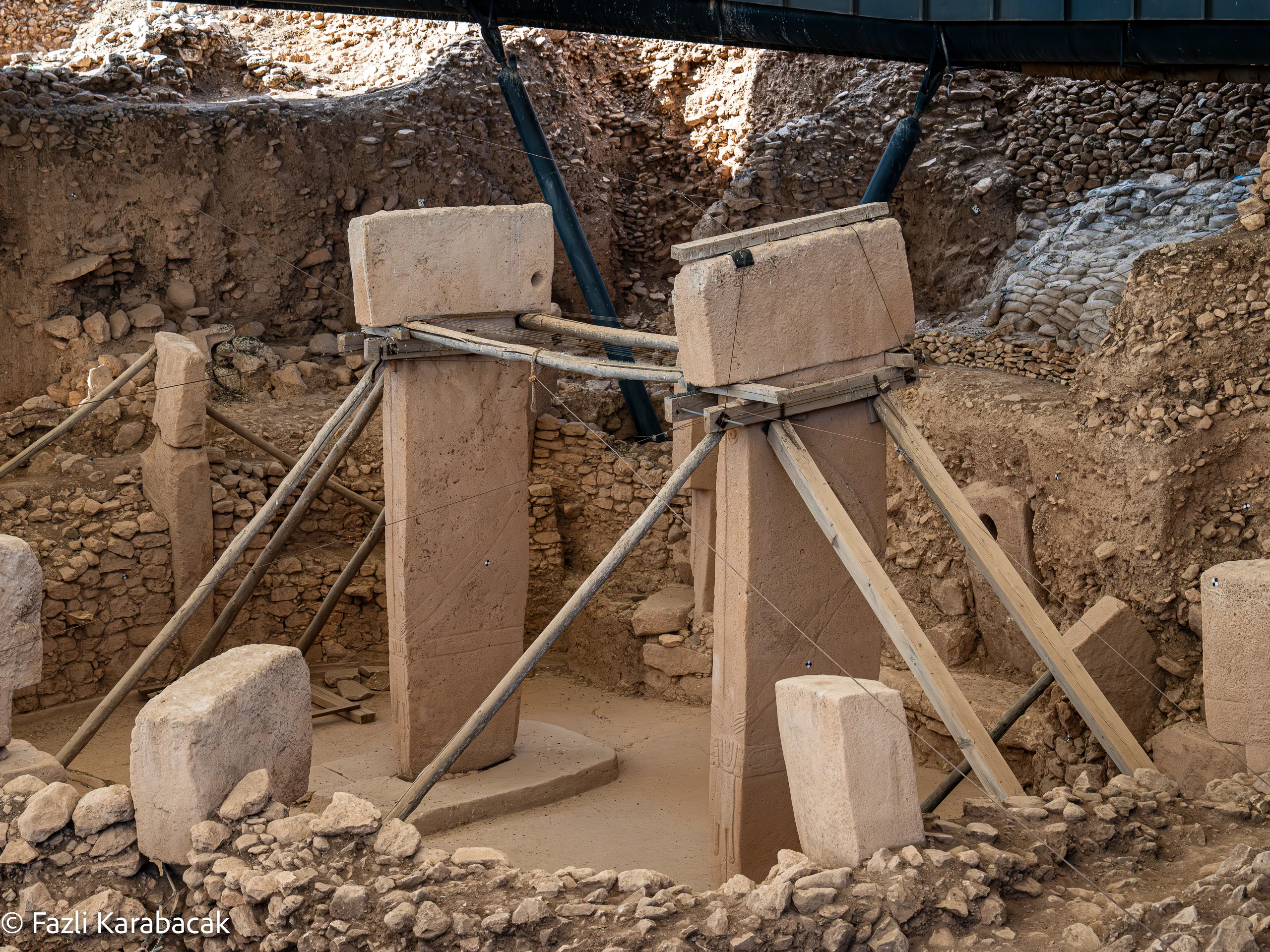
The most distinctive feature of Göbekli Tepe — the T-shaped limestone pillars that stand up to 5.5 metres tall and weigh over ten tonnes — may also be its most theologically significant. These pillars are not abstract architectural elements. They are anthropomorphic: the T-shape represents a stylised human head and shoulders, and many pillars bear carved arms, hands, belts, and loincloths on their shafts. They are, in the most literal sense, stone beings.
But what kind of beings? Klaus Schmidt, who excavated the site from 1995 until his death in 2014, interpreted the central pillars as representations of supernatural entities — not ordinary humans, but powerful figures that towered over the smaller peripheral pillars and the human visitors who entered the enclosures. The arrangement is consistent: in each enclosure, two large central pillars face each other, surrounded by a ring of smaller pillars set into bench-like walls. The central pair always dominates the space.
When I guide groups through the enclosures, I ask them to imagine what it would have felt like to enter these spaces twelve thousand years ago — probably by torchlight, through narrow openings, into a circular chamber where carved stone figures loomed overhead. The experience would have been overwhelming, and it was clearly designed to be. These were not decorative sculptures. They were presences.
Now consider what we know of early Mesopotamian religion. As Jeremy Black and Anthony Green documented in their authoritative dictionary of Mesopotamian religious symbols, the gods of Sumer and Babylon were understood as powerful, anthropomorphic beings who inhabited specific temples and received offerings from human communities. The earliest Sumerian temples — at Eridu, Uruk, and elsewhere — featured cult statues placed in niches or on pedestals, often flanked by attendant figures. Worshippers entered the temple to stand in the presence of the divine image.
The structural parallel with Göbekli Tepe is difficult to ignore. Six thousand years before the first Sumerian temple was built, communities in southeastern Turkey were already constructing enclosed sacred spaces centred on anthropomorphic stone beings, arranged in hierarchical configurations, and maintained through communal ritual activity. The T-shaped pillars may not be “gods” in the Sumerian sense — the concept likely had not yet crystallised — but they occupy the same functional position in the ritual landscape.
The Animal Realm: Helper Spirits and Divine Attributes
One of the most remarkable features of Göbekli Tepe’s iconography is its animal carvings. Foxes, snakes, boars, aurochs, cranes, vultures, scorpions, spiders, and leopards appear across dozens of pillars, sometimes in naturalistic poses, sometimes in configurations that suggest narrative or symbolic meaning. The animals are depicted with extraordinary attention to behaviour and character — the coiled tension of a snake, the aggressive posture of a boar, the spread wings of a vulture.
In shamanic cosmologies documented by ethnographers, animals serve as helper spirits — entities that guide the shaman on journeys between cosmic realms, protect against hostile forces, and lend their powers to the ritual specialist. As Dietrich noted, different shamanic traditions distinguish between animals of the sky (birds, particularly raptors), animals of the earth (predatory mammals), and animals of the underworld (snakes, burrowing creatures). At Göbekli Tepe, all three categories are richly represented.
Fast-forward six thousand years to the Mesopotamian pantheon, and we find something strikingly familiar. Every major Sumerian and Babylonian deity was associated with specific animals that served as their symbols, vehicles, or manifestations. Inanna/Ishtar was associated with the lion; Enki/Ea with the goat-fish and serpent; Ningirsu/Ninurta with the lion-headed eagle Imdugud; Dumuzi with the bull. As Black and Green documented, these animal associations were not merely decorative — they expressed essential aspects of divine power and character.
The question that haunts me as a guide is whether these later divine-animal pairings preserve, in heavily transformed form, the much older Neolithic tradition of human-animal relationships visible at Göbekli Tepe. We cannot trace a direct lineage — the evidence simply does not allow it. But the structural pattern is the same: powerful anthropomorphic beings accompanied by specific animals that express their nature and authority.
On the ground: On our Göbekli Tepe and Karahan Tepe day tour, I like to pair the morning at Göbekli Tepe with an afternoon in the Şanlıurfa Museum. Standing in front of an Early Dynastic Sumerian worshipper statuette after a morning among the T-shaped pillars, most visitors see the line between them instantly — without anyone having to argue for it.
The Cosmic Architecture
Shamanic worldviews typically include a multi-layered cosmos — sky, earth, and underworld — connected by a central axis along which the ritual specialist travels during ecstatic journeys. This axis may take the form of a pillar, a tree, a mountain, or a ladder. Dietrich’s analysis found probable evidence for this cosmological structure at Göbekli Tepe: the central pillars may represent an axis mundi, and the enclosures themselves — carved into bedrock, partially subterranean, open to the sky above — physically embody the connection between underground and celestial realms.
At Karahan Tepe, this cosmic architecture becomes even more explicit. The processional route from Structure AD through Structure AB to Structure AA moves progressively deeper into the earth, with each structure more enclosed and more symbolically intense than the last. The final structure — the Pit Shrine — features a carved pit descending 2.3 metres into bedrock, possibly representing a passage to the underworld.
Now consider the Mesopotamian temple. The Sumerian word for temple, é, literally means “house” — the house of the god. But the temple was conceived as far more than a dwelling. It was a cosmic node, a point where heaven and earth met. The ziggurat — the stepped temple tower that became the defining architectural form of Mesopotamian civilisation — was explicitly understood as a link between the terrestrial and divine realms. The very name of Babylon’s great ziggurat, Etemenanki, meant “House of the Foundation of Heaven and Earth.”
The idea that sacred architecture should function as a cosmic axis, connecting different levels of reality, did not appear suddenly in Sumerian culture. It has roots that stretch back into the Neolithic — and Göbekli Tepe is currently the oldest monumental expression of this idea that we know.
Feasting, Sacrifice, and the Temple Economy
Archaeological evidence from Göbekli Tepe includes massive quantities of animal bones — primarily aurochs, gazelle, and wild boar — indicating that large-scale feasting accompanied ritual activities at the site. These were not everyday meals. The volume of bones, their concentration near the enclosures, and the evidence for coordinated butchering suggest organised communal events that brought together people from across the region.
This pattern — ritual feasting centred on a sacred site, involving the consumption of specific animals — is one of the most consistent features of Near Eastern religious practice from the Neolithic through the historical periods. By the time we reach Sumerian civilisation, the temple has become the centre of an elaborate sacrificial economy: animals are offered to the gods, portions are consumed by priests and worshippers, and the temple itself functions as both a spiritual and economic institution.
Jacques Cauvin, in his influential study of the Neolithic revolution, argued that this entire system — the temple, the sacrifice, the communal feast — originated not as a response to agricultural surplus but as a driver of social and economic transformation. He called it the “revolution of symbols”: the idea that humanity first reimagined its relationship with the cosmos, and only then reorganised its material existence to match. Göbekli Tepe, built by hunter-gatherers before the advent of farming, seems to confirm Cauvin’s thesis. The temple came first. The economy followed.
Skull Cult and Ancestor Worship
Recent discoveries at Göbekli Tepe have added another layer to the mythological picture. Modified human skulls — carved, drilled, and possibly hung or displayed — have been found at the site, indicating what archaeologists call a skull cult or ancestor veneration practice. This is consistent with broader Pre-Pottery Neolithic patterns: at sites like Jericho, Köşk Höyük, and Çatalhöyük, human skulls were plastered, painted, and kept in domestic or ritual contexts.
Ancestor worship is one of the most widespread religious phenomena in human cultures, and it forms a significant strand of Mesopotamian religion. The Sumerian concept of the gidim (spirits of the dead) and the elaborate funerary rituals documented in Mesopotamian texts reflect a belief that the deceased maintained influence over the living and required ongoing attention and offerings. The Sumerian term ki-a-nag, meaning “place of libation,” referred to locations where offerings were made to the dead — a practice with clear echoes in the Neolithic skull cult.
The Long Thread
I want to be clear about what I am not claiming. I am not arguing that Göbekli Tepe’s builders worshipped Sumerian gods, or that the Sumerian pantheon can be traced directly to specific Neolithic carvings. Six thousand years of cultural transformation separate these traditions, and we have virtually no textual evidence for the intervening period.
What I am suggesting — and what the archaeological evidence increasingly supports — is that the deep structure of Mesopotamian religious thought has Neolithic roots visible at Göbekli Tepe. The pattern of anthropomorphic beings in enclosed sacred spaces, attended by specific animals, maintained through communal feasting and sacrifice, connected to a multi-layered cosmos, and anchored by ancestor veneration — this entire complex appears, in early form, at the world’s oldest known monumental site.
When visitors stand before the carved pillars of Enclosure D and ask me what the builders believed, I tell them we will never know the specifics — the names of their spirits, the words of their rituals, the stories they told around their feast-fires. But we can see the shape of their world. And that shape — the sacred enclosure, the towering presence, the guardian animals, the cosmic axis, the feast of communion — is a shape that would echo through millennia, across the plains of Mesopotamia, into the temples of Sumer, and ultimately into religious traditions that still live today.
The roots go deeper than we ever imagined. Göbekli Tepe is where we can finally see them.
Key Takeaways
- Göbekli Tepe’s symbolic system shows strong parallels with shamanic belief structures — animistic ontologies, multi-layered cosmology, and human-animal transformation imagery.
- The T-shaped pillars function as anthropomorphic beings in enclosed sacred spaces, a structural pattern that prefigures Mesopotamian temple cult statues by six thousand years.
- Animal symbolism at Göbekli Tepe mirrors the later Mesopotamian tradition of associating deities with specific animal attributes.
- The site’s architecture may embody a cosmic axis concept (axis mundi) that later crystallised into the Mesopotamian ziggurat tradition.
- Communal feasting at Göbekli Tepe foreshadows the Mesopotamian temple economy of sacrifice and ritual consumption.
- No direct textual link connects Göbekli Tepe to Sumerian religion, but the structural parallels suggest deep Neolithic roots for Mesopotamian mythological traditions.
Planning Your Visit
If you want to see the line from Neolithic ritual to Mesopotamian temple tradition up close — from the T-shaped pillars of Göbekli Tepe to the early cult figures in the Şanlıurfa Museum — our Göbekli Tepe and Karahan Tepe guided day tour is designed to make that long thread visible in a single day.
Your Next Read
Suggested path: Was Göbekli Tepe the First Religion? → Shamanism at Göbekli Tepe → Ancestor and Skull Cult → Karahan Tepe’s Three Rooms.
Frequently Asked Questions
Did Göbekli Tepe’s builders worship Sumerian gods? No. Göbekli Tepe predates Sumerian civilisation by roughly six thousand years, and the specific gods of the Sumerian pantheon had not yet developed. However, the structural patterns of belief visible at the site — anthropomorphic beings, animal symbolism, sacred enclosures, cosmic architecture — prefigure key elements of later Mesopotamian religion.
What religion was practised at Göbekli Tepe? The best current evidence suggests a belief system consistent with shamanic or animistic traditions, characterised by fluid human-animal boundaries, multi-layered cosmology, ritual specialists, and communal feasting. Oliver Dietrich’s 2023 study found that Göbekli Tepe meets the majority of archaeological criteria for identifying shamanism.
Are the T-shaped pillars gods? The pillars are anthropomorphic — they represent beings with human features (arms, hands, belts, loincloths) — but whether they represent gods, ancestors, spirits, or some category we have no word for is unknown. They occupy the same functional position in ritual space that divine images would later occupy in Mesopotamian temples.
How does Göbekli Tepe connect to Mesopotamian temples? Both feature enclosed sacred spaces centred on anthropomorphic figures, attended by animal symbolism, maintained through communal offerings, and conceptualised as cosmic connection points between different realms. The Mesopotamian temple can be understood as a later, more formalised expression of patterns already visible at Göbekli Tepe.
Is there evidence of ancestor worship at Göbekli Tepe? Yes. Modified human skulls — carved, drilled, and possibly displayed — have been found at the site, consistent with the skull cults documented at other Pre-Pottery Neolithic sites. Ancestor veneration later became a significant component of Mesopotamian religion.
Fazlı Karabacak is a licensed Turkish tour guide with over 25 years of experience and the founder of Serendipity Turkey. He specialises in archaeological and cultural tours across Turkey, with particular expertise in Göbekli Tepe and the Pre-Pottery Neolithic sites of southeastern Anatolia.