Quick Answer
The T-shaped pillars of Göbekli Tepe are among the defining features of the site. Carved from limestone and placed at the heart of monumental enclosures, they are widely understood not as ordinary supports but as symbolic or anthropomorphic forms. Their shape, posture, carvings, and placement suggest that they represented powerful beings — perhaps ancestors, ritual figures, or entities that no longer fit neatly into modern categories.
At a Glance
- Material: Limestone
- Shape: T-shaped monoliths
- Role: Symbolic focal points within the enclosures
- Why they matter: They are central to understanding Göbekli Tepe’s architecture and belief world
- Main question: Were they gods, ancestors, spirits, or something else?
When visitors first arrive at Göbekli Tepe, the sheer age of the site is often what shocks them. But once they begin looking carefully, it is the pillars that take over their attention.
These T-shaped monoliths are not just architectural features. They are the conceptual heart of the site. Without them, Göbekli Tepe would still be old and important. With them, it becomes something stranger, deeper, and much harder to reduce to ordinary categories.
Why the Pillars Matter So Much
The T-shaped pillars matter because they seem to stand at the intersection of architecture, symbolism, and social meaning.
They are part of the built structure, but they are not simply structural supports. They dominate space. They organise movement and attention. They carry carvings. And in several of the best-known examples, they appear to have bodily features.
This is why so many archaeologists interpret them as anthropomorphic or semi-anthropomorphic forms.
The Shape Itself
The T-shape is simple, but its simplicity is misleading.
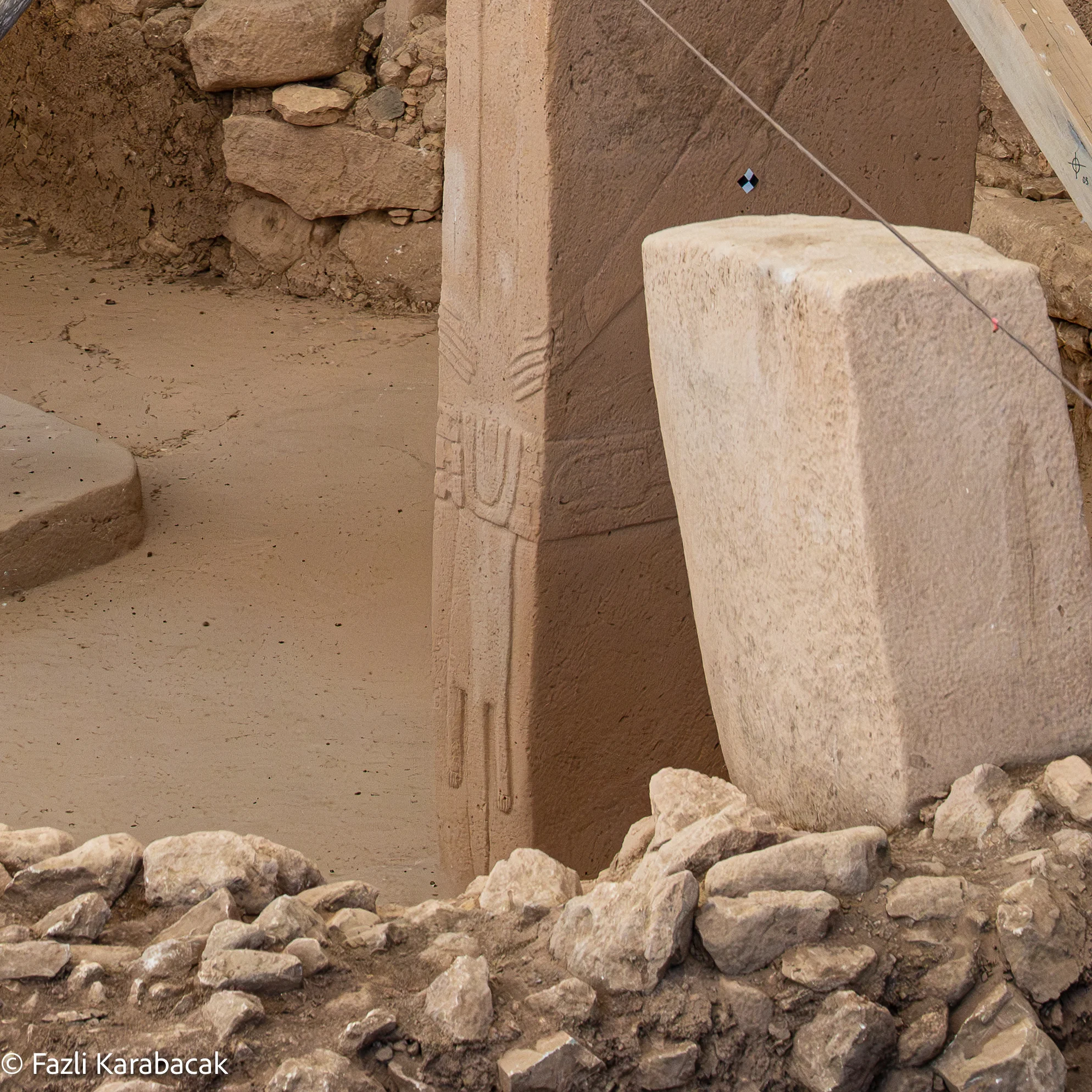
At first glance, it can look abstract. But once you compare several examples, especially the larger central pillars, the form begins to feel deliberate and human-like. The upright shaft resembles a body, while the horizontal top suggests shoulders or a head.
This is one reason the pillars are often read as stylised human figures rather than merely technical stone elements.
Arms, Hands, Belts, and Garments
The strongest evidence for this interpretation comes from the carved details.
Some of the most famous pillars at Göbekli Tepe show carved arms running down the sides, with hands meeting at the front. Others show belts, buckles, and what appear to be animal-skin garments. These are not accidental marks. They are signs of intentional person-like representation.
Once you see these details, it becomes much harder to think of the pillars as neutral architecture.
The Central Pillars
The central pair in the major enclosures is especially important.
These larger pillars do not just stand within the space — they dominate it. They face one another, creating a visual and ritual focus that seems fundamental to the enclosure’s meaning.
This repeated arrangement suggests that the builders were not simply decorating the space with symbolic stones. They were creating a relationship between the pillars and the people who gathered around them.
Gods, Ancestors, or Ritual Beings?
So what exactly do the pillars represent?
This is where certainty ends and interpretation begins.
Some readers instinctively call them gods. Others prefer ancestors. Others avoid both words, since they carry later religious meanings that may distort what the pillars actually signified.
My own view is that the pillars represent powerful beings, but not necessarily in categories we can cleanly translate into modern religious language. They are person-like, but they belong to a ritual imagination that is older than the frameworks most of us bring to the site.
Why the Carvings Around Them Matter
The pillar forms do not stand alone. Around them, Göbekli Tepe presents a world of animals: foxes, vultures, snakes, boars, scorpions, cranes, and other charged creatures.
This matters because the pillars seem to preside over a symbolic field rather than simply stand in an empty enclosure. The animals are part of the same visual programme. Together they create a world of tension, danger, transformation, and ritual intensity. If you want to look more closely at the animals themselves, continue with Fox Symbolism at Göbekli Tepe and Snake Symbolism at Göbekli Tepe.
That is one reason the pillars feel alive even in silence.
Architectural and Symbolic Focus
At a purely architectural level, the pillars help define the space.
They create rhythm around the enclosure walls. They anchor the central area. They shape where the eye goes and where the body stands. The site is not just built with stone — it is organised through the presence of these upright forms.
This is why the engineering story and the symbolic story cannot really be separated. If you want the construction side, it helps to pair this with How Was Göbekli Tepe Built?.
Why the T-Shaped Form Is So Unusual
One reason Göbekli Tepe remains so extraordinary is that the T-shaped pillars do not feel like the obvious result of trial-and-error building.
They look canonical. Repeated. Intentional. As if the builders already knew this was the form they wanted.
That suggests that the T-shape was meaningful before the surviving enclosures were finished. It belonged to a symbolic language the builders were already using.
The Human Presence in Stone
For me, the most powerful thing about the pillars is that they produce presence.
Even when no face is carved, the stone does not feel empty. The broad top, the vertical shaft, the hands, the belts — all of this creates the sense that the pillar is not just a column. It is a being standing in the enclosure.
That effect may be one of the main reasons the site remains so emotionally powerful to modern visitors.
What the Pillars Tell Us About Göbekli Tepe
The pillars tell us that Göbekli Tepe was not simply a construction site or a prehistoric monument in the narrow sense. It was a place where stone was used to make social and symbolic ideas visible.
They also tell us that the people who built the site were thinking in formal, repeatable symbolic systems. These were not isolated carvings made at random. They were part of a coherent visual and architectural programme.
Why Visitors Should Slow Down
If you visit Göbekli Tepe, do not only look at the enclosures as spaces. Look at the pillars as presences.
Notice the difference between the central pair and the outer ring. Notice which pillars feel person-like, which feel more abstract, and how the carvings shift from one area to another.
The pillars are one of the best reminders that Göbekli Tepe is not important only because it is old. It is important because it encodes meaning in a way that still reaches us.
Key Takeaways
- These are not mere structural columns — arms, hands, belts, and garments carved into the stone show they represent beings.
- The taller central pair in each enclosure dominates the space, acting as the focal point of whatever happened inside.
- Pillars and animal carvings work as a unified system: one does not make full sense without the other.
- Whether they depict ancestors, spirits, or something without a modern label, the T-pillars are the key to Göbekli Tepe’s belief world.
From Research to Route
For the engineering behind these pillars, read How Was Göbekli Tepe Built?. For the full site introduction, start with What Is Göbekli Tepe?. Travellers can shape their route on Plan Your Göbekli Tepe Trip.
Frequently Asked Questions
What are the T-shaped pillars at Göbekli Tepe, and why were they created? The T-shaped pillars are massive limestone monoliths, some reaching over five metres in height, that were placed at the centre and around the edges of Göbekli Tepe’s enclosures. Rather than serving as ordinary structural supports, they are widely interpreted as symbolic or anthropomorphic forms — carved beings meant to represent powerful entities. Their labour-intensive creation and central placement suggest they held profound ritual or spiritual significance.
Do the T-shaped pillars definitely represent humans or gods? The carved details — arms, hands, belts, and garments — strongly suggest anthropomorphic intent. However, “god” or “human” may be too modern or narrow. Ancestors, spirit beings, shamanic figures, or ritual presences might be more appropriate descriptions. What is clear is that they were not ordinary structural supports but meaningful representations of powerful beings.
What carvings and details appear on the pillars? Different pillars feature different carvings. Many show carved arms and hands, sometimes positioned as if holding objects. Belts and what appear to be garments are common, and some feature animal imagery such as fox pelts incorporated into their bodily forms. The T-head itself resembles a simplified human head or torso, further suggesting anthropomorphic intent.
Why do the central pillars in each enclosure seem more important than the peripheral ones? The pair of large pillars at the centre of each enclosure are positioned to dominate the space and likely function as the primary focal points of ritual activity. Their greater height, more elaborate carvings, and central placement all suggest they held higher symbolic status. The outer rings of pillars may have functioned as supporting presences or a symbolic community surrounding the central figures.
Are the pillars connected to the animal carvings, or are they separate symbolic systems? They are closely integrated. Fox pelts appear on the pillars themselves, pillar bodies incorporate animal imagery, and the animals carved on surrounding stones work in relation to the pillars. The pillars and animal world form a unified symbolic system rather than separate decorative programmes.
Can visitors today see the T-shaped pillars clearly, and how do they compare to museum pieces? Yes. Several pillars remain in situ at Göbekli Tepe itself, where you can see them in their original architectural context — a powerful experience. However, portable pillar fragments and carved examples are housed in the Şanlıurfa Archaeology Museum. Visiting the museum first allows you to see fine details and carvings that are harder to discern on the weathered originals at the site.
Fazlı Karabacak is a licensed Turkish tour guide with over 25 years of experience and the founder of Serendipity Turkey. He specialises in archaeological and cultural tours across Turkey, with particular expertise in Göbekli Tepe and the Pre-Pottery Neolithic sites of southeastern Anatolia.