Quick Answer
Klaus Schmidt was the archaeologist who recognised the true significance of Göbekli Tepe and devoted much of his career to revealing its importance. Without his insight in the 1990s, the site might have remained misread as little more than a hill with scattered stones. His work transformed Göbekli Tepe from a local anomaly into one of the most important archaeological discoveries in the world.
At a Glance
- Who he was: German archaeologist
- Why he matters: He recognised Göbekli Tepe’s significance and led the excavations that changed archaeology
- Main contribution: He placed Göbekli Tepe at the centre of the global Neolithic debate
- Legacy: He reshaped how scholars think about early ritual, monumentality, and pre-agricultural societies
There are some archaeologists whose names remain mostly inside specialist circles, and there are others whose work changes the shape of global history. Klaus Schmidt belongs to the second group.
For many visitors, Göbekli Tepe feels almost mythic — a place that seems to have emerged suddenly and overturned everything. But sites do not interpret themselves. Someone has to recognise what they are, understand their significance, and persuade the wider world to look again. For Göbekli Tepe, that person was Klaus Schmidt.
Before Klaus Schmidt
Göbekli Tepe was not completely unknown before Schmidt arrived. The hill had already been noted in the 1960s during survey work. But at that stage, its true significance was not understood.
Like many important sites in archaeology, it was visible and yet not really seen. The clues were there, but they had not yet been assembled into the right interpretation. This is one reason Schmidt matters so much: he did not just excavate Göbekli Tepe — he recognised it.
The Moment of Recognition
When Klaus Schmidt visited the site in the 1990s, he immediately understood that the stones on the hill could not be explained away as ordinary remains.
He had already worked on Neolithic archaeology in the region and knew enough to recognise that the visible fragments pointed to something far older and more important than a later cemetery or scatter of stones. That act of recognition changed everything.
In archaeology, this kind of moment is rare. Excavation is essential, of course, but interpretation begins with seeing what others have missed.
Why Schmidt’s Role Was So Important
Schmidt’s contribution was not only technical. It was conceptual.
He saw Göbekli Tepe not as an isolated curiosity but as a site that could force archaeology to rethink its biggest assumptions. The dominant story had long been that agriculture came first, and large-scale ritual or monumental building followed later. Göbekli Tepe destabilised that sequence.
Schmidt grasped early on that this site had the power to change the narrative of the Neolithic.
The Sanctuary Interpretation
Schmidt is strongly associated with the interpretation of Göbekli Tepe as a ritual centre or sanctuary.
In his view, the site was not an ordinary settlement. It was a place where groups gathered for ceremonial purposes, labour, and social coordination. Whether every detail of that interpretation remains unchanged today is less important than the fact that Schmidt gave the site a legible archaeological frame that made the world understand its scale.
Even where scholars now debate or refine his conclusions, they are still working inside a conversation he helped create.
“First Came the Temple”
One of the most memorable ideas associated with Klaus Schmidt is the phrase often summarised as: first came the temple, then the city.
Whether one agrees fully with that wording or not, the phrase captured the shock Göbekli Tepe created. It suggested that ritual gathering and monumental architecture may have played a foundational role in the emergence of social complexity, rather than being late products of settled agricultural life.
That idea travelled far beyond archaeology. It entered public imagination because it was simple, provocative, and grounded in a real archaeological challenge.
Excavation and Global Attention
Under Schmidt’s leadership, Göbekli Tepe moved from a little-known excavation into one of the most important archaeological sites in the world.
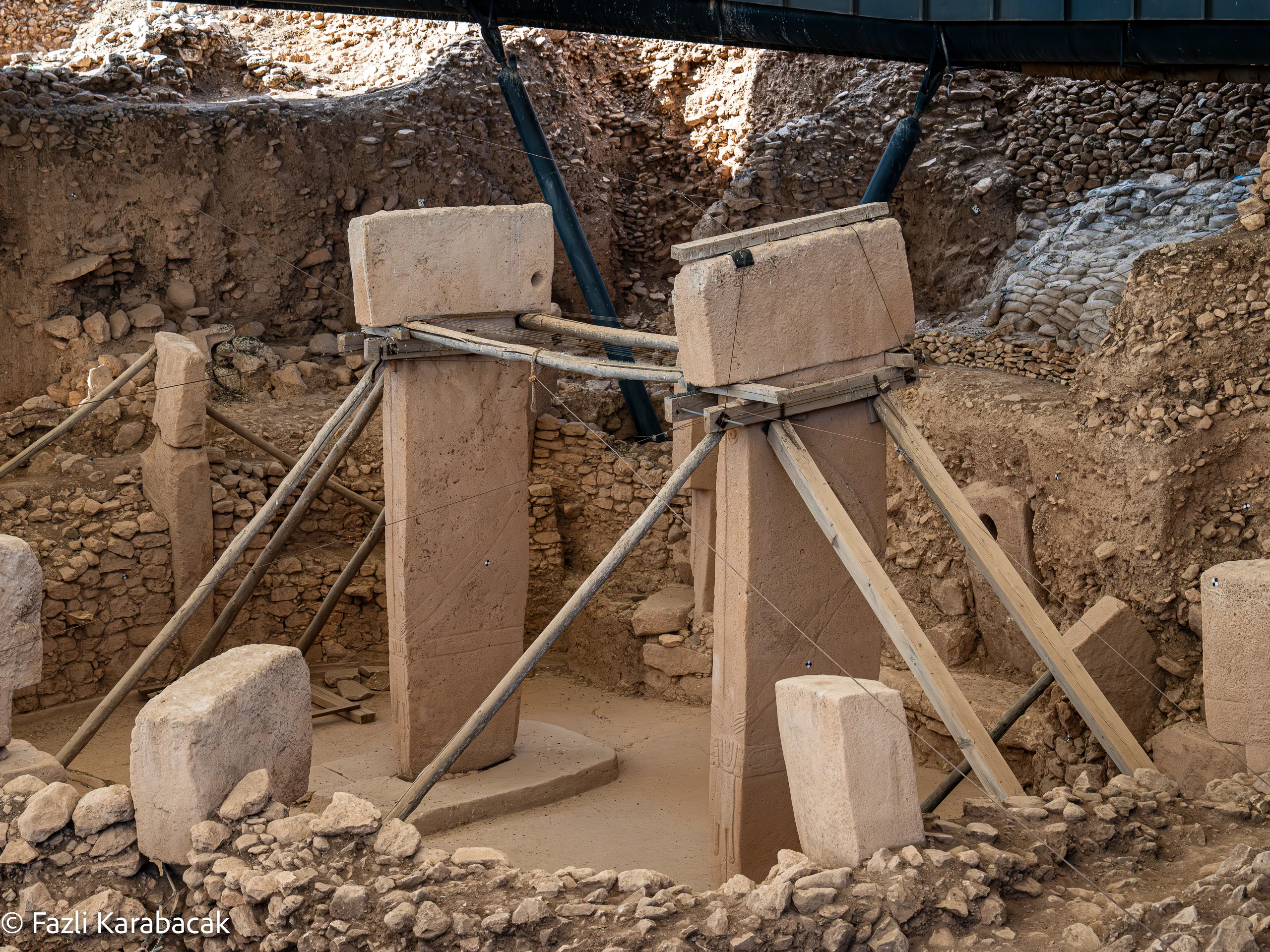
The work was slow, careful, and cumulative. Enclosures emerged, pillars were revealed, carvings became visible, and with each season the site’s significance grew clearer. Schmidt became the central interpreter of that unfolding story.
For many people outside archaeology, his name is now inseparable from Göbekli Tepe itself.
Why His Legacy Endures
Not every part of Schmidt’s interpretation will remain frozen forever. That is not how archaeology works. New trenches, new methods, and new arguments always modify older views.
But that does not reduce his importance. In fact, it proves it. The reason later scholars can argue about Göbekli Tepe in such detail is because Schmidt first made it impossible to ignore.
His legacy is not simply a theory. It is the opening of a field.
Klaus Schmidt and the Visitor Experience
Even for visitors who never read a formal archaeological paper, Schmidt’s influence is everywhere.
The way people talk about Göbekli Tepe — as a turning point, as a challenge to standard history, as a site of immense ritual significance — is shaped in large part by the framework he established. When modern travellers stand above the enclosures and feel that they are looking at something that rewrites the human story, they are often experiencing the site through a language Schmidt helped create.
What Makes Him Different
Many archaeologists excavate important places. Fewer change the historical meaning of those places in ways that alter the discipline itself.
Klaus Schmidt belongs to that smaller group. His importance comes not only from persistence in excavation, but from interpretive boldness. He understood that Göbekli Tepe was not one more site among many. It was a site that asked larger questions about ritual, monumentality, labour, and the making of human worlds.
Why This Still Matters
It matters because Göbekli Tepe is now larger than any one person, but it is still impossible to tell the site’s story honestly without Schmidt.
If you want to understand why Göbekli Tepe became globally important, you need to understand not only the site, but the archaeologist who saw its meaning early and clearly enough to change the field around it.
Key Takeaways
- Schmidt did not just excavate Göbekli Tepe — he made the world understand why it mattered.
- His core claim: ritual and monumental architecture came before agriculture, not after. That single idea reshaped prehistory.
- Later scholars adjust his conclusions, but they still work inside the conversation he started.
- Bottom line: Without Schmidt, Göbekli Tepe might still be an obscure hilltop.
Continue Exploring
Schmidt’s legacy connects to every major debate about the site. Try Was Göbekli Tepe a Temple? for the function question he launched, or How Was Göbekli Tepe Built? for the engineering that amazed him. Visiting? The Göbekli Tepe Visitor Guide covers the practical side.
Frequently Asked Questions
Who was Klaus Schmidt, and what was his background? Klaus Schmidt (1953–2014) was a German prehistoric archaeologist trained at the University of Heidelberg, with early field experience at Nevalı Çori — another important Pre-Pottery Neolithic site in southeastern Turkey that was lost to dam flooding in the 1990s. His work at Nevalı Çori gave him the eye to recognise what he was looking at when he first visited Göbekli Tepe in 1994. He spent the rest of his career directing the Göbekli Tepe excavations through the German Archaeological Institute (DAI).
Did Schmidt really “discover” Göbekli Tepe? Not in the strict sense. The site was noted in a joint Istanbul–Chicago survey in 1963 and dismissed at the time as a probable Byzantine or medieval cemetery because of the visible limestone fragments. Schmidt’s contribution was interpretive: when he visited in 1994, he recognised that what the 1963 survey had catalogued as “grave markers” were actually the tops of buried Neolithic pillars. That reinterpretation is what unlocked the site.
What was Schmidt’s “first came the temple, then the city” idea? It is the shorthand for his bigger argument: that large-scale ritual gathering and monumental architecture could predate — and perhaps even drive — the shift to settled agricultural life, rather than being a consequence of it. The traditional sequence put farming villages first and temples later; Schmidt’s reading of Göbekli Tepe suggested the reverse may have been true. The phrase is catchier than his actual position, which was more nuanced, but it captures the intellectual shock of the site.
How much of his interpretation is still accepted today? Mixed. The broader frame — that Göbekli Tepe is a specialised, communally built site of profound ritual significance — has held up well. Specific claims have been refined: the DAI team under Lee Clare and Jens Notroff now see more evidence of domestic-scale activity around the enclosures, and the “pure sanctuary” reading has softened. But the conversation is still happening on the ground Schmidt opened.
Did he ever see the site become globally famous? Partly. By the time of his death in July 2014, Göbekli Tepe was already a major archaeological story, widely covered in international press. UNESCO World Heritage inscription came in 2018, four years after his death. So he saw the site’s transformation from obscurity into global attention, but not the full institutional recognition that followed.
What happened to the excavation after Schmidt? The DAI team continued under Lee Clare, with Jens Notroff and Moritz Kinzel playing key roles alongside the Turkish Ministry of Culture and the Şanlıurfa Museum. They have moved from the large open-area excavation strategy of the Schmidt years toward more focused, conservation-led work — partly because the exposed enclosures need protection, and partly because the site’s importance now makes every decision about digging it carefully considered. The ongoing Taş Tepeler project, which extends the work across more than a dozen related sites, is arguably Schmidt’s biggest posthumous legacy.
Fazlı Karabacak is a licensed Turkish tour guide with over 25 years of experience and the founder of Serendipity Turkey. He specialises in archaeological and cultural tours across Turkey, with particular expertise in Göbekli Tepe and the Pre-Pottery Neolithic sites of southeastern Anatolia.