Quick Answer
Göbekli Tepe has produced three human skulls with deliberate post-mortem modifications — carved sagittal grooves, drilled perforations, and ochre traces — suggesting they were defleshed, marked, and possibly suspended for display. Combined with headless pillar figures, kneeling sculptures holding severed heads, and the faceless T-shaped pillars themselves, this places Göbekli Tepe at the centre of a 12,000-year-old tradition of ancestor veneration.
At a Glance
- Key find: Three modified human skulls (Gresky, Haelm & Clare 2017, Science Advances)
- Modifications: Carved sagittal grooves, drilled perforations, ochre staining, defleshing marks
- Scale: ~10% of all skull fragments from the site show cut marks
- Iconographic evidence: Headless figure on Pillar 43, kneeling sculptures grasping severed heads
- The T-pillars: Anthropomorphic with arms and clothing, but deliberately faceless — interpreted as ancestor figures
- No formal burials in the monumental enclosures; skulls circulated as ritual objects
- Regional parallels: Jericho plastered skulls, Çatalhöyük skull removal, Nevalı Çori, Körtik Tepe
Where Are the People? The Question That Haunts Every Visit
In my twenty-five years of guiding visitors through Turkey’s archaeological heartland, the questions people ask at Göbekli Tepe tend to follow a pattern. First comes wonder at the age — nearly twelve thousand years. Then curiosity about the animal carvings — foxes, serpents, vultures frozen in limestone. But sooner or later, someone in the group asks the question that hangs in the air of every enclosure: “Where are the people? Where are the dead?”
It is a perceptive question. And the answer takes us into the most haunting dimension of Göbekli Tepe — its relationship with human skulls, with death, and with the rituals these builders performed to keep the dead among the living.
What Did Archaeologists Find When They Looked at the Human Bones?
For years, the presence of human remains at Göbekli Tepe was something of an afterthought in the literature. The bone fragments scattered through the fill deposits seemed incidental — the detritus of a site used over centuries. That changed dramatically in 2017, when Julia Gresky, Juliane Haelm, and Lee Clare published a landmark study in Science Advances documenting three human skulls that bore unmistakable signs of deliberate post-mortem modification.
The most striking feature was the presence of deep, artificially carved grooves running along the sagittal crest — the midline ridge of the skull from front to back. One specimen also showed a drilled perforation, and all three displayed evidence of defleshing: the systematic removal of soft tissue from bone after death. On one skull, traces of red ochre were still visible, suggesting the cranium had been painted as part of a ritual process.
What Gresky and her colleagues proposed was a previously unknown variant of the Neolithic skull cult — one in which skulls were not plastered and modelled to resemble the living face (as at Jericho) but instead incised, perforated, and likely suspended with cord for vertical display. The carved grooves, they argued, may have served as channels to hold binding material in place, allowing the skull to be hung from a post or carried during ceremonies.
When I share this with visitors, the reaction is always the same — a mixture of fascination and unease. But what I emphasise is that this was not macabre butchery. It was a form of care. These skulls were selected, cleaned, marked with deliberate artistry, and kept in circulation long after the flesh had gone. Whatever these people believed about death, they clearly believed the skull retained something essential — identity, power, perhaps the presence of the ancestor themselves.
See it in person: The central pillars of Enclosure D — Pillars 18 and 31 — stand over five metres tall, arms carved along their shafts, facing inward over the ritual space where these skull ceremonies took place. On our Göbekli Tepe guided tour, we bring this archaeology to life and explain what these enclosures were actually used for.
How Common Was Skull Processing at Göbekli Tepe?
The three modified skulls published by Gresky and colleagues represent the most dramatic evidence, but they are not isolated finds. Approximately ten percent of the skull fragments recovered from Göbekli Tepe show cut marks consistent with defleshing — the deliberate scraping of skin and muscle from bone. This is a remarkably high proportion, and it tells us that removing flesh from human crania was not a rare act at this site. It was a regular practice.
What the excavations have not revealed is equally telling. Göbekli Tepe has produced no complete, formal burials from its main occupation phases — no bodies laid out in prepared graves with funerary goods. Human remains come overwhelmingly from secondary deposits: fragments of bone, isolated skull pieces, and disarticulated elements mixed into the fill of the monumental enclosures.
This pattern is significant. It suggests the dead were not brought to Göbekli Tepe to be buried. Parts of the dead — specifically skulls — were brought after decomposition and processing elsewhere. These skulls were then incorporated into the ritual life of the enclosures, used in ceremonies, and eventually deposited.
A notable exception emerged from more recent fieldwork. Lee Clare reported in 2020 that a kidney-shaped sub-floor burial cut, discovered during excavation of a rainwater drainage channel at the southeastern part of the site, contained the disturbed remains of at least three individuals. This burial was associated with domestic structures rather than the monumental enclosures — consistent with Pre-Pottery Neolithic practice across the region, where the dead were routinely interred beneath living spaces.
What Do the Carved Figures on the Pillars Tell Us About Death?
If the physical skull fragments tell us what was done with the dead, the imagery carved into Göbekli Tepe’s pillars tells us what the dead meant. And the iconographic evidence is even more arresting than the bones.
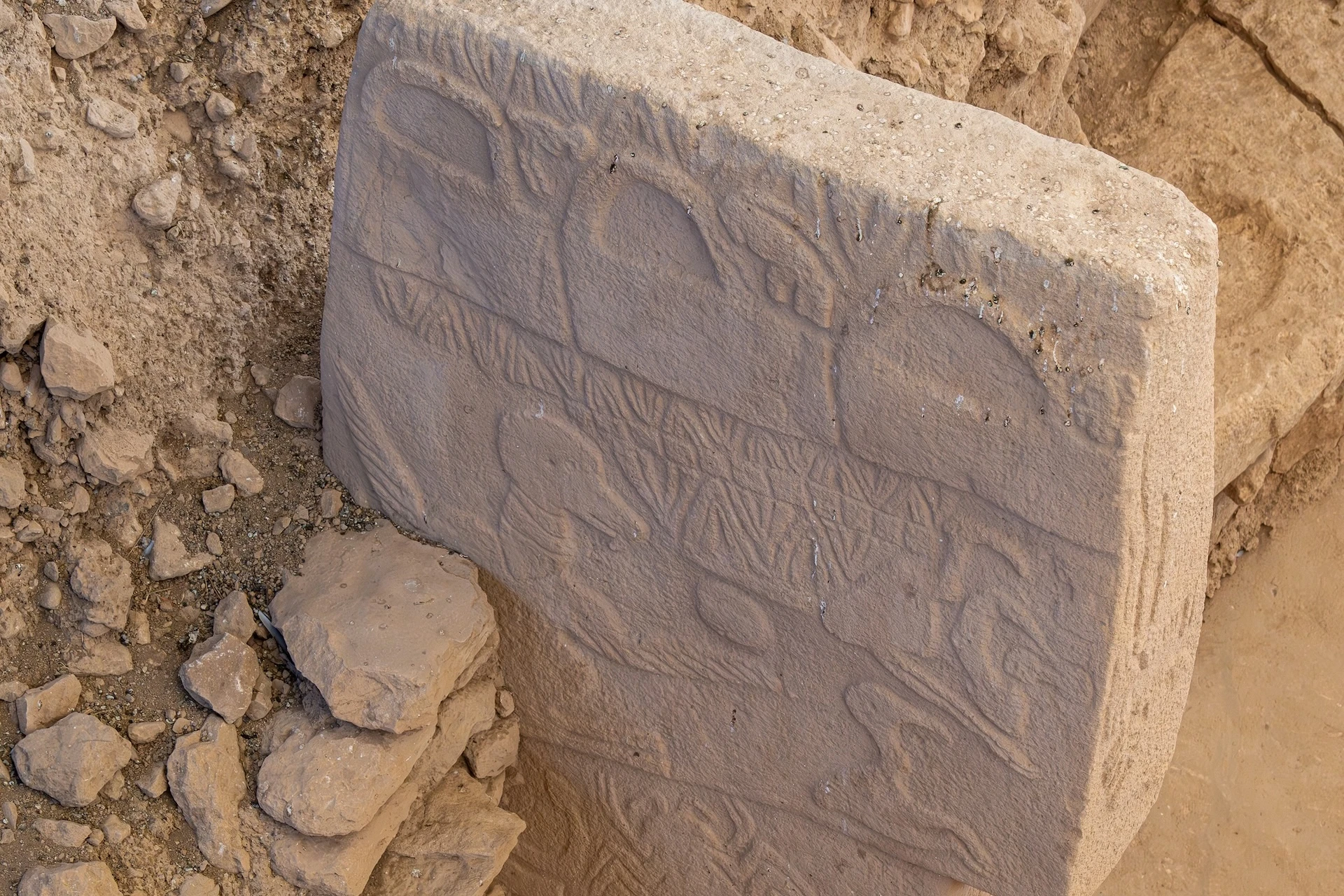
The most famous example is the headless figure on the lower shaft of Pillar 43 in Building D — the so-called “Vulture Stone.” This figure, rendered in low relief, depicts a human body without a head, positioned beneath the great vulture that dominates the upper portion of the pillar. Some scholars interpret it as a representation of excarnation — exposure of the dead to scavenging birds. Others see a shamanic transformation in which the removal of the head signifies a temporary death and journey between worlds.
But the headless figure on Pillar 43 is not alone. Among the sixty-three pieces of anthropomorphic sculpture documented so far at Göbekli Tepe, several depict ritual encounters with severed human heads. Most striking are the kneeling figures documented by Dietrich and colleagues in 2019 — small but intensely detailed sculptures showing individuals grasping what appear to be detached crania.
What many visitors don’t realise is that the treatment of the sculptures themselves mirrors the treatment of human skulls. Dietrich’s study has shown that the heads of anthropomorphic sculptures were frequently and deliberately broken off and deposited separately from their bodies. The sculptures were found face-down or with deliberate damage to their faces. This pattern of intentional breakage strongly parallels the removal and separate circulation of human skulls in Pre-Pottery Neolithic burial practices — as if the sculptured images were understood as animate beings whose “death” required the same ritual separation of head from body performed on actual human remains.
Are the T-Shaped Pillars Representations of Ancestors?
Perhaps the most profound connection between Göbekli Tepe and the ancestor cult lies not in the skull fragments or figurines but in the monumental T-shaped pillars themselves. Standing up to 5.5 metres tall and weighing as much as ten tonnes, these pillars are unmistakably anthropomorphic. They have arms carved in low relief along their sides, hands with fingers meeting at the front below the belt line, and in some cases depictions of clothing — fox-pelt loincloths, woven belts, and what appear to be long ritual gowns.
Yet the pillars have no faces. Their T-shaped tops represent stylised human heads — broad, flat, featureless. Klaus Schmidt interpreted the pillars as representations of supernatural beings or ancestors. The facelessness, rather than being a limitation of the sculptors’ skill (they were clearly capable of extraordinary naturalistic carving when depicting animals), appears to have been a deliberate choice. Dietrich has linked this facelessness to the broader tendency toward masking and concealing the face that characterises shamanic and ritual imagery across the Pre-Pottery Neolithic.
When I guide groups through Building D and we stand between Pillars 31 and 18 — each over five metres tall — I ask visitors to imagine these not as abstract monuments but as figures. Stone beings dressed in elaborately carved garments, their arms folded in a contemplative gesture, surrounded by a ring of smaller pillar-figures all facing inward. On their clothing, the relief bands represent animal ornaments — each pillar bearing its own unique combination that Dietrich has interpreted as representing the assembly of spirit helpers associated with a particular shaman-ancestor.
Standing between them: Nothing prepares you for the experience of standing between the two central pillars of Enclosure D. On our expert-guided day tour, we explain the ancestor interpretation and the shamanic context — the archaeology that makes these stones more than beautiful ruins.
How Does Göbekli Tepe Compare to Other Neolithic Skull Cults?
To understand what was happening at Göbekli Tepe, we need to place it within the wider tradition of skull modification that swept across the Near East during the Pre-Pottery Neolithic.
At Jericho, Kathleen Kenyon’s excavations in the 1950s uncovered human skulls plastered with clay, modelled to restore the appearance of living faces, and fitted with cowrie shells for eyes. Similar plastered skulls have since been found at Tell Aswad in Syria and Kfar HaHoresh in the Galilee, among other sites.
At Nevalı Çori — just sixty-five kilometres from Göbekli Tepe and broadly contemporary with its later phases — excavations uncovered T-shaped pillars remarkably similar to those at Göbekli Tepe, along with the famous “birdman” sculpture: a limestone figure that from the side appears to be a bird with a large beak and hanging wings, but from the front reveals a human face hidden beneath the avian exterior. The fluid boundary between human and animal that characterises Neolithic belief extended to the treatment of the dead.
At Çatalhöyük in central Anatolia, some four thousand years later, the community buried their dead beneath house floors — 470 complete individuals and 272 partial skeletons recovered. In a significant number of cases, skulls were later removed by reopening graves. These retrieved skulls then circulated through the community, perhaps passing from house to house over generations, before being deposited elsewhere. As the bioarchaeological team led by Clark Spencer Larsen demonstrated in 2019, social bonds at Çatalhöyük were based not on biological kinship but on the shared custody of ancestral remains. The dead were active participants in social life.
At Körtik Tepe on the Batman River, finely decorated stone vessels were deliberately broken and their fragments scattered over the bodies of the deceased — their destruction marking the transition between worlds. This resonates with what Dietrich has documented at Göbekli Tepe, where eighty-three fragments of finely worked “greenstone” bowls have been recovered but almost no complete vessels. The deliberate breakage of ritually significant objects — stone bowls, anthropomorphic sculptures, even the T-pillars themselves — appears to have been a core element of the site’s symbolic vocabulary.
What Does All This Evidence Tell Us About Neolithic Belief?
The ancestor cult at Göbekli Tepe was not an isolated peculiarity. It was a foundational element of the Neolithic worldview — a way of understanding the relationship between past and present, between the individual and the community, between the visible world and whatever forces were believed to animate it. The carved skulls, the headless figures, the faceless pillar-ancestors, the shattered bowls, the kneeling sculptures grasping severed heads — all of these point to a society in which death was not an ending but a transformation, and in which the dead retained power and a continuing role in the world of the living.
As Oliver Dietrich has argued, the buildings at Göbekli Tepe functioned as orchestrated spaces for what Harvey Whitehouse has called “imagistic rituals” — rituals designed to produce intense, unforgettable experiences. The semi-subterranean enclosures, entered through deliberately difficult passages, filled with images of dangerous animals and presided over by towering faceless figures, would have created conditions for transformative encounters — initiations, perhaps, in which the boundary between living and dead was temporarily dissolved.
The evidence from Göbekli Tepe challenges us to rethink our assumptions about early human societies. These were not simple hunter-gatherers eking out a precarious existence. They were people with a rich symbolic world, devoted immense resources to maintaining relationships with their dead, and left us — in the carved grooves of a twelve-thousand-year-old skull — evidence of beliefs that would echo through millennia of human civilisation.
Key Takeaways
- Three human skulls from Göbekli Tepe show deliberate post-mortem modification: carved sagittal grooves, drilled perforations, ochre staining, and defleshing, representing a previously unknown variant of the Neolithic skull cult (Gresky, Haelm & Clare 2017).
- Approximately ten percent of skull fragments from the site bear defleshing cut marks, indicating skull processing was a regular practice rather than an exceptional event.
- Headless figures in pillar reliefs, kneeling sculptures holding severed heads, and the deliberate breakage of anthropomorphic sculptures all point to a rich symbolic engagement with death and decapitation.
- The faceless T-shaped pillars — with carved arms, clothing, and unique animal “signatures” — are widely interpreted as representations of ancestors, making the enclosures essentially houses of the dead.
- Göbekli Tepe’s skull practices connect to a broader PPNB tradition seen at Jericho, Nevalı Çori, Çatalhöyük, and Körtik Tepe.
Planning Your Visit
The skull cult evidence is not visible at the site itself — the modified skulls are in Şanlıurfa Museum — but the enclosures where these ceremonies took place are extraordinary. Standing inside Building D between Pillars 18 and 31, imagining the skulls circulating through this space, changes how you see the entire site.
Our Göbekli Tepe and Şanlıurfa Museum day tour visits both the site and the museum where the modified skulls and key sculptures are displayed, giving you the complete picture in a single day.
Your Next Read
Suggested path: Shamanism at Göbekli Tepe → Psychoactive Plants and Altered States → The Vulture Stone: Pillar 43 → What Is Göbekli Tepe?. Planning a trip? Start with Plan Your Göbekli Tepe Trip.
Frequently Asked Questions
What is the skull cult at Göbekli Tepe? The skull cult refers to the deliberate post-mortem modification of human skulls found at the site. Three crania bear carved grooves, drilled perforations, and ochre traces, suggesting they were defleshed, marked, and possibly suspended for ritual display. About ten percent of all skull fragments from the site show cut marks. This represents a unique variant of the broader Pre-Pottery Neolithic skull cult tradition.
Were people buried at Göbekli Tepe? The monumental enclosures have not yielded formal burials. Human remains appear as fragmentary, disarticulated bones in fill deposits — particularly skull fragments. However, recent excavations discovered at least one sub-floor burial with three individuals in the domestic area of the site, consistent with standard Pre-Pottery Neolithic burial practices.
How do the Göbekli Tepe skulls compare to those at Jericho? At Jericho, skulls were plastered with clay to recreate facial features and fitted with shell eyes. At Göbekli Tepe, the treatment was different: skulls were incised with deep grooves, drilled with holes, and possibly hung for vertical display. Both practices reflect a belief in the continuing power of the human skull after death, but they represent distinct regional variants of the Neolithic skull cult.
What do the headless figures on the pillars mean? The headless figure on Pillar 43 and other decapitation imagery likely relate to beliefs about death, transformation, and the ritual separation of skull from body. Some scholars interpret them as depictions of excarnation (exposure of the dead to scavenging birds), while others see references to shamanic experiences of temporary death and rebirth.
Are the T-shaped pillars representations of ancestors? The T-shaped pillars are clearly anthropomorphic — they have arms, hands, belts, and clothing carved in relief. Their deliberately featureless heads have been interpreted as representations of ancestors or supernatural beings. Klaus Schmidt proposed they represented a community of mythic figures, while Oliver Dietrich has suggested each pillar’s unique animal imagery represents the spirit helpers of a particular ancestral shaman.
What connects Göbekli Tepe to Çatalhöyük? Both sites practised forms of skull cult, though Çatalhöyük is several thousand years later. At Çatalhöyük, the dead were buried beneath house floors and skulls were later removed and circulated through the community. The evidence suggests social bonds were maintained through the shared custody of ancestral remains — a practice with conceptual roots in the same tradition visible at Göbekli Tepe.
Fazlı Karabacak is a licensed Turkish tour guide with over 25 years of experience and the founder of Serendipity Turkey. He specialises in archaeological and cultural tours across Turkey, with particular expertise in Göbekli Tepe and the Pre-Pottery Neolithic sites of southeastern Anatolia.