Quick Answer
Göbekli Tepe is not where religion began — human spiritual behaviour stretches back at least 100,000 years, to the earliest intentional burials and the use of ochre. What Göbekli Tepe represents is the oldest known monumental religious architecture: the first time communities invested enormous collective labour in building permanent sacred spaces in stone. Klaus Schmidt’s famous dictum “first came the temple, then the city” captured a revolutionary insight — that organised ritual may have driven the transition to settled life and agriculture, not the other way around.
At a Glance
- Date: Approximately 9600–8200 BC (Pre-Pottery Neolithic A/B)
- Location: Near Şanlıurfa, southeastern Turkey — within the Fertile Crescent
- Key figure: Klaus Schmidt, lead excavator (1994–2014)
- Revolutionary claim: Monumental ritual architecture preceded agriculture and settled life
- Theoretical framework: Jacques Cauvin’s “revolution of symbols” (1994)
- Current view: Ritual and domestic life were intertwined, not separated — but the site’s scale and symbolism still make it the oldest known temple complex
- Status: Widely accepted as transformative; the simple “purely ritual site” model has been nuanced by recent finds
There is no question I am asked more often at Göbekli Tepe than this one: “Is this really the world’s first religion?”
It is asked with a mixture of hope and scepticism, and I understand both responses. The idea that we are standing at the birthplace of human belief is thrilling — and the claim has been repeated so often in documentaries, magazine articles, and travel guides that many visitors arrive expecting it to be settled fact. But the truth, as I have learned in twenty-five years of guiding visitors through Turkey’s archaeological heritage, is both more complicated and more interesting than the headline suggests.
Göbekli Tepe did not invent religion. What it did was something perhaps equally remarkable: it gave religion a permanent home in stone, creating the oldest known monumental architecture dedicated to ritual practice. And in doing so, it overturned one of the foundational assumptions of modern archaeology — the belief that human beings first settled down, then invented farming, and only afterward developed the social and intellectual complexity required to build temples.
The Old Story: First the Farm, Then the Temple
To understand why Göbekli Tepe was so revolutionary, you need to understand the narrative it disrupted. For most of the twentieth century, archaeologists worked within a framework established by V. Gordon Childe in the 1920s and 1930s. Childe’s “Neolithic Revolution” was a linear progression: warming temperatures at the end of the Ice Age produced abundant vegetation and game, human groups began to cultivate wild plants, agriculture produced settlement, settlement produced surplus, and only at the end of this chain did organised religion emerge as a social technology for managing increasingly complex communities.
This was, at heart, a Victorian progress narrative dressed in archaeological clothing. Religion appeared last, as a product of social complexity rather than a driver of it.
The cracks in this narrative began to appear well before Göbekli Tepe was discovered. The excavation of Natufian sites in the Levant — semi-permanent settlements of hunter-gatherers dating to roughly 12,500–9,500 BC — demonstrated that people had settled down before they began farming, not after. Then came Jacques Cauvin. In the 1990s, the French archaeologist proposed what he called a “revolution of symbols” — arguing that the fundamental change enabling the Neolithic transition was not environmental but cognitive and spiritual. Communities developed the capacity for shared mythologies and ritual practices that could sustain cooperation at scales far beyond what kinship alone could manage.
Cauvin’s argument was provocative but largely theoretical. What it lacked was a smoking gun — a site that demonstrated, beyond reasonable doubt, that complex ritual architecture could exist before agriculture, before pottery, before villages. And then, in 1994, Klaus Schmidt walked up a hill near Şanlıurfa and found exactly that.
Schmidt’s Revolution: First the Temple, Then the City
When I first began guiding visitors to Göbekli Tepe in the years after its significance became widely known, I would repeat Schmidt’s famous formulation like a mantra: “First came the temple, then the city.” It was a beautiful inversion of everything archaeologists had believed, and it captured something genuinely true about the site.
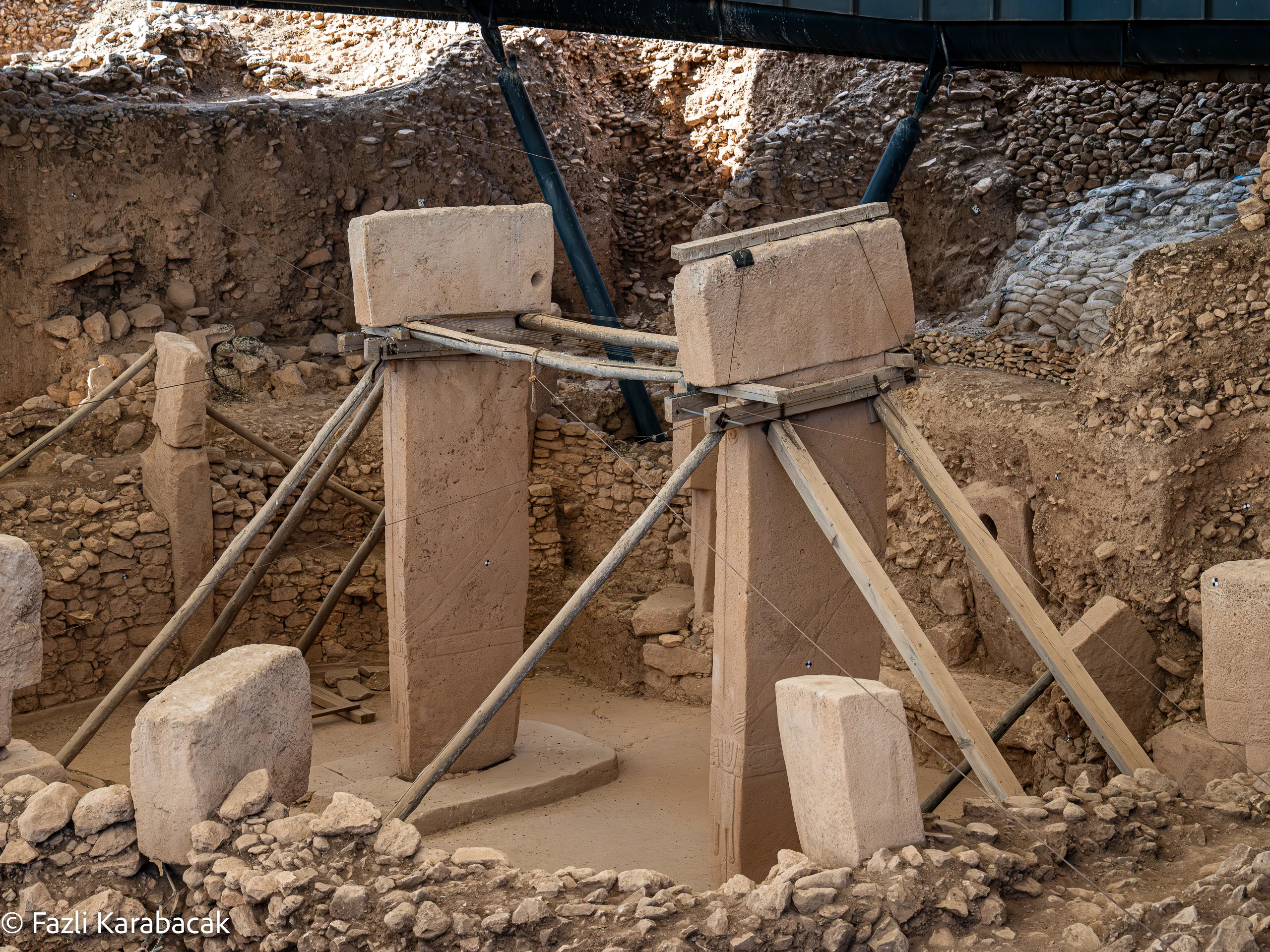
Here was monumental architecture — T-shaped pillars up to 5.5 metres tall, weighing as much as sixteen tonnes, carved with extraordinary artistry and erected in carefully designed semi-subterranean enclosures — built by people who, as far as Schmidt could determine, had no agriculture and no domesticated animals. The builders were foragers. The thousands of animal bones recovered from the site represent the remains of feasts, not daily domestic meals. The vast quantities of flint tools testify to workshops serving the construction effort, not to year-round habitation.
Schmidt’s conclusion was radical: Göbekli Tepe proved that religion — or at least monumental ritual activity — could precede and drive the development of settled life and agriculture. The labour required to quarry, transport, carve, and erect these pillars demanded a level of social organisation never before attributed to pre-agricultural hunter-gatherers. The need to feed the workforce may have been the very stimulus that pushed communities toward cultivating wild cereals — a hypothesis supported by the fact that the wild ancestor of domesticated einkorn wheat was genetically traced to the Karacadağ mountains, barely thirty kilometres from Göbekli Tepe.
On the ground: On our Göbekli Tepe and Karahan Tepe guided day tour, I stand visitors in front of the central pillars of Enclosure D and pause. Most have come expecting “the first religion.” What they leave with, instead, is a more profound story — a site where twelve thousand years ago, belief became architecture for the very first time.
But Is It Really “the First Religion”?
Here is where I need to complicate the story, because the media narrative and the archaeological reality diverge in important ways.
Human spiritual behaviour extends far deeper into prehistory than the tenth millennium BC. The earliest intentional burials known to science come from sites like Skhul and Qafzeh in Israel, dating between 100,000 and 130,000 years ago. At Skhul, a burial was accompanied by a boar mandible — one of the earliest known grave goods. The systematic use of red ochre, a substance with no practical nutritional value, appears in the African archaeological record possibly as far back as 300,000 years ago, and is widely interpreted as evidence of symbolic or ritual behaviour. The great painted caves of Upper Palaeolithic Europe — Lascaux, Chauvet, Altamira — date from roughly 40,000 to 15,000 years ago, undeniable evidence of sophisticated symbolic systems.
So when we ask whether Göbekli Tepe was “the first religion,” the answer is clearly no — not if we mean the first evidence of human beings engaging with the sacred. What Göbekli Tepe represents is something more specific and, in its way, more significant: the first monumental architecture of belief. It is the oldest known place where human communities channelled their spiritual impulses into permanent stone structures designed to endure — to outlast individual lives, to serve as gathering places for generations, and to make visible in the landscape the invisible forces that animated their world.
In my experience, visitors appreciate this distinction once it is explained. The site does not need to be the absolute origin of human religion to be profoundly important. It is the moment when belief became architecture.
What Kind of Religion?
If we accept that Göbekli Tepe was built for ritual purposes — and the evidence for this, while nuanced by recent discoveries, remains overwhelming — the next question becomes: what kind of religion are we talking about?
This is where the site challenges modern assumptions most deeply. When most people hear the word “religion,” they think of organised faiths with doctrines, scriptures, and hierarchical priesthoods. None of this applies to Göbekli Tepe. The builders lived in a world that was animistic — a world in which the boundary between human and non-human, between living and dead, between the visible and the invisible, was fluid and permeable.
The evidence assembled by Oliver Dietrich in his 2023 study points not to organised religion in any modern sense but to shamanism — a practice centred on individual ritual specialists who, through trance, could cross the boundaries between worlds. The T-shaped pillars, with their anthropomorphic forms and unique assemblages of animal imagery, likely represented not gods in the later Mesopotamian sense but ancestors or powerful shamanic figures, each accompanied by their personal constellation of animal spirit helpers.
This distinction matters. The site does not show us the birth of theology — of systematic beliefs about divine beings. What it shows us is older, rooted in direct experience: a tradition of ecstatic practice in which individual practitioners entered altered states of consciousness and returned with knowledge, healing, or guidance for their communities. The monumental architecture was not a church — it was a stage, a designed environment for producing specific transformative experiences.
Trevor Watkins has proposed that Göbekli Tepe and similar Pre-Pottery Neolithic sites functioned as “theatres of memory” — spaces where communities stored, transmitted, and collectively experienced the mythic narratives that held their social worlds together.
The Complication: Domestic Life at the Site
For years, the narrative of Göbekli Tepe as a purely ritual site — a place of pilgrimage with no permanent inhabitants — was central to Schmidt’s “first came the temple” hypothesis. Recent excavations, however, have significantly complicated this picture.
As Lee Clare reported in his 2020 summary of research from 2015 to 2019, deep soundings in the northwestern part of the mound revealed a series of round-oval structures consistent with domestic architecture. These buildings bordered activity areas with hearths, bead production, and domestic tool assemblages. Further domestic structures appeared during the excavation of a rainwater drainage channel on the western slope.
The discovery of domestic contexts at Göbekli Tepe does not destroy the ritual interpretation. The monumental enclosures with their T-shaped pillars remain extraordinary and clearly served a purpose far beyond everyday habitation. But it does mean that the stark dichotomy between “temple” and “settlement” — the binary that made Schmidt’s hypothesis so media-friendly — can no longer be sustained in its original form.
What the evidence now suggests is something more nuanced: Göbekli Tepe was a place where people lived and worshipped, where daily activities and monumental ritual coexisted, perhaps from the very beginning. This is, in fact, far more consistent with what we know of Pre-Pottery Neolithic lifeways across the region. Edward Banning’s 2011 critique made the broader point: the categorical distinction between “temple” and “house” is itself a modern imposition. The people who built Göbekli Tepe almost certainly did not distinguish between “religious” and “secular” in the way modern Western societies do. Their world was one where the sacred permeated everything.
What Göbekli Tepe Tells Us About the Origins of Religion
After twenty-five years of walking this landscape and thinking about what it means, I have come to believe that the question “Was Göbekli Tepe the first religion?” is the wrong question. It assumes that religion is a thing that began at a specific time and place, like the invention of the wheel. The evidence suggests something different: that human engagement with the sacred is as old as human consciousness itself.
What Göbekli Tepe represents is not the origin of belief but a threshold — a moment when communities that had been practising ritual for millennia first acquired the social organisation, the technical capability, and the collective will to translate their beliefs into monumental form. The site marks the point where religion became visible in the landscape.
And it marks something else too: a shift in the relationship between belief and society. The construction of Göbekli Tepe required coordination among groups that had previously lived in small, mobile bands. It demanded the organisation of labour on an unprecedented scale. It required feeding the workers. And it may have been precisely this requirement — the need to sustain large numbers of people gathered for ritual purposes — that provided the impetus for the first experiments with cereal cultivation.
If this reconstruction is correct, then Göbekli Tepe does not tell us where religion began — but it may tell us something even more profound: that religion was the engine that drove the single most important transformation in human history, the transition from mobile foraging to settled agricultural life. Not economics, not climate, not population pressure, but the human compulsion to gather together in the presence of the sacred.
That is what I try to convey to visitors as we stand among the pillars of Enclosure D in the late afternoon light: not that this is where belief began, but that this is where belief changed the world.
Key Takeaways
- Göbekli Tepe is not where religion originated — human spiritual behaviour (burials, ochre use, cave art) extends back at least 100,000 years. It is the oldest known monumental religious architecture.
- Klaus Schmidt’s “first came the temple, then the city” hypothesis reversed the traditional sequence (agriculture → settlement → religion), proposing that ritual drove the transition to settled life.
- Jacques Cauvin’s “revolution of symbols” (1994) provided the theoretical framework: the Neolithic transformation was fundamentally cognitive and spiritual.
- Recent excavations (Clare 2020) revealed domestic structures alongside the monumental enclosures, complicating the “purely ritual site” interpretation.
- Edward Banning’s 2011 critique challenged the temple-vs-house dichotomy, arguing that PPN societies likely did not separate “religious” from “secular” space.
- The evidence points to animism and shamanism rather than organised religion, centred on ecstatic practice, spirit communication, and ancestor veneration.
- Feeding large ritual gatherings may have been the stimulus that drove the earliest experiments with cereal cultivation.
Planning Your Visit
The meaning of Göbekli Tepe is something you feel most powerfully when you stand inside one of the enclosures and take in the scale of what was attempted here twelve thousand years ago — but only if someone can explain what you are looking at and why it matters.
Our Göbekli Tepe and Karahan Tepe guided day tour covers both sites with the archaeological context that transforms a hilltop visit into an encounter with the moment human belief first took monumental form.
Your Next Read
Suggested path: Shamanism at Göbekli Tepe → Ancestor and Skull Cult → Did Religion Invent Agriculture? → Klaus Schmidt and the Discovery. Planning a trip? Start with Plan Your Göbekli Tepe Trip.
Frequently Asked Questions
Was Göbekli Tepe the world’s first religion? No. Human spiritual behaviour extends back at least 100,000 years, as evidenced by intentional burials at Skhul and Qafzeh, the use of red ochre, and Upper Palaeolithic cave art. What Göbekli Tepe represents is the oldest known monumental religious architecture — the first time communities built permanent stone structures for ritual purposes, dating to approximately 9600 BC.
What does “first came the temple, then the city” mean? This phrase, coined by excavator Klaus Schmidt, summarises the revolutionary implication of Göbekli Tepe: complex ritual architecture was built by pre-agricultural hunter-gatherers, reversing the traditional assumption that religion only emerged after farming and settled life. The need to organise labour and feed workers for temple construction may have actually driven the development of agriculture.
Was Göbekli Tepe a temple or a settlement? Recent evidence suggests it was both. While the monumental T-pillar enclosures were clearly ritual spaces, excavations from 2015–2019 revealed domestic structures alongside the special buildings. Sacred and everyday activities appear to have coexisted at the site.
What kind of religion was practised at Göbekli Tepe? The evidence points to animism and shamanism rather than organised religion. The site appears to have been used for shamanic performances involving trance, spirit communication, and ancestor veneration. The T-shaped pillars likely represented ancestral or supernatural figures, each with unique animal imagery interpreted as personal spirit helpers.
How does Cauvin’s “revolution of symbols” relate to Göbekli Tepe? French archaeologist Jacques Cauvin argued in the 1990s that the Neolithic transition was driven by a cognitive-spiritual revolution — the development of symbolic capabilities that enabled communities to formulate shared identities and cooperate at new scales. Göbekli Tepe provided the physical evidence Cauvin’s theory needed.
Does the discovery of houses at Göbekli Tepe disprove the temple theory? No. The monumental enclosures remain extraordinary and clearly served ritual purposes. But the presence of domestic structures means the site was not purely a pilgrimage centre visited periodically by mobile groups. A resident community appears to have lived alongside or among the ritual buildings.
Fazlı Karabacak is a licensed Turkish tour guide with over 25 years of experience and the founder of Serendipity Turkey. He specialises in archaeological and cultural tours across Turkey, with particular expertise in Göbekli Tepe and the Pre-Pottery Neolithic sites of southeastern Anatolia.