Quick Answer
The Şanlıurfa Archaeology Museum (Şanlıurfa Arkeoloji Müzesi) is one of Turkey’s most important museums, housing original artefacts from Göbekli Tepe, Karahan Tepe, and dozens of other archaeological sites spanning 12,000 years. Its star attraction is the “Urfa Man” — the world’s oldest known life-size human statue, dating to approximately 9000 BCE. The museum is essential before or after visiting Göbekli Tepe, providing the context that transforms the site from an impressive monument into a fully intelligible Neolithic world.
At a Glance
- Location: Haleplibahçe Boulevard, Şanlıurfa
- Best for: Göbekli Tepe visitors, archaeology lovers, history-focused travellers
- Time to allow: 2 to 3 hours
- Must-see highlight: The Urfa Man
- Best pairing: Visit before Göbekli Tepe
- Also worth seeing: Haleplibahçe Mosaic Museum next door
Note: Opening hours, ticketing, and Museum Pass arrangements can change. Check current official information before your visit.
If you visit Göbekli Tepe without visiting the Şanlıurfa Archaeology Museum, you are seeing only half the story.
I have been making this argument to my tour groups for over two decades, and it has only become more compelling as the museum has expanded. Since its relocation to a vast modern complex on the northern outskirts of Şanlıurfa in 2015, the museum has grown into one of the most important archaeological collections in Turkey — and, for the Neolithic period specifically, one of the most important in the world.
What makes this museum essential is simple: most of what was found at Göbekli Tepe is here, not at the site. The pillars remain in their enclosures, but the smaller finds — the carved stone vessels, the plaquettes, the animal figurines, the modified human skulls, and above all the extraordinary statuary — are housed in the museum’s climate-controlled galleries. To understand what the builders of Göbekli Tepe created, you need both places.
Getting There and Practical Information
The museum sits on Haleplibahçe Boulevard, about three kilometres north of the old city centre. If you are coming from the Balıklıgöl area, it is a fifteen-minute taxi ride or a pleasant thirty-minute walk. There is ample parking for private vehicles and tour buses.
At the time of this review, the official museum listing shows the Şanlıurfa Museum as open every day, with published hours of 08:30 to 18:30 and a ticket-office closing time of 17:00. These details can still shift seasonally or administratively, so I always recommend checking current official information before you go. Turkish museum card access is officially noted, and broader Museum Pass arrangements may apply for international visitors, but pass coverage should be confirmed before travel.
Plan at least two to three hours for a thorough visit. Most tour groups rush through in ninety minutes, which is a mistake. The Neolithic galleries alone deserve an hour of careful attention. If you are visiting Göbekli Tepe on the same day, I recommend starting at the museum in the morning and going to the site in the afternoon, when the light on the pillars is at its most beautiful.
What Not to Miss
- The Urfa Man
- The Göbekli Tepe gallery
- Modified skulls and stone vessels
- Karahan Tepe material
- Nevalı Çori finds
- Haleplibahçe Mosaic Museum next door
The Ground Floor: A Journey Through Time
The museum is organised roughly chronologically, beginning with the Palaeolithic and moving through the Neolithic, Chalcolithic, Bronze Age, Iron Age, Roman, Byzantine, and Islamic periods. Şanlıurfa’s location at the crossroads of Mesopotamian, Anatolian, and Levantine cultures means that every major civilisation of the ancient Near East is represented.
But let me be direct: most visitors come for the Neolithic galleries, and rightly so. If your time is limited, head straight for the ground-floor halls dedicated to Göbekli Tepe and the Pre-Pottery Neolithic.
The Urfa Man: Meeting the World’s Oldest Portrait
The single most important object in the museum — and arguably one of the most important archaeological artefacts on earth — stands in its own dedicated gallery space. The “Urfa Man” (officially the Balıklıgöl Statue) is a limestone figure approximately 180 centimetres tall, carved from a single block, with a haunting face defined by deep-set obsidian eyes and no visible mouth.
Discovered in 1993 during construction work near the Balıklıgöl sacred fishponds, the statue dates to approximately 9000 BCE, making it the oldest known life-size human sculpture in the world. It predates the famous Ain Ghazal statues of Jordan by over a thousand years.
What strikes every visitor — and what I never tire of pointing out — is the statue’s hands. They are positioned over the groin area, a gesture that recurs obsessively in Pre-Pottery Neolithic art from Göbekli Tepe to Karahan Tepe. The figure wears a V-necked garment carved in low relief. The obsidian eyes give the face an uncanny intensity — this is not a generic representation but a specific presence, someone (or something) meant to be encountered.
When I stand with visitors before the Urfa Man, I explain that this figure belongs to the same cultural horizon as Göbekli Tepe. The same communities, the same artistic tradition, the same symbolic vocabulary. He — if it is a he — may represent an ancestor, a ritual specialist, or a supernatural being. We do not know. But at eleven thousand years old, he is the oldest face in the world to look back at us with recognisable intention.
The Göbekli Tepe Gallery
The dedicated Göbekli Tepe hall contains original finds from the excavations alongside excellent reproductions and explanatory panels. Key objects to look for include:
Carved Stone Vessels: Göbekli Tepe produced some of the finest stone vessels of the Pre-Pottery Neolithic — large limestone bowls and plates carved with animal imagery, including predators and snakes. Some show evidence of use in feasting activities. The craftsmanship is exceptional, requiring hours of careful work with flint tools.
Stone Plaquettes: Small flat stones carved with animal figures — mostly predators and snakes — that may have served as portable ritual objects.
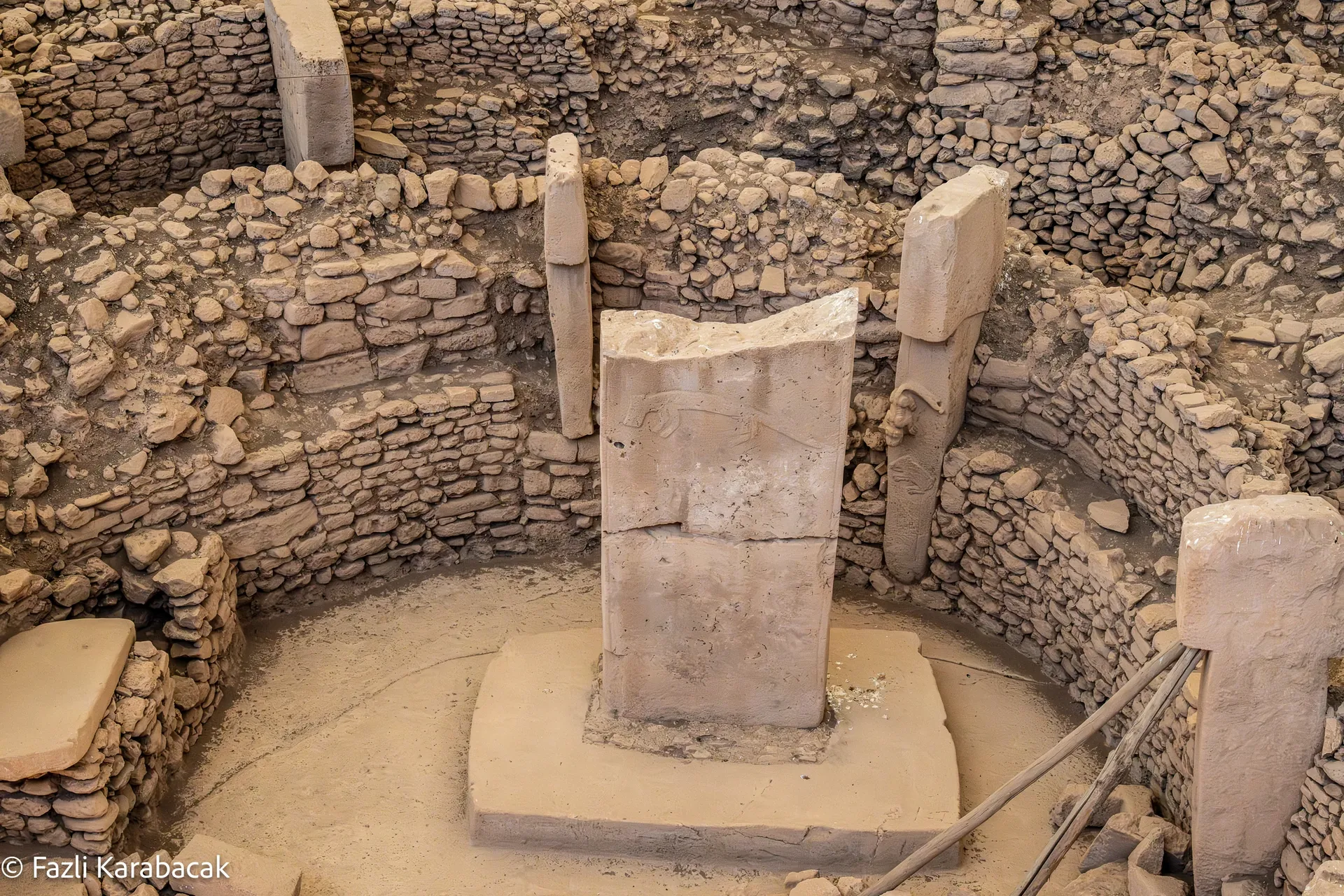
T-Shaped Pillar Fragments: While the complete pillars remain at the site, the museum houses fragments and smaller examples that allow you to examine the carving technique at close range. Pay particular attention to the relief work on the narrow sides of the pillar shafts — the detail is finer than most visitors expect.
Modified Human Skulls: Among the most recent and most significant discoveries, these carved and drilled skulls provide evidence for ancestor veneration practices. The museum displays several examples alongside explanatory material about the broader skull cult phenomenon in the Pre-Pottery Neolithic.
The Totem Pole: A tall, narrow limestone sculpture carved with multiple figures — human and animal — stacked vertically. This object, sometimes called the “totem pole of Göbekli Tepe,” is one of the most complex three-dimensional carvings from the site and suggests a hierarchical or narrative arrangement of beings.
The Karahan Tepe Section
Since excavations at Karahan Tepe intensified under Necmi Karul’s direction from 2019 onward, the museum has progressively added material from this extraordinary sister site. The most dramatic piece is a cast of the giant stone head from Structure AB — the carved face that rises from a serpentine stone neck, staring upward with open mouth.
Also look for the carved pillar fragments showing the distinctive leopard-pelt loincloth motif from Structure AD, which differs from the fox-pelt imagery predominant at Göbekli Tepe. These differences hint at distinct ritual identities for each site within the broader Taş Tepeler network.
The Haleplibahçe Mosaics
Adjacent to the main museum building is the Haleplibahçe Mosaic Museum, built over the original excavation site to protect a stunning collection of Roman-era floor mosaics discovered in 2006. The finest of these — a depiction of the Amazon warrior queen — is among the most beautiful Roman mosaics ever found in Turkey.
The mosaics date to approximately the second to third century CE, making them nearly ten thousand years younger than the Neolithic material in the main museum. But they demonstrate Şanlıurfa’s extraordinary continuity as a cultural centre — from the world’s oldest monumental architecture to some of the Roman Empire’s finest domestic art, all within the same city.
What Most Visitors Miss
After twenty-five years of guiding through this museum, I have learned that most visitors miss three things:
First, the Nevalı Çori material. This Pre-Pottery Neolithic site, excavated by Harald Hauptmann in the 1980s and 1990s, was flooded by the Atatürk Dam reservoir. The museum houses rescued finds including a remarkable limestone head with a snake-and-bird headdress — one of the most evocative Neolithic sculptures anywhere. Nevalı Çori was contemporary with Göbekli Tepe and used similar T-shaped pillars, providing crucial evidence that the Göbekli Tepe phenomenon was regional, not unique.
Second, the Islamic and Ottoman galleries upstairs. Şanlıurfa’s identity as the “City of Prophets” — associated with Abraham, Job, Moses, and Elijah in Islamic tradition — is beautifully presented through calligraphy, architectural fragments, and manuscript pages. For visitors interested in the full arc of this city’s sacred history, from the Neolithic to the present, these galleries are essential.
Third, the museum garden. Several large stone objects, including basalt stele and architectural fragments from various periods, are displayed outdoors. The garden is also a pleasant place to rest between gallery visits, with views toward the old city.
A Guide’s Recommendation
I always tell my groups the same thing: visit the museum before Göbekli Tepe, not after. I know this contradicts many itineraries, which place the site visit first for dramatic impact. But in my experience, visitors who arrive at Göbekli Tepe already understanding what the small finds look like, what the carved vessels reveal about feasting practices, and what the modified skulls tell us about ancestor veneration have a fundamentally richer experience at the site.
The pillars are magnificent. But they are also austere — massive limestone forms in open enclosures, their finer details weathered by exposure. The museum’s controlled environment allows you to see the delicacy and precision of Neolithic craftsmanship in a way that the site itself cannot. When you then stand before the pillars, you bring that knowledge with you. The two experiences multiply each other.
And do not skip the Urfa Man. He is eleven thousand years old, and he is waiting for you.
Is the Museum Worth Visiting If You Are Short on Time?
Yes. If you have time for only one museum in Şanlıurfa, this should be it. Even a focused ninety-minute visit can dramatically deepen your understanding of Göbekli Tepe, Karahan Tepe, and the wider Neolithic world of southeastern Anatolia.
Plan Your Visit
Want to connect the museum with the archaeological sites? The Göbekli Tepe Visitor Guide covers site access, and the Day Tour Guide lays out a full Göbekli Tepe–Karahan Tepe itinerary. Shape your route at Plan Your Göbekli Tepe Trip.
Key Takeaways
- Must-see: The Urfa Man — the world’s oldest known life-size human sculpture, dating to approximately 9000 BCE.
- This museum holds the majority of portable finds from both Göbekli Tepe and Karahan Tepe. Skip it, and you miss half the story.
- Highlights include carved stone vessels, plaquettes, pillar fragments, modified skulls, the “totem pole” sculpture, and Nevalı Çori material.
- Pro tip: Visit the museum before Göbekli Tepe. The context transforms the site experience.
- The adjacent Haleplibahçe Mosaic Museum adds a Roman-era layer to the same visit.
Frequently Asked Questions
Where is the Şanlıurfa Archaeology Museum, and how do I get there? The museum is located on Haleplibahçe Boulevard in the northern part of Şanlıurfa, approximately three kilometres from the old city centre and about a fifteen-minute taxi ride from the Balıklıgöl sacred fishponds in the city. It is best reached by taxi or rental car; there is paid parking available. If you are combining this with a Göbekli Tepe visit, budget time accordingly.
How much time should I spend at the museum for a meaningful visit? Plan at least two to three hours for a thorough experience, allowing time to read the labels and take in the material. If you want to also visit the adjacent Haleplibahçe Mosaic Museum (Roman-era mosaics), add another 60–90 minutes. For a quick focused visit on just Göbekli Tepe and Karahan Tepe material, 90 minutes is the absolute minimum, but this feels rushed.
Should I visit the museum before or after Göbekli Tepe? Visit before. The museum provides essential context — understanding the types of portable objects, carving techniques, and art styles enormously enriches your ability to read the site itself. When you then stand before the pillars at Göbekli Tepe, you bring that knowledge with you, and the two experiences multiply each other.
What is the Urfa Man, and why is he so important? The Urfa Man (also called the Balıklıgöl Statue) is the world’s oldest known life-size human sculpture, dating to approximately 9000 BCE — roughly three thousand years older than any comparable monumental human carving. He stands at the museum’s conceptual and visual centre, a testament to the sophisticated artistic imagination of Neolithic people. Standing before him is genuinely moving.
What other major finds from Göbekli Tepe does the museum hold? The museum houses carved stone vessels, ritual plaquettes, animal figurines, modified skull fragments, zoomorphic staffs (Nemrik scepters), fragments of T-shaped pillars with carvings, and hundreds of smaller artefacts. It also holds material from Karahan Tepe (including its unusual “totem pole” sculptures) and numerous other Neolithic sites from southeastern Anatolia.
Are Göbekli Tepe finds available with current museum passes? Turkish MüzeKart (Museum Card) holders may have access, and international Museum Pass arrangements may apply. Coverage varies and changes frequently. Check the museum’s official website or contact them directly before travel to confirm current ticketing and pass arrangements. Always verify this before making your visit plans.
Fazlı Karabacak is a licensed Turkish tour guide with over 25 years of experience and the founder of Serendipity Turkey. He specialises in archaeological and cultural tours across Turkey, with particular expertise in Göbekli Tepe and the Pre-Pottery Neolithic sites of southeastern Anatolia.