Quick Answer
Visiting Göbekli Tepe in the early morning — when the light is golden, the crowds are thin, and the Harran Plain stretches silent to the south — is one of the most profound experiences available to any traveller interested in human origins. The site is quieter, more austere, and more emotionally powerful than photographs suggest. Standing above enclosures carved twelve thousand years ago, watching the same sun rise the builders watched, creates a connection to the deep past that no museum or textbook can replicate.
At a Glance
- Best time: first two hours after opening (golden light + fewest visitors)
- Allow: minimum two hours on-site; half a day with the Şanlıurfa Museum
- What to bring: binoculars (essential), zoom lens (70–200mm), wide-angle, water, hat
- Excavated so far: ~5% of the site — at least fifteen more enclosures remain underground
- Distance from Şanlıurfa: ~18 km / 25-minute drive
- Viewing: elevated walkways above the enclosures; no access to the bedrock floor
- The one detail most visitors miss: arms and hands on the pillars — look carefully
I have visited Göbekli Tepe more times than I can count. Thousands of visits across twenty-five years, in every season, in every light, in heat that cracked the limestone and in rain that turned the paths to mud. And still, when I arrive early — before the tour buses, before the midday glare, before the ridge fills with voices — something happens.
The site is quiet. The Harran Plain spreads southward in soft greys and golds. A hawk rides the thermals above the ridge. The canopy over the enclosures catches the first direct light, and the shadows of the T-shaped pillars lengthen across the bedrock floors. In these moments, Göbekli Tepe stops being an archaeological site and becomes what it was always meant to be: a place of encounter.
The Approach
The experience begins before you reach the enclosures. The walk from the visitor centre to the excavation area takes about ten minutes on a gently rising paved path, and it is worth taking slowly. The ridge of Göbekli Tepe — its Turkish name means “Potbelly Hill” — rises modestly from the surrounding plateau, and there is nothing dramatic about its profile. You would drive past it without a second glance.
This ordinariness is part of the revelation. When you learn that this unremarkable limestone ridge contains the oldest monumental architecture on earth, the landscape itself shifts. Every hill in the distance becomes a potential site. The Karacadağ mountain range to the northeast — where wild einkorn wheat was first domesticated — takes on new significance. You realise that this entire landscape was sacred to communities who saw meaning in every feature of the terrain.
In the early morning, the air carries scents of wild thyme and dry limestone. Larks sing from the scrub. If you are visiting in April or May, the plateau is carpeted with wildflowers — blood-red poppies, purple vetches, yellow composites — a reminder that this was once part of the richest ecosystem in the ancient Near East.
First Sight
Then you reach the walkways, and you look down.
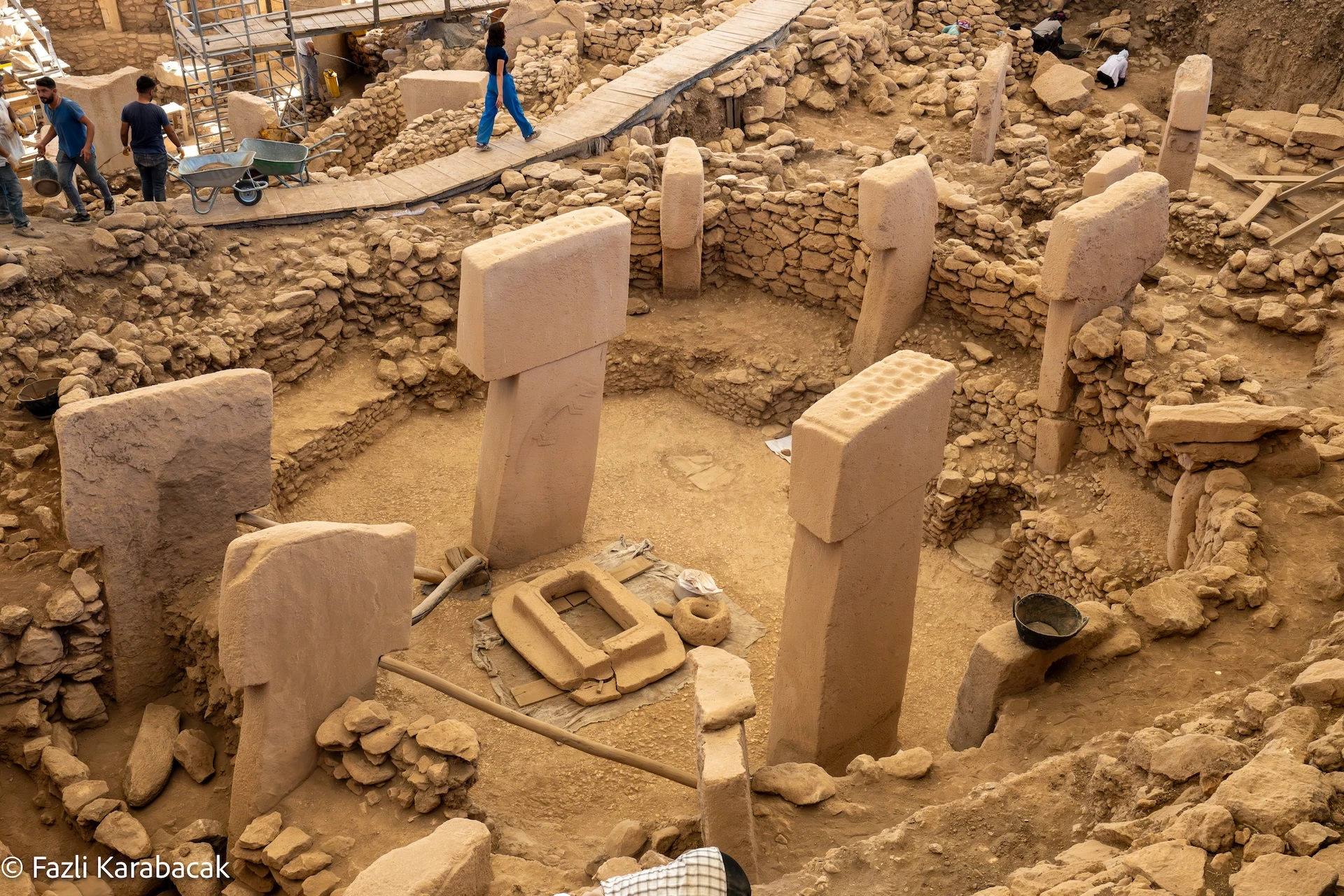
Nothing in the photographs prepares you for the reality of the enclosures. The T-shaped pillars are simultaneously larger and more subtle than they appear in images. In photographs, they look like abstract monuments. In person, you see the arms — bent at the elbow, hands meeting below the navel, fingers carefully articulated. You see the belts, the loincloths, the carved ribcages on some of the central pillars. These are not columns. They are figures. They are standing in the enclosures like sentinels who have been waiting for twelve thousand years.
Enclosure D is where most visitors feel the greatest impact. The two central pillars — each over five metres tall, weighing an estimated ten tonnes — face each other across a narrow space, their flat faces blank, their arms folded. Around them, smaller pillars line the walls, each carrying its own carved menagerie: foxes mid-stride, boars with bristling backs, snakes coiling upward, cranes with spread wings.
The first time I brought a group here, in the late 1990s when the excavations were still young, a woman from Edinburgh stood on the viewing platform for nearly twenty minutes without speaking. When she finally turned to me, she said simply: “They are still here.” She was right. The pillars have an undeniable presence — not just as objects but as beings. Whatever the builders intended them to represent, that intention survives in the stone.
The Details
Once the initial impact subsides, the details begin to emerge. This is why I always tell visitors to slow down and look carefully. The carvings at Göbekli Tepe are not immediately obvious from the walkways — some are in low relief, worn by millennia of burial and exposure, and they reveal themselves gradually as your eyes adjust.
On the western central pillar of Enclosure D, look for the fox-pelt loincloth — a finely carved textile hanging from the belt, rendered with individual strands. This detail tells us that these people had sophisticated weaving technology twelve thousand years ago, long before the invention of agriculture.
On Pillar 43 in Enclosure D — the famous Vulture Stone — the carvings are more complex. A headless human figure, a vulture with outstretched wings holding a circle (a head? the sun?), a scorpion, an H-shaped symbol, a snake, and several other animals crowd the surface. The scene has been interpreted as everything from a funerary narrative to an astronomical record, and the debate is far from settled. But seeing it in person, in the raking morning light that picks out every contour, you understand why it has generated so much discussion. The composition is deliberate, complex, and clearly meaningful.
Binoculars are invaluable here. Small details — a spider in a niche, a net pattern on a pillar shaft, the curve of a snake’s body — become visible with magnification that the naked eye cannot achieve from the walkway distance.
On the ground: On our Göbekli Tepe and Karahan Tepe day tour, I always schedule Göbekli Tepe for the first visit of the day — ideally before 09:00. The difference between the site at 08:30 and the same site at 12:00 is the difference between a cathedral at dawn and a train station at rush hour.
The Silence
What strikes many visitors most powerfully is not what they see but what they hear — or rather, do not hear. In the early morning, before the crowds arrive, Göbekli Tepe is remarkably quiet. The canopy structure muffles wind. The limestone absorbs sound. The enclosures, sunk into the bedrock, feel insulated from the modern world.
I have spent enough time at this site to know that this silence is not accidental. The builders of Göbekli Tepe chose a ridge that commands views in every direction — you can see anyone approaching from kilometres away. But the enclosures themselves are inward-facing, enclosed, intimate despite their monumental scale. You were meant to leave the outside world behind when you entered.
In this silence, standing above the carved figures, something shifts. The twelve thousand years between you and the builders compress. You are looking at the work of hands that moved with purpose and skill, driven by beliefs we cannot fully reconstruct but can dimly sense. The foxes on the pillars are still running. The snakes are still coiling. The vulture is still spreading its wings over the headless figure. Whatever story these carvings tell, it is still being told.
The Landscape
After examining the enclosures, step away from the walkways and look outward. The view from Göbekli Tepe’s ridge is one of the great panoramas of the ancient world.
To the south, the Harran Plain — the biblical “Haran” where Abraham sojourned — stretches flat and golden toward the Syrian border. On clear days, you can see the faint line of the Tell Abyad crossing. This plain was one of the most fertile zones of the ancient Near East, and the communities that built Göbekli Tepe would have known its seasonal rhythms intimately — the spring greening after winter rains, the golden harvest of wild cereals, the dry brown of summer, the return of the gazelle herds in autumn.
To the northeast, Karacadağ rises darkly, the mountain where DNA analysis has traced the origin of domesticated einkorn wheat. To the east, the terrain rolls toward the Tektek Mountains and Karahan Tepe. To the west, the land drops toward the Euphrates valley. You are standing at a geographical and historical crossroads — the point where the worlds of Anatolia and Mesopotamia meet.
The builders chose this ridge. Not the highest point in the landscape, not the most sheltered, but a place with commanding views and a particular relationship to the surrounding terrain. Whatever ceremonies took place in the enclosures, the landscape was part of them.
The Emotional Weight
I will be honest: Göbekli Tepe affects people differently. Some visitors are moved to tears. Some are puzzled — the site does not conform to expectations shaped by Egyptian pyramids or Greek temples. Some feel frustration that so little is excavated and so much remains unknown. All of these responses are valid.
What I try to convey to every group is the scale of what this site represents. When Göbekli Tepe was built, there were no cities anywhere on earth. No writing. No metal. No pottery. No domesticated animals. The people who carved these pillars had flint tools, their own muscles, and a vision powerful enough to organise hundreds of workers across years of construction. They did this not because they had surplus grain or a king’s command, but because they believed it was necessary.
That belief — the conviction that the invisible world matters enough to build for, that community identity requires monumental expression, that some places are sacred — is the oldest thing at Göbekli Tepe. Older than the pillars, older than the carvings, older than the bedrock they are cut from. It is the belief that made us human, and it is still alive in every temple, mosque, church, and synagogue on earth.
Standing here in the morning light, you are standing at its source.
Photography Tips
For those who want to capture the site visually, a few practical suggestions from years of experience.
The best light for the enclosures is in the first two hours after opening and the last hour before closing. Midday light flattens the carved surfaces and washes out detail. Morning light from the east illuminates Enclosure D’s carved reliefs beautifully; afternoon light favours the western faces.
A zoom lens (70–200mm or equivalent) is essential for capturing pillar details from the walkways. A wide-angle lens captures the enclosure layouts and the surrounding landscape. If you have both, bring both.
The canopy structure creates interesting lighting conditions — dappled, directional, constantly shifting. This can produce dramatic photographs but also challenging exposure situations. Bracketing is recommended.
For the landscape panoramas, the golden hour light — the first and last thirty minutes of direct sun — transforms the Harran Plain into something genuinely magnificent.
Key Takeaways
- Visiting Göbekli Tepe in the early morning offers the best light, fewest crowds, and most atmospheric experience.
- The T-shaped pillars are anthropomorphic figures, not abstract columns — their arms, hands, and clothing details are visible in person.
- Binoculars are invaluable for examining carved details from the elevated walkways.
- The site’s silence and inward-facing design create an intimate, contemplative atmosphere despite the monumental scale.
- The panoramic landscape views are integral to the experience — Karacadağ, the Harran Plain, and the Euphrates watershed are all visible.
- Allow at least two hours on-site; slow, careful observation reveals details invisible at first glance.
Planning Your Visit
If you want the full early-morning experience — timed arrival, unhurried walkways, binoculars in hand, Karahan Tepe and the Şanlıurfa Museum in the afternoon — our Göbekli Tepe and Karahan Tepe guided day tour is built exactly around that rhythm.
Your Next Read
Suggested path: Göbekli Tepe Visitor Guide → The Vulture Stone — Complete Guide → Şanlıurfa Museum Guide → Göbekli Tepe & Karahan Tepe Day Tour.
Frequently Asked Questions
What does Göbekli Tepe look like in person? More intimate and more powerful than photographs suggest. The enclosures are smaller than most visitors expect, but the T-shaped pillars — with their carved arms, belts, and animal reliefs — have an uncanny presence. The site feels less like a ruin and more like a place that is still inhabited by its original purpose.
Is Göbekli Tepe worth visiting? Absolutely. It is one of the most important archaeological sites ever discovered and offers an experience unlike any other heritage site in the world. The combination of extreme antiquity, mysterious symbolism, and dramatic landscape setting makes it unforgettable.
What is the best time of day to visit? Early morning, just after opening. The light is best for photography, the temperatures are manageable, and the site is at its quietest and most atmospheric.
How much of Göbekli Tepe is excavated? Only about five percent. Geophysical surveys indicate at least fifteen more enclosures remain underground. What you see is a small fraction of what exists.
How long should I spend at the site? Minimum two hours. With good weather, good light, and time to really look at the carvings and the landscape, half a day is not excessive. Pair it with the Şanlıurfa Museum in the afternoon for a complete day.
Can I photograph inside the enclosures? Photography from the walkways is permitted. You cannot descend onto the bedrock floor of the enclosures — all viewing is from the elevated walkway system that runs around the excavation.
Fazlı Karabacak is a licensed Turkish tour guide with over 25 years of experience and the founder of Serendipity Turkey. He specialises in archaeological and cultural tours across Turkey, with particular expertise in Göbekli Tepe and the Pre-Pottery Neolithic sites of southeastern Anatolia.