Quick Answer
The “Neolithic Package” refers to the interconnected cluster of innovations — plant cultivation, animal domestication, permanent settlement, new architecture, and complex symbolic practice — that reshaped human societies in the Near East between roughly 10,000 and 7,000 BC. Göbekli Tepe disrupts the traditional assumption that these innovations arrived in a neat sequence (farming first, religion last). The site shows monumental ritual architecture fully developed among people whose subsistence was still entirely wild, suggesting that ritual gathering, feasting, and intensive cereal processing created the social conditions under which plant and animal domestication eventually emerged.
At a Glance
- Traditional sequence: farming → sedentism → specialisation → religion (V. Gordon Childe, 1930s)
- What Göbekli Tepe shows: monumental ritual architecture appears before agriculture and animal domestication (c. 9600–8700 BC)
- Faunal evidence: 100% wild species (Peters et al.) — gazelle, aurochs, wild boar, fox, Asiatic wild ass
- Botanical evidence: wild einkorn, barley, wheat/rye only (Neef; L. Dietrich 2019) despite 7,200+ grinding tools
- The eight founder crops: einkorn wheat, emmer wheat, barley, lentil, pea, chickpea, bitter vetch, flax
- Domestic einkorn origin: Karacadağ mountains, ~30 km from Göbekli Tepe (Heun et al., 2000)
- Cauvin’s thesis: the Neolithic began with a “revolution of symbols,” not economics
- Modern view: co-evolution through feedback — ritual, feasting, and intensification reinforced each other
In the traditional telling of the Neolithic story, everything happens in a neat sequence. First, people domesticate plants and animals. Then they settle into permanent villages. Surplus food allows specialisation — potters, weavers, builders. Religion develops as communities grow more complex. Eventually you get cities, writing, and what we call civilisation.
Archaeologists came to call this cluster of innovations the “Neolithic Package” — a bundle of interrelated changes that appeared to travel together as a unit when farming spread from the Near East into Europe and beyond. The term was convenient. It suggested order, logic, and a clear causal chain: agriculture first, everything else after.
In twenty-five years of guiding visitors through Turkey’s ancient sites, I have found that this tidy narrative is what most people carry in their heads when they arrive. And Göbekli Tepe is the site that most thoroughly disrupts it.
V. Gordon Childe and the Revolution That Wasn’t
The idea that agriculture was the prime mover of human progress goes back to the Australian-born archaeologist V. Gordon Childe, who in the 1930s coined the term “Neolithic Revolution.” In Childe’s model, climate change at the end of the Pleistocene forced humans and animals into close proximity around dwindling water sources — his “Oasis Theory.” This proximity, he argued, led to the domestication of both plants and animals, which in turn enabled sedentary life, population growth, and the emergence of complex societies.
Childe’s model was elegant but flawed. As Robert Braidwood demonstrated through his excavations at Jarmo in northern Iraq during the 1940s and 1950s, the climatic conditions Childe envisioned were incorrect — the Near East was actually getting wetter, not drier, during the early Holocene. Braidwood proposed instead that agriculture emerged in the “hilly flanks” of the Fertile Crescent, where wild progenitors of crops and livestock naturally occurred, and that it resulted from cultural readiness rather than environmental desperation.
Lewis Binford complicated matters further in the late 1960s by introducing demographic pressure as a driving force: growing populations at the margins of optimal zones were pushed into experimenting with food production. Kent Flannery expanded this into a systems model involving feedback loops between environment, population, and technology. And Barbara Bender, in a prescient 1978 argument that would prove remarkably relevant to the Göbekli Tepe evidence decades later, suggested that social factors — the demands of emerging leadership, alliance formation, and competitive feasting — were the true engines of agricultural adoption.
What all these models shared, despite their differences, was an assumption that agriculture came first and social complexity followed. Göbekli Tepe challenged that assumption at its root.
What Is the Neolithic Package, Exactly?
Before we examine how Göbekli Tepe disrupts the narrative, it is worth being precise about what the Neolithic Package actually comprises. Scholars generally identify five to seven key elements.
The first is plant cultivation and domestication — the transition from gathering wild cereals and pulses to deliberately sowing, tending, and eventually genetically transforming them. The eight founder crops (einkorn wheat, emmer wheat, barley, lentil, pea, chickpea, bitter vetch, and flax) form the core of this element, with their wild progenitors concentrated in southeastern Turkey and the northern Fertile Crescent.
The second is animal domestication — the transformation of wild aurochs into cattle, wild boar into pigs, wild mouflon into sheep, and wild bezoar goats into domestic goats across the Near East between approximately 8500 and 7000 BC.
The third is sedentism — permanent year-round settlement in fixed locations, distinct from the seasonal or semi-sedentary patterns characteristic of late Pleistocene and early Holocene foragers.
The fourth is architecture — the construction of permanent, often multi-roomed buildings using stone, mudbrick, or timber, along with communal structures for social, ritual, or storage functions.
The fifth is new material technologies, particularly pottery (which actually arrived somewhat later, in the Pottery Neolithic after c. 7000 BC), polished stone tools, and sophisticated textile production.
The sixth — and this is where Göbekli Tepe enters the picture most dramatically — is symbolic and religious expression: figurative art, ritual spaces, mortuary practices, and shared cosmological systems.
The Göbekli Tepe Problem: Religion Before Farming
The fundamental challenge Göbekli Tepe poses to the Neolithic Package concept is chronological. The site’s earliest monumental phase (Layer III, approximately 9600–8700 cal BC) features massive circular enclosures with T-shaped pillars weighing up to sixteen tonnes, elaborate animal reliefs, and evidence for coordinated communal construction — all created by people whose subsistence was based entirely on wild resources.
As Joris Peters, Klaus Schmidt, and colleagues documented in their analysis of the site’s faunal and botanical evidence, the animal bones are exclusively wild species — approximately 58% gazelle, 18% aurochs, with wild boar, fox, and Asiatic wild ass making up the remainder. The botanical evidence, confirmed by Reinder Neef’s preliminary archaeobotanical report and Laura Dietrich’s comprehensive 2019 phytolith and grinding-stone study, shows only wild cereals — einkorn, barley, and wheat or rye — despite the presence of over 7,200 grinding tools confirming intensive cereal processing.
In other words, Göbekli Tepe demonstrates that the “religion” element of the Neolithic Package was fully operational — arguably at a level of sophistication and scale exceeding anything found at contemporary sites — before any of the other elements were in place. There was no agriculture, no animal domestication, no permanent village, no pottery, and no evidence of year-round sedentary occupation. There was only monumental architecture, complex symbolism, and organised ritual.
This is not a minor adjustment to the traditional sequence. It is a fundamental reordering.
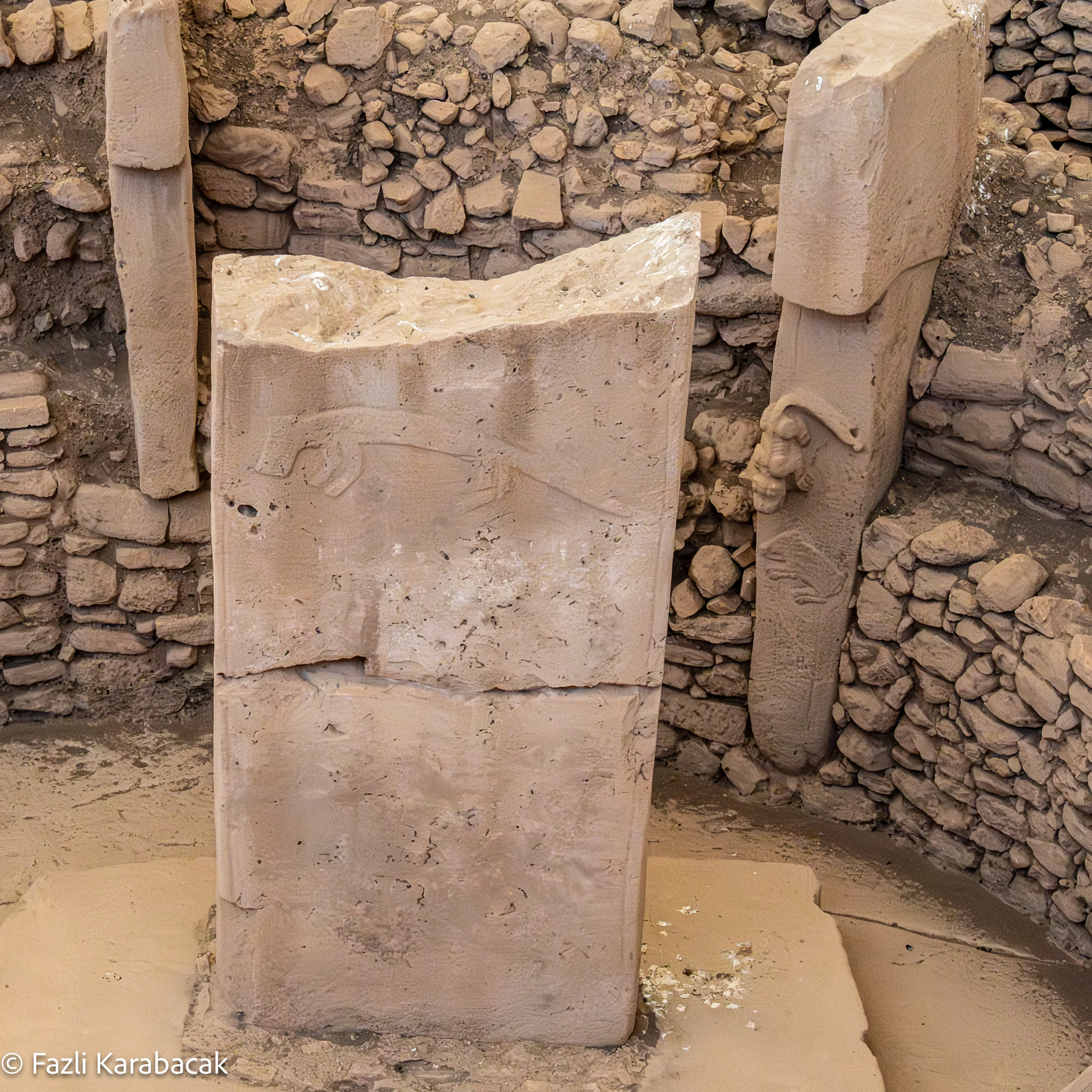
On the ground: When I guide groups on our Göbekli Tepe and Karahan Tepe day tour, I use the moment we first see the twin central pillars of Enclosure D to make this point. These were raised by people who did not yet know the taste of bread made from their own sown grain. The hilltop came before the field.
The Co-Evolution Model: Feedback Rather Than Sequence
The most productive way to understand the relationship between the elements of the Neolithic Package, in light of the Göbekli Tepe evidence, is not as a linear sequence but as a feedback system — a web of mutually reinforcing processes that accelerated one another.
Consider the chain of connections that the evidence reveals. Ritual gatherings brought dispersed forager communities together at a central location. These gatherings required feeding large numbers of people, creating demand for intensive wild cereal harvesting and processing. The scale of communal construction projects required even larger labour forces, intensifying the food demand further. The need to reliably supply these gatherings pushed communities toward more systematic management of wild plant stands — what archaeobotanists call “pre-domestication cultivation.” Over generations, this management pressure, combined with the genetic effects of human selection (even if initially unconscious), produced the morphological changes associated with domestication.
Simultaneously, the ritual gatherings created a social context for inter-group exchange of knowledge, materials, and techniques. Different communities brought their own ecological expertise to the shared space of Göbekli Tepe. Innovations in plant management, animal tracking, stone working, and construction techniques could spread rapidly through these networks of periodic contact.
Trevor Watkins, in his influential work on the cognitive and social dimensions of the Neolithic transition, has argued that what was truly revolutionary about this period was not the economic shift to food production but the emergence of new forms of shared symbolic culture — what he calls “communities of memory.” These shared symbolic systems, expressed through the iconography of sites like Göbekli Tepe, created the social cohesion necessary for larger, more complex communities to function.
Plant Domestication: The Slow Burn
The plant domestication element of the Neolithic Package has proved to be far more complex and drawn out than earlier scholars imagined. The neat picture of a single “invention” of agriculture has given way to a much messier reality.
Eleni Asouti and Andrew Fairbairn, in their important 2010 chapter “Farmers, Gatherers or Horticulturalists?”, argued forcefully against the categorical distinction between “hunter-gatherers” and “farmers” as discrete evolutionary stages. Drawing on archaeobotanical evidence from across the Near East, they demonstrated that early Neolithic plant-based subsistence involved a complex spectrum of practices — from continued gathering of truly wild plants, through landscape management and proto-cultivation, to full-scale agriculture — often practised simultaneously by the same communities.
This perspective is crucial for understanding Göbekli Tepe’s place in the Neolithic Package. The people who built the site were not “hunter-gatherers” in the simple sense of the term. They were sophisticated managers of their landscape who harvested wild cereals at industrial scale, transported them to a central processing site, and used standardised grinding technologies to convert them into flour — and, as Oliver Dietrich and colleagues argued in 2012, possibly into fermented beverages as well.
The full morphological domestication of cereals — the appearance of non-shattering rachis in wheat, for instance — was a consequence of this intensified management, not its cause. DNA studies by Manfred Heun and colleagues in 2000 placed the origin of domesticated einkorn on Karacadağ, roughly thirty kilometres from Göbekli Tepe. That proximity is not coincidental. The intensive exploitation of wild einkorn documented at Göbekli Tepe was part of the same regional process that eventually produced domesticated varieties.
Animal Domestication: A Parallel Path
Animal domestication followed a somewhat different trajectory but was equally intertwined with the social dynamics visible at Göbekli Tepe. The faunal evidence from the site shows exclusively wild taxa throughout its occupation, but the animals depicted on the pillars — and the relationships between humans and animals implied by those depictions — suggest a deep, complex engagement with the animal world that went far beyond simple predator–prey dynamics.
The T-shaped pillars are dominated by animal imagery: foxes, snakes, wild boar, aurochs, cranes, vultures, scorpions, and spiders, among others. Each monumental enclosure appears to feature a distinct set of emblematic animals, which Notroff, Dietrich, and Schmidt have interpreted as possible totemic identifiers for different social groups. This intense symbolic investment in animal imagery suggests that the relationship between humans and animals was being actively conceptualised and negotiated during the period when Göbekli Tepe was in use — precisely the centuries leading up to the first evidence of animal domestication in the region.
Peters and colleagues noted that ungulate domestication in southeastern and eastern Anatolia began around 8000 BC — roughly coinciding with the final phase of Göbekli Tepe’s occupation. The site was abandoned around 8200 cal BC, at a point when the transition from gazelle hunting to small livestock herding was well underway in the surrounding region. The implication is that Göbekli Tepe’s social system, built around large-scale communal hunting and seasonal gathering, was replaced by a fundamentally different economic and social order based on sedentary farming and animal husbandry.
Sedentism and Architecture: Not What You Think
The conventional assumption is that sedentism was a prerequisite for monumental architecture. You need to stay in one place to build large structures, or so the reasoning goes.
Göbekli Tepe challenges this assumption too. The earliest monumental phase shows no evidence of being a permanent settlement in the conventional sense — no residential buildings, no fixed domestic hearths, no cistern storage sufficient for year-round occupation. The architecture was the purpose of the gathering, not a byproduct of permanent settlement. This is a crucial distinction. It means that the “architecture” element of the Neolithic Package does not depend on the “sedentism” element in the way traditionally assumed.
The later phases of Göbekli Tepe (Layer II, approximately 8700–8000 cal BC) do show smaller rectangular buildings with domestic features — terrazzo floors, some evidence of food preparation — and Lee Clare’s 2020 report on the 2015–2019 excavations added round-oval domestic structures to the picture. A degree of more permanent or prolonged occupation evidently developed over time. But this came after, not before, the monumental construction phase. The sequence is the reverse of what the traditional model predicts.
The Role of Feasting: The Social Glue
If there is a single mechanism that ties the elements of the Neolithic Package together at Göbekli Tepe, it is feasting. The anthropological concept of the work feast — as elaborated by Michael Dietler and Ingrid Herbich — provides the key.
Work feasts are temporally bounded events in which commensal hospitality mobilises collective labour. They operate across kinship and alliance boundaries, creating and reinforcing social bonds through the reciprocal obligation of shared food and drink. Archaeological markers of feasting include food and tools in quantities exceeding daily subsistence needs, special serving paraphernalia, evidence of ritual or performance, and spatial association with communal construction projects.
Göbekli Tepe ticks every one of these boxes. The 7,200+ grinding tools exceed anything found at contemporaneous settlements. The approximately eighty stone vessel sherds — thin-walled, decorated, some repaired — suggest special serving ware. The monumental enclosures with their benches and carved pillars are ritual performance spaces par excellence. And the entire site is a communal construction project of unprecedented scale.
As Kathryn Twiss has argued, feasting was a transformative social institution in the Pre-Pottery Neolithic. Meat was central (and aurochs, the most dangerous and prestigious prey, features prominently in both the faunal assemblage and the iconography at Göbekli Tepe). But plant food was the logistical backbone — the reliable, storable, processable resource that made large-scale feeding possible. The interplay between feasting, cereal intensification, and social competition created exactly the conditions under which both plant and animal domestication would eventually emerge.
The Spread of the Package: From Southeastern Turkey to Europe
Once the elements of the Neolithic Package were fully assembled — which occurred gradually across the Pre-Pottery Neolithic B period (approximately 8700–7000 cal BC) in southeastern Turkey and the broader Levant — they began to spread. This expansion, one of the most consequential demographic and cultural events in human history, carried farming, herding, settled village life, and associated technologies across Anatolia, into the Aegean, and eventually throughout Europe.
The PPNB expansion was not a simple migration of people carrying a pre-formed cultural package. It involved complex processes of colonisation, acculturation, exchange, and adaptation. Different elements were adopted at different rates in different regions. Pottery, for instance, was a relatively late addition, appearing after approximately 7000 BC, while plant cultivation and animal herding arrived much earlier in most areas.
What is remarkable is how coherent the package remained despite the enormous distances and diverse environments it traversed. The founder crops domesticated in southeastern Turkey — including the einkorn and emmer wheat genetically traced to the Karacadağ area near Göbekli Tepe — formed the agricultural basis of farming communities from the Levant to the British Isles.
Cauvin’s “Revolution of Symbols”
The French archaeologist Jacques Cauvin proposed one of the most influential models for understanding the relationship between symbolic thought and the Neolithic Package. In his 1994 work Naissance des divinités, Naissance de l’agriculture, Cauvin argued that a fundamental transformation in human symbolic thought — the emergence of goddess imagery and bull symbolism in the Levantine late Natufian and early Neolithic — preceded and enabled the economic changes of the Neolithic. He called this a “revolution of symbols” and argued that it represented a new relationship between humans and nature.
Göbekli Tepe provides stunning, if complex, support for Cauvin’s thesis. The symbolic transformation he envisioned is spectacularly evident in the site’s carved pillars, with their elaborate animal imagery and anthropomorphic T-shapes. But the specific imagery differs from what Cauvin predicted — there are no goddess figures at Göbekli Tepe, and the animal symbolism centres on wild predators and dangerous creatures rather than domesticated cattle. This suggests the “revolution of symbols” was more diverse and regionally variable than Cauvin imagined, but no less real.
What Göbekli Tepe confirms is Cauvin’s core insight: that the cognitive and symbolic dimensions of the Neolithic transition were not secondary consequences of economic change but active drivers of it. The people who built Göbekli Tepe were not yet farmers. But they were already engaged in the kind of symbolic world-making that would reshape humanity’s relationship with the natural environment.
Beyond the Package: A Fluid Spectrum
It is important to note that not all scholars are comfortable with the “Neolithic Package” concept itself. Asouti and Fairbairn have argued that the very terms we use — “hunter-gatherer,” “farmer,” “agriculture,” “domestication” — impose categorical boundaries on what was actually a fluid spectrum of practices. In their view, early Neolithic communities engaged in a wide range of plant procurement strategies simultaneously, from wild gathering through various forms of horticulture to recognisable cultivation. The neat categories of the Neolithic Package obscure this messy, practice-based reality.
This critique is valuable. It reminds us that the transition to agriculture was not a single event but a long, regionally variable process involving countless decisions by countless communities over centuries.
When I stand with visitors among the pillars, I try to convey this complexity. The people who carved these pillars and ground these cereals did not know they were participating in a “revolution.” They were managing their relationships with plants, animals, each other, and what they understood as the sacred — day by day, season by season, generation by generation. The transformation we see in hindsight was invisible to those who lived it.
What Göbekli Tepe Teaches Us About Beginnings
In the end, Göbekli Tepe’s greatest contribution to our understanding of the Neolithic Package may be this: it dissolves the neat boundaries between the categories we use to understand the past. At this site, “religion” and “subsistence” are not separate domains — the ritual enclosures are inseparable from the food processing that sustained them. “Architecture” and “mobility” are not opposites — monumental structures were built by people who did not live permanently on site. “Hunting” and “proto-farming” are not distinct stages — the same communities that hunted wild gazelle also processed wild cereals at a scale that prefigured agriculture.
The Neolithic Package, seen through the lens of Göbekli Tepe, was not a pre-formed bundle of innovations that arrived together. It was an emergent property of human social life — a set of deeply interconnected changes that arose from the interaction between ecological knowledge, social ambition, ritual practice, and the demands of communal living. The elements did not cause one another in a simple chain. They co-created one another in a feedback loop that, once set in motion, proved irreversible.
Standing on the limestone ridge of Göbekli Tepe and looking out across the Şanlıurfa steppe, you are standing at the point where that loop began to spin. Twelve thousand years later, we are still living with its consequences.
Key Takeaways
- The Neolithic Package traditionally bundles plant domestication, animal domestication, sedentism, architecture, new technologies, and symbolic culture — assumed to emerge in roughly that order.
- Göbekli Tepe disrupts this sequence: monumental architecture and complex ritual are fully developed among non-farming, non-sedentary foragers (c. 9600–8700 BC).
- The best current model is co-evolution — ritual gatherings, feasting, cereal intensification, and social organisation reinforced one another in a feedback loop.
- The “work feasts” model links ritual (the purpose) to subsistence intensification (the logistics) to eventual domestication (the long-term outcome).
- Asouti and Fairbairn remind us that “farmer” and “hunter-gatherer” are not clean categories — early Neolithic communities lived on a fluid spectrum.
- Once assembled in the PPNB, the package spread from southeastern Turkey across the Old World, carrying the founder crops still at the centre of human diet today.
Planning Your Visit
If you want to see the landscape where this package began to assemble — the limestone hilltop, the wild cereal grounds of Karacadağ, the sister site of Karahan Tepe — we can walk you through it with the archaeological context that makes the story land.
Our Göbekli Tepe and Karahan Tepe guided day tour is the fastest way to see the evidence on the ground with an experienced guide.
Your Next Read
Suggested path: Was Religion the Real Engine of Agriculture? → Who Started Agriculture — Hunter-Gatherers or Temple Builders? → The Şanlıurfa–Karacadağ Wheat Connection → Was Göbekli Tepe the First Religion?.
Frequently Asked Questions
What is the Neolithic Package? The Neolithic Package refers to the interconnected cluster of innovations that transformed human societies in the Near East between approximately 10,000 and 7,000 BC: plant cultivation and domestication, animal domestication, permanent settlement, new architectural forms, pottery and other material technologies, and complex symbolic and religious practices. These elements tended to spread together as farming expanded across Europe and Asia.
Did agriculture come before religion? The evidence from Göbekli Tepe strongly suggests otherwise. Monumental architecture and elaborate ritual practice are fully evident by approximately 9600 BC, while all plant and animal species at the site remain wild. This indicates that organised communal ritual preceded agriculture by several centuries in this region. The relationship is best understood as co-evolutionary rather than strictly sequential.
What is the PPNB expansion? The PPNB (Pre-Pottery Neolithic B, approximately 8700–7000 cal BC) expansion is the spread of farming communities, their domesticated crops and animals, and their cultural practices from the core zone of the Fertile Crescent into new regions — eventually carrying the Neolithic Package across Anatolia, into Europe, and beyond.
How does Göbekli Tepe change our understanding of the Neolithic Package? Göbekli Tepe demonstrates that the “religion/ritual” element was fully operational before any other element. This challenges the traditional view that farming came first and enabled everything else, and instead suggests that social and ritual motivations drove the intensification of subsistence practices that eventually led to domestication.
Were the builders of Göbekli Tepe hunter-gatherers or farmers? All direct evidence indicates they were hunter-gatherers — they consumed only wild plants and animals. But scholars like Asouti and Fairbairn argue the binary is misleading. Göbekli Tepe communities practised intensive wild cereal harvesting and processing at a scale that blurs the boundary between “gathering” and “proto-cultivation.”
What are the founder crops? The eight Neolithic founder crops are einkorn wheat, emmer wheat, barley, lentil, pea, chickpea, bitter vetch, and flax. Their wild progenitors are concentrated in southeastern Turkey and the northern Fertile Crescent — the same region where Göbekli Tepe is located.
Fazlı Karabacak is a licensed Turkish tour guide with over 25 years of experience and the founder of Serendipity Turkey. He specialises in archaeological and cultural tours across Turkey, with particular expertise in Göbekli Tepe and the Pre-Pottery Neolithic sites of southeastern Anatolia.