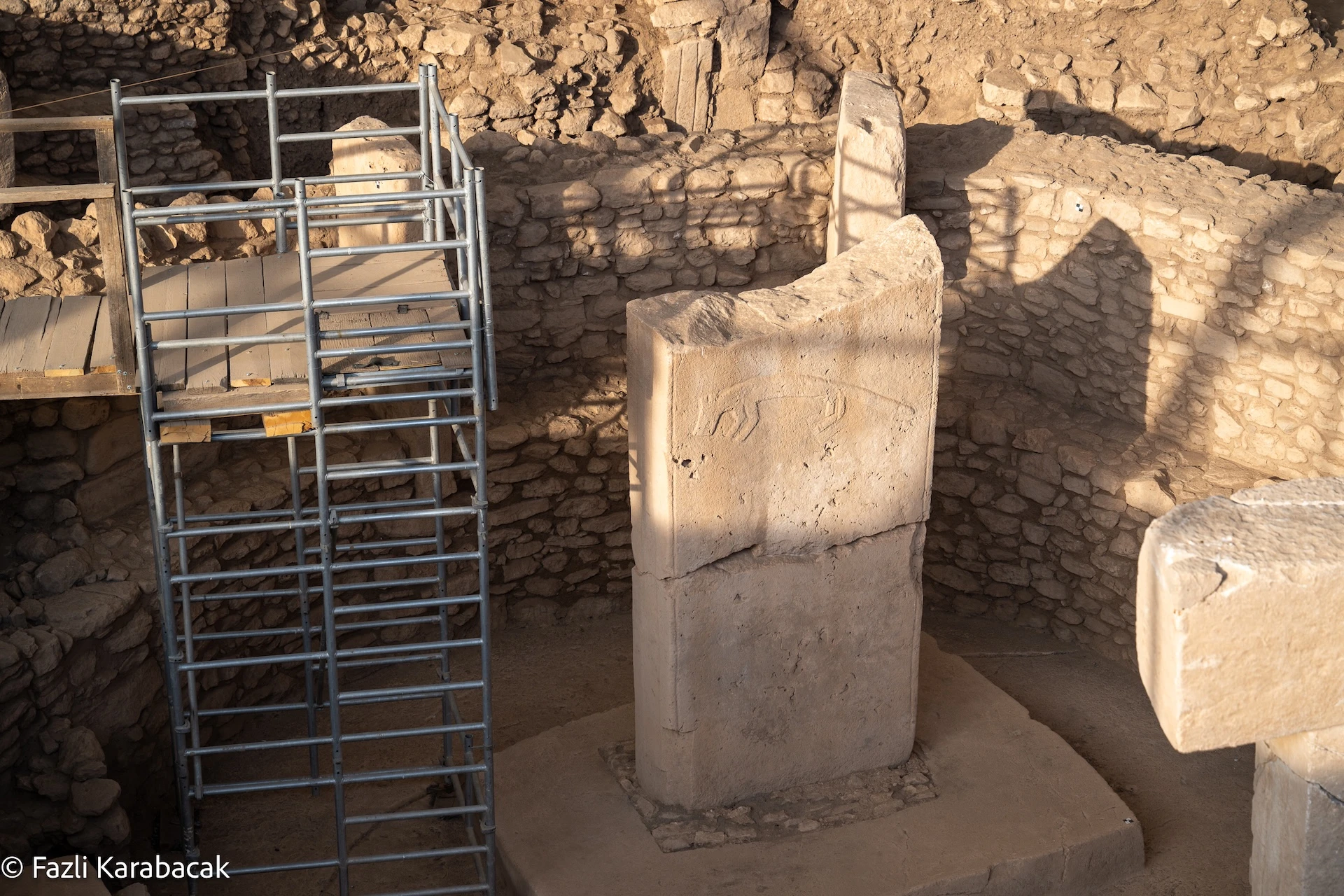
Quick Answer
Oliver Dietrich’s comprehensive 2023 study tested Göbekli Tepe’s material culture against established criteria for identifying shamanism and found positive evidence across nearly every category: trance-like postures in sculptures, spirit helper imagery, animal costumes and transformation scenes, shamanic staffs, musical instruments, deliberately animated and destroyed ritual objects, and architecture designed for transformative performances before audiences of 20–30 people.
At a Glance
- Key study: Dietrich (2023, Praehistorische Zeitschrift) — comprehensive checklist of shamanic criteria applied to Göbekli Tepe material culture
- Anthropomorphic sculptures: 63 documented; trance-like postures — arms pressed hard against body, open or clenched mouths, missing or closed eyes
- Spirit helper figurine: 5.1 cm figure in trance posture with a leopard on its shoulder — interpreted as shaman and spirit helper
- Shamanic costumes: T-pillar relief bands are long open gowns with animal ornaments; fox-pelt loincloths and possible feathered headdresses
- Shamanic sacra: Zoomorphic stone batons (“Nemrik scepters”), stone masks, bullroarers, ritual plaquettes
- Architecture: Corridor-like “difficult” entrances, semi-subterranean darkness, acoustics calibrated for 20–30 people
- Dominant animal per enclosure: Snakes (A), foxes (B), boars (C), birds (D) — interpreted as spirit helper totems
What Happened Inside the Enclosures? The Question That Changes Everything
There is a moment that occurs on nearly every tour I lead through Göbekli Tepe. We descend the walkway into the main excavation area, and visitors find themselves looking down into the semi-subterranean enclosures — those great circular rooms with their rings of carved pillars. Inevitably, someone asks: “What happened in there?”
For decades it was one of the hardest questions to answer. We could see what the builders of Göbekli Tepe had created — the monumental T-shaped pillars, the extraordinary animal carvings, the carefully orchestrated architecture — but the nature of the rituals performed within these spaces remained elusive.
In 2023, Oliver Dietrich — one of the archaeologists who has worked most closely with the Göbekli Tepe material for over a decade — published a landmark study in Praehistorische Zeitschrift that brought us closer to an answer than we have ever been. His paper, “Shamanism at Early Neolithic Göbekli Tepe,” systematically tested the site’s material culture against a comprehensive set of criteria for identifying shamanic practice in the archaeological record. The results were striking: positive evidence across nearly every category.
How Do You Identify Shamanism in a 12,000-Year-Old Archaeological Record?
The term “shamanism” has been applied so broadly in archaeological literature that some scholars have dismissed it as meaningless — a catch-all label attached to anything mysterious in the prehistoric record. What Dietrich did was different.
Rather than starting from a single theoretical model, he assembled criteria from multiple disciplines — ethnography, the history of religions, cognitive archaeology, and pharmacology — and created a comprehensive checklist against which the Göbekli Tepe evidence could be tested systematically. The criteria included animistic ontology, evidence of calling and initiation, altered states of consciousness, the presence of helper spirits, shamanic sacra (costumes, staffs, masks, musical instruments), entoptic phenomena in imagery, and evidence for multi-tiered cosmology.
Across these categories, the evidence returned positive indicators on a remarkable number of criteria — enough, Dietrich argued, to move the identification of shamanism at this site from speculation to a well-supported interpretation.
What Do the Sculptures Tell Us About Trance?
Some of the most compelling evidence comes from what may seem an unlikely source: the postures of the anthropomorphic sculptures found at Göbekli Tepe. Sixty-three such figures have been recovered from the site, and they are unlike typical figurines. These are not serene, static representations. They are bodies under stress.
The postures are remarkably consistent. Arms are pressed hard against the body, or hands clutch the knees of sitting individuals, or arms are bent strongly behind the backs. The faces — where they survive — show either clenched teeth or mouths wide open, as if screaming or gasping. Eyes are either missing entirely, reduced to narrow slits, or squeezed shut. The overall impression is one of intense physical and psychological tension.
As Dietrich noted, these postures are distinctly similar to trance postures documented by Felicitas Goodman in her cross-cultural study of ritual body positions associated with altered states of consciousness. Goodman demonstrated that specific bodily postures, held for sustained periods, can reliably induce trance states. The sculptures at Göbekli Tepe may depict not simply people in pain or distress but people in the process of entering shamanic trance.
Even more striking is the possibility that some figures depict individuals whose hands and legs are bound. One relief fragment shows arms strongly bent behind the back in a position consistent with binding. The immobilisation of shamans by tying their hands and feet has been documented as a regular feature of shamanic séances in Siberian and other traditions, where binding served both to contain the shaman’s thrashing body and to demonstrate the spirit’s power through the shaman’s miraculous escape from the bonds.
The sculptures in the museum: Many of the original Göbekli Tepe sculptures are housed in Şanlıurfa Archaeological Museum. On our guided tour, we visit both the site and the museum to see the trance posture figures in person — and the difference between seeing them in photographs and standing before them is considerable.
What Are the Spirit Helpers on the Pillars?
If the sculptures represent shamans in trance, then the animal imagery that covers virtually every surface at Göbekli Tepe may represent what ethnographers call spirit helpers — the animal allies that accompany, protect, and empower the shaman during journeys between worlds.
The T-shaped pillars are covered with relief carvings of animals — foxes, snakes, boars, birds, scorpions, spiders, aurochs, leopards — depicted with a ferocity and dynamism that goes far beyond decorative intent. The animals snarl, leap, bare their teeth, and appear to be in motion. Many are shown in attack postures or with exaggerated features. These are not gentle pastoral scenes. They are depictions of dangerous, powerful beings.
What makes the shamanic interpretation particularly persuasive is the way animal imagery relates to the architecture. As Peters and Schmidt documented in their foundational 2004 study, each enclosure at Göbekli Tepe has a dominant animal: snakes predominate in Building A, foxes in Building B, boars in Building C, and birds in Building D. Meanwhile, individual pillars carry their own unique combinations of animal imagery, different from their neighbours. Dietrich interpreted this as representing the assembly of spirit helpers associated with a particular shaman-ancestor — each pillar an individual figure with its own personal collection of animal allies.
The clearest single piece of evidence may be a small figurine — just 5.1 centimetres tall — found on the surface of the north-western hilltop. It depicts a person looking upward with eyes and mouth wide open, sitting with legs dragged forward. Between the legs, genitalia are prominently depicted. Most significantly, a quadruped animal — possibly a leopard — sits on the person’s left shoulder in a crouched position, with no indication of aggression. The interpretation of this image as a shaman in trance with one of his spirit helpers, Dietrich argued, is highly probable. It is precisely the kind of intimate, non-threatening relationship between human and animal spirit that characterises shamanic traditions worldwide.
How Do the T-Shaped Pillars Function as Shamanic Costumes?
The T-shaped pillars are perhaps the most monumental shamanic costumes ever created. Dietrich’s close analysis of Pillars 18 and 31 — the great central pillars of Building D — revealed that the relief bands running along their front sides, which Schmidt had interpreted as “stoles,” are better understood as the hems of long open gowns. The fox pelt depicted below the belt of Pillar 31 is shown being held in place by the pillar’s hands, with the upper part of the pelt turned down over the belt. The animal reliefs on the pillars’ surfaces, rather than being separate decorative elements, appear to be embroidered or stamped ornaments on these garments — the assembly of spirit helpers identifying a particular shaman.
Bird feathers likely played a significant role. The faunal record from Göbekli Tepe includes an unusually high percentage of vultures, crows, and thrushes among thirty-eight identified bird taxa. It is plausible that at least some of these birds were hunted specifically for their feathers, to be incorporated into headdresses or ritual garments.
Among the most intriguing finds are the zoomorphic stone batons known as “Nemrik scepters” — cylindrical limestone objects bearing sculpted upper ends depicting vultures, eagles, bovids, and other animals. They show no clear evidence of functional use as tools and are made of stone too soft for practical percussion. Given their zoomorphic representations and lack of clear utilitarian function, they are strong candidates for shamans’ staffs — the ritual implements carried during performances.
Musical instruments are also present. Three fragments of elongated bone objects from Göbekli Tepe have been identified as probable bullroarers — the spinning noise-makers used in ritual contexts across many cultures. Comparable finds come from Körtik Tepe and Hasankeyf Höyük.
How Were the Buildings Designed as Ritual Spaces?
Perhaps the most powerful argument for shamanism at Göbekli Tepe lies not in any single artefact but in the buildings themselves — in the way these spaces were designed to create specific psychological and sensory experiences.
Building C provides the clearest example. Access to the interior was through a corridor-like path that Dietrich described as deliberately “difficult,” with up-and-down movement and visual blinds that would have disoriented anyone entering. Inside, sculptures of dangerous animals with brandishing teeth and tusks received the visitor in leaping attitudes. The experience of moving through this passage — from daylight into darkness, from the open hillside into a confined, subterranean space dominated by images of threat — culminates in the encounter with two imposing humanoid pillars rising to 5.5 metres in the centre.
The acoustics reinforce the impression of deliberate design. Alexis McBride’s study of the reverberation and proxemics of the large buildings concluded that a speaker positioned near the central pillars would have been well-heard by an audience, but would have been obstructed from view for some listeners — limiting audience size and creating an effect where the ritual performance was heard but not fully seen. An audience of twenty to thirty people would have been comfortable in most buildings — consistent with the intimate, high-intensity character of shamanic séances.
The buildings, in Dietrich’s analysis, orchestrate a difficult journey to another world below the surface — a descent that relates directly to shamanic experiences of travelling through dangerous passages to reach the spirit realm. The architecture would have produced the kind of intense, unforgettable experience that Harvey Whitehouse has termed “imagistic ritual” — ritual designed to create lasting memories through emotional extremity rather than doctrinal repetition.
Descending into the enclosure: The experience of walking down the passage into Enclosure D is unlike anything else at an archaeological site. On our expert-guided tour, we explain exactly what the architecture was designed to do — and why understanding it changes how you read every carving inside.
How Does Pillar 43 Encode a Shamanic Cosmos?
The famous “Vulture Stone” — Pillar 43 in Building D — may contain the most ambitious cosmological statement at Göbekli Tepe. Benz and Bauer suggested that the animals depicted on its shaft represent beings belonging to the underworld in a sub-recent shamanic cosmology. Dietrich extended this analysis by examining the pillar’s imagery as a possible depiction of a multi-tiered cosmos.
The pillar features three rectangles topped by dome-like arcs close to the summit of the pillar head. Above each “dome” appears an animal: a crane, a leopard, and a quadruped. The lower zone is dominated by danger and death — the great vulture with outstretched wings, a headless ithyphallic human figure, and various predatory animals. The upper area appears to depict an anthropogenic landscape with animals under the sun. The extent to which this represents different cosmological layers remains debatable, but it would fit with a depiction of the upper, middle, and lower worlds through which the shaman’s soul journeys.
What Social Role Did Shamans Play as Göbekli Tepe Was Being Built?
To understand why shamanism took the specific form it did at Göbekli Tepe, we need to consider the broader social context. Marion Benz and Joachim Bauer proposed that during the rapid social change at the threshold of Neolithisation, hunter-gatherer societies experienced a “liminal” state in which traditional constants — shared resources, mobile lifeways, mutual reciprocity — were being challenged by the concentration of more people in permanent or semi-permanent settings.
In this situation, shamans would have risen to power through the public display of danger and fear-invoking symbolism — asserting their authority over the perils of a world in transformation. The monumental buildings at Göbekli Tepe, with their threatening animal imagery, disorienting architecture, and towering ancestral figures, would have served as instruments of this authority. The buildings were used precisely during the centuries when the transition to agriculture was unfolding. Only the rectangular buildings remain in use until around 8000 BCE, when the transition to farming was largely complete.
Key Takeaways
- Oliver Dietrich’s 2023 study identified positive evidence for shamanism across multiple categories: trance postures, spirit helper imagery, animal transformation, costumes and masks, staffs, musical instruments, animated ritual sculptures, and architecture designed for intense small-group experiences.
- Sixty-three anthropomorphic sculptures display trance-like postures consistent with documented shamanic body positions.
- A 5.1 cm figurine depicting a person in trance with a leopard on their shoulder is among the clearest evidence for the shaman–spirit helper relationship.
- Each pillar carries a unique combination of animal reliefs interpreted as the personal assemblage of spirit helpers belonging to a particular shaman-ancestor.
- The T-shaped pillars’ relief bands represent long open gowns with embroidered animal ornaments — monumental depictions of shamanic costumes.
- The buildings were acoustically and architecturally designed for performances before audiences of 20–30 people, with corridor-like entrances consistent with initiatory journeys.
Planning Your Visit
The shamanic reading of Göbekli Tepe is the most evidence-based interpretation of what happened inside these enclosures. But it requires context to fully appreciate — the relationship between trance posture, spirit helper, costume, and architecture is invisible without knowing what to look for.
On our Göbekli Tepe guided day tour, we walk through this interpretation systematically, explaining each element and connecting the material evidence to the broader picture of Pre-Pottery Neolithic ritual life.
Your Next Read
Suggested path: Psychoactive Plants and Altered States → Ancestor Cult and the Skull Cult → The Vulture Stone: Pillar 43 → T-Shaped Pillars: What Do They Mean?. Planning a trip? Start with Plan Your Göbekli Tepe Trip.
Frequently Asked Questions
What evidence supports shamanism at Göbekli Tepe? Oliver Dietrich’s comprehensive 2023 study identified positive evidence across multiple categories: trance-like body postures in sculptures, spirit helper imagery on pillars and figurines, animal transformation scenes, shamanic costume elements on the T-pillars, zoomorphic staffs (Nemrik scepters), stone masks, musical instruments (bullroarers), deliberately animated and destroyed ritual sculptures, and architecture designed for intense performances before small audiences.
What are the trance postures found at Göbekli Tepe? The site’s 63 anthropomorphic sculptures display specific body positions consistent with those documented by Felicitas Goodman as trance-inducing postures: arms pressed against the body, hands clutching knees, arms bent behind the back, mouths open wide or clenched shut, and eyes either missing, narrowed to slits, or squeezed closed. Some figures may depict bound limbs, consistent with documented shamanic séance practices.
What are spirit helpers and how do they appear at Göbekli Tepe? Spirit helpers are the animal allies that accompany and empower shamans during their journeys between worlds. At Göbekli Tepe, the animal reliefs on each pillar — foxes, snakes, birds, boars, leopards, scorpions — are interpreted as the personal assemblage of spirit helpers belonging to the shaman-ancestor that the pillar represents. A small figurine showing a person in trance with a leopard on their shoulder provides particularly clear evidence of this relationship.
How were the buildings designed for shamanic rituals? The enclosures feature corridor-like entrances with deliberate obstacles and visual blinds, creating a disorienting passage from daylight to underground darkness. Inside, dangerous animal sculptures lead to towering central pillars. Acoustic studies show a speaker near the central pillars would be heard but partially hidden from view. The buildings accommodated 20–30 people — consistent with intimate shamanic séances — and were designed to produce intense, transformative psychological experiences.
What are the “Nemrik scepters” found at Göbekli Tepe? These are cylindrical stone batons with zoomorphic sculpted upper ends depicting vultures, eagles, bovids, and other animals. First identified at the site of Nemrik in northern Iraq, a large number have been found at Göbekli Tepe. They show no evidence of practical tool use, making them strong candidates for shamans’ staffs — ritual implements carried during performances.
Is the shamanic interpretation of Göbekli Tepe controversial? The use of “shamanism” as an archaeological label has generated significant debate. Critics argue it can become a catch-all for anything mysterious in the prehistoric record. However, Dietrich’s approach was methodologically rigorous, testing the evidence against multiple independent criteria drawn from ethnography, religious studies, cognitive science, and pharmacology. The convergence of positive evidence across many categories makes this one of the most well-supported shamanic identifications in prehistoric archaeology.
Fazlı Karabacak is a licensed Turkish tour guide with over 25 years of experience and the founder of Serendipity Turkey. He specialises in archaeological and cultural tours across Turkey, with particular expertise in Göbekli Tepe and the Pre-Pottery Neolithic sites of southeastern Anatolia.