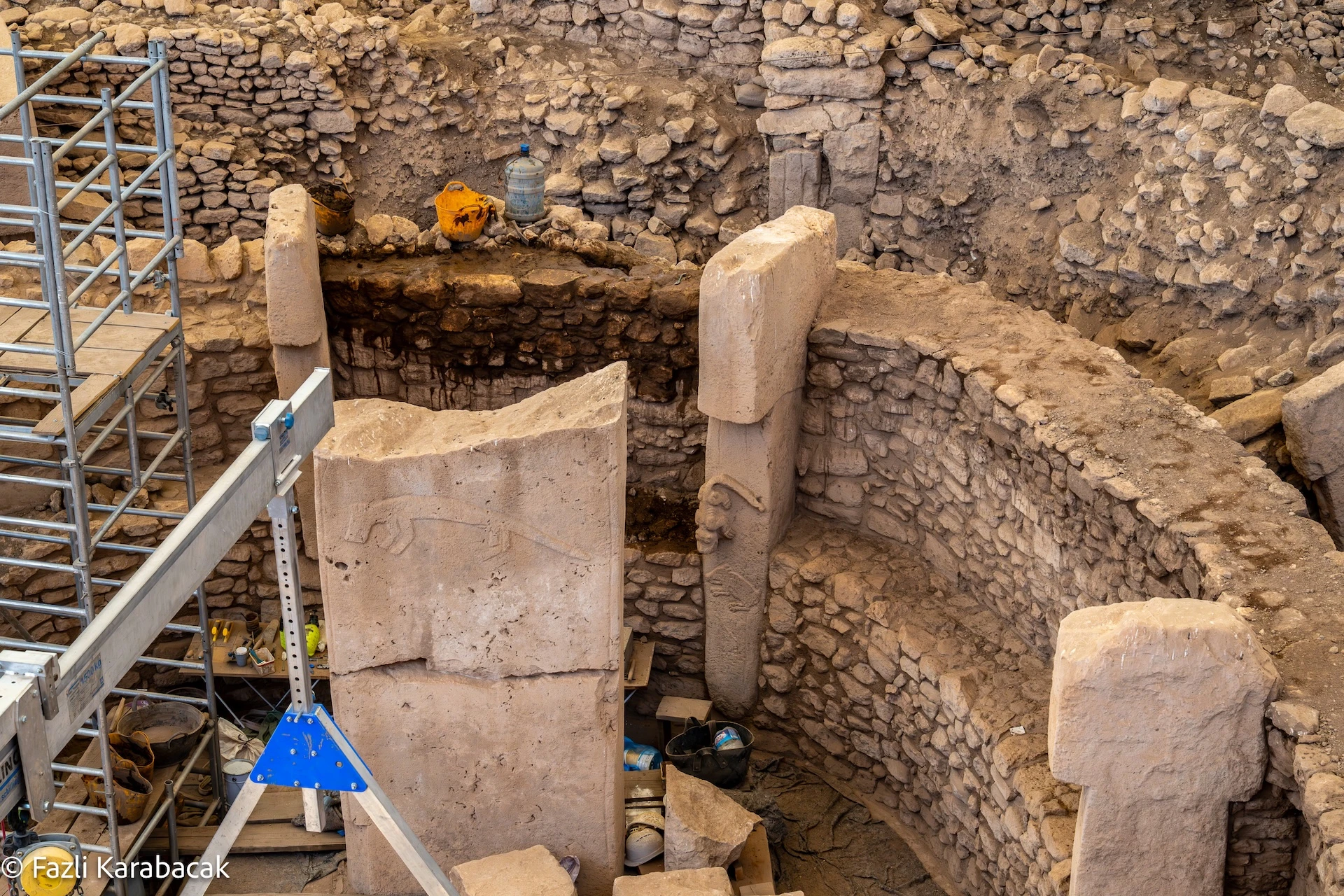
Quick Answer
One of the most revealing patterns at Göbekli Tepe is that the major enclosures do not all emphasise the same animals. Instead, different spaces seem to favour different symbolic creatures: snakes in one enclosure, foxes in another, boars in another, birds in another. This has led scholars to suggest that the enclosures may have expressed different social identities within a shared ritual landscape.
At a Glance
- Main idea: Each major enclosure appears to have its own animal emphasis
- Why it matters: The pattern may reflect different communities, ritual groups, or symbolic identities
- Best-known examples: snakes, foxes, boars, and birds in different enclosure settings
- Big takeaway: Göbekli Tepe may have been a shared ceremonial landscape rather than a single undifferentiated sanctuary
When people first encounter Göbekli Tepe, they often focus on its age, the scale of the pillars, or the mystery of why it was buried. But one of the most useful ways to read the site is to pay attention to how the animal imagery is distributed across space.
Because once you do that, the enclosures begin to look less like interchangeable stone circles and more like distinct symbolic worlds.
Each Enclosure Has Its Own Character
The major enclosures at Göbekli Tepe do not appear to repeat the same visual formula in exactly the same way.
Instead, certain animals seem to dominate certain built spaces. This is one of the reasons the site feels so layered. The builders were not just decorating pillars. They were creating environments with different visual emphases and, possibly, different identities.
That pattern matters because it suggests structure. It suggests selection. It suggests that the carved animals were tied to how each enclosure was understood and used.
Snakes, Foxes, Boars, and Birds
One of the clearest ways scholars describe this pattern is through dominant animal associations.
In simplified terms:
- snakes are strongly associated with Enclosure A
- foxes are especially associated with Enclosure B
- boars are strongly tied to Enclosure C
- birds play a leading role in Enclosure D
For deeper reading on two of the strongest animal clusters, continue with Snake Symbolism at Göbekli Tepe and Fox Symbolism at Göbekli Tepe.
These categories should not be treated too rigidly. The site is more complex than a neat one-animal-per-enclosure formula. But the broader pattern is still useful, because it shows that species distribution was not random.
Some animals appear more often, or more emphatically, in certain spaces than in others.
What Might That Mean?
This is where the discussion becomes especially interesting.
Oliver Dietrich and other researchers have suggested that different enclosures may reflect different social entities within the broader world of Göbekli Tepe. In other words, the site may not have belonged to one single, uniform group. It may have been a gathering place used by multiple communities, each of which maintained its own symbolic vocabulary inside a shared ritual framework.
That does not mean we can simply impose a later clan model and declare the issue solved. The social world of the Pre-Pottery Neolithic was its own world, and its categories may not map neatly onto modern anthropological labels.
Still, the idea of enclosure-based identity is one of the most persuasive ways to make sense of the pattern.
More Than Decoration
The enclosure identity pattern also matters because it helps us move beyond the idea that the animal carvings were decorative extras.
If the same animals were repeated in the same spaces over time, then those choices were probably meaningful. They may have marked belonging, lineage, ritual role, mythic orientation, or some combination of these.
The repetition itself is part of the evidence.
This becomes even more important when we remember that the imagery at Göbekli Tepe was not entirely fixed. Pillar surfaces could be reworked. Reliefs could be altered. Yet broader symbolic tendencies seem to persist. That persistence suggests commitment rather than accident.
Shared Space, Different Identities
One of the strongest implications of this pattern is that Göbekli Tepe may have been a meeting place.
Instead of imagining it as a monument belonging to one single social unit, it may be more useful to imagine it as a shared ceremonial landscape where different groups came together, each maintaining its own sacred emphasis while participating in a larger ritual world.
This helps explain why the site feels both unified and differentiated at the same time.
The architecture shares key principles across enclosures. The T-shaped pillars recur. The ritual language overlaps. But the animal worlds are not identical. That combination of sameness and difference is one of the site’s most important clues.
The Role of the Central Pillars
The central pillars make this even more intriguing.
Across the enclosures, the great paired T-shaped pillars seem to belong to a shared symbolic grammar. They have anthropomorphic features and a recognisable bodily logic. Yet around these shared central beings, the outer carved world shifts from enclosure to enclosure.
That suggests that the central pillars may have expressed something common across the whole site, while the surrounding animal programmes expressed more local or group-specific identity.
If that is right, Göbekli Tepe was not only an architectural achievement. It was also a social map built in stone.
Why This Matters for Visitors
For visitors, this way of reading the site changes the experience.
It encourages you to ask not only, “What animal is carved here?” but also, “Why this animal in this space?” and “What changes when I move from one enclosure to another?”
Those questions make Göbekli Tepe feel less like a static ruin and more like a carefully designed ritual landscape full of social signals.
What This Pattern Tells Us About Göbekli Tepe
The enclosure pattern suggests that the site was organised through more than brute labour or shared belief alone. It was also organised through differentiation.
Different spaces seem to have carried different symbolic emphases, and that may reflect different communities, roles, or ceremonial identities within the wider system.
That possibility matters because it turns Göbekli Tepe into something larger than a single sacred structure. It becomes a place where multiple identities were brought into relation with one another through architecture, imagery, and ritual space.
Key Takeaways
- Each major enclosure favours different animals — snakes in A, foxes in B, boars in C, birds and foxes in D.
- That pattern is too consistent to be random. Different groups likely expressed different identities through their carved programmes.
- Göbekli Tepe was probably not one community’s sanctuary but a shared ritual landscape where multiple groups met.
- Bottom line: Reading the enclosures side by side transforms the site from an architectural marvel into a social system.
Where to Go from Here
Dive into the individual animals: Fox Symbolism, Snake Symbolism, Wild Boar. For the big picture, start with What Is Göbekli Tepe?. Planning a visit? See Plan Your Göbekli Tepe Trip.
Frequently Asked Questions
Does each enclosure at Göbekli Tepe have one unique animal and no others? No — animals often appear in multiple enclosures. But when you map the distribution carefully, each major enclosure shows a clear preference or emphasis. Enclosure A favours snakes, Enclosure B strongly features foxes, Enclosure C emphasises boars, and Enclosure D includes both birds and foxes. That pattern is too consistent to be random accident.
What does the animal distribution pattern suggest about Göbekli Tepe’s organisation? It suggests the site was organised through differentiation. Different groups or communities may have used different enclosures and expressed their identities through their preferred animal emphases. This is one of the strongest pieces of evidence that Göbekli Tepe functioned as a shared ritual landscape where multiple social groups met, rather than a single unified monument belonging to one people.
Is this definitely proof of clans, totems, or formal group organisation? No — certainty is not possible with 12,000-year-old archaeological evidence. It is better to say the pattern strongly supports the idea of distinct social entities or group identities. Whether these were formal clans, age-grade societies, ritual brotherhoods, or other forms of organisation remains speculative. The key point is that the animal patterns are too deliberate to ignore.
Could the animal distribution just reflect practical hunting or availability? Unlikely. The consistency of the pattern across enclosures, combined with the fact that economically important animals are not necessarily the most symbolically dominant, suggests the distribution was meaningful rather than practical. The animals appear to have been chosen for symbolic reasons, not because they were abundant or important to subsistence.
How strong is the evidence that different communities built the different enclosures? The animal evidence is suggestive but not conclusive. It fits well with other observations: differences in architectural style, variations in pillar forms, and chronological evidence that different enclosures may have been built and used at different times. Together, these point to multiple groups using the site over centuries, but we cannot yet identify these groups or prove formal separation.
Are there examples of other Neolithic sites with similar animal-based differentiation? Not in exactly the same form. Göbekli Tepe appears to be unique in its scale and intensity of organised animal symbolism across multiple enclosures. However, other Taş Tepeler sites show similar kinds of symbolic animal emphasis, suggesting that this way of organising ritual space through animal identity was part of a broader regional practice in early Neolithic southeastern Anatolia.
Fazlı Karabacak is a licensed Turkish tour guide with over 25 years of experience and the founder of Serendipity Turkey. He specialises in archaeological and cultural tours across Turkey, with particular expertise in Göbekli Tepe and the Pre-Pottery Neolithic sites of southeastern Anatolia.