Quick Answer
Göbekli Tepe sits within the “Golden Triangle” where wild wheat, barley, and other founder crops originated — yet its builders were not farmers. This paradox fuels one of archaeology’s biggest debates: did the need to feed large ritual gatherings at monumental sites like this one actually drive the transition from foraging to farming?
At a Glance
- Date: Approximately 9600–8200 BC (Pre-Pottery Neolithic A/B)
- Location: Within the “Golden Triangle” of wild crop progenitor distribution, southeastern Turkey
- Distance to wheat’s birthplace: ~30 km from Karacadağ, where einkorn wheat was first domesticated
- Crops at the site: Wild einkorn and wild barley — no domesticated plants
- Core theory: Ritual construction demands drove grain intensification, which eventually led to domestication
- Status: Debated but increasingly supported; both “temple-first” and gradualist models place Göbekli Tepe at the centre
There is a moment on every tour I lead at Göbekli Tepe when the significance of its location begins to dawn on visitors. We stand on the limestone ridge overlooking the Harran Plain, and I ask them to imagine this landscape twelve thousand years ago — not the irrigated cotton fields they see today, but rolling grasslands thick with wild einkorn, emmer wheat, and barley. Then I point southeast toward the Karacadağ mountains and tell them something that tends to stop conversations: that is where genetic analysis has shown the very first domesticated wheat on Earth originated.
The world’s oldest monumental architecture and the birthplace of agriculture are practically neighbours. In twenty-five years of guiding, I have never found this less than electrifying — because the more you understand what it means, the more it overturns the story most of us were taught about how civilisation began.
Why Does the Old Story No Longer Work?
The conventional narrative runs like this: people discovered farming, which produced surpluses, which allowed settlements, which generated social complexity, which eventually gave rise to religion and monumental architecture. Agriculture first, temples later.
Göbekli Tepe demolishes it. Here we have monumental temples built by people who had not yet domesticated a single crop, in the precise region where that domestication would soon occur. The temples came first.
This overturning has deep roots. V. Gordon Childe coined “Neolithic Revolution” in the 1930s. Robert Braidwood challenged his model by showing early farming emerged in uplands where wild cereals actually grew, not in lowlands. Barbara Bender argued that social competition — the desire for surplus to fund feasting — drove the transition. And most provocatively, the French archaeologist Jacques Cauvin proposed that a “revolution in symbols” preceded the economic transformation — that changes in belief systems were the engine, not the consequence.
When I share Cauvin’s argument with visitors at Göbekli Tepe, I watch the recognition spread across their faces. They are standing inside the proof.
What Is the Golden Triangle and Why Does It Matter?
The Golden Triangle is the compact region in southeastern Turkey where the wild progenitors of the Near East’s “founder crops” overlap in their natural distribution. Mapped by Lev-Yadun, Gopher, and Abbo in their landmark 2000 study in Science, this zone includes wild einkorn, emmer wheat, barley, lentil, pea, chickpea, bitter vetch, and flax — all growing within close proximity.
Göbekli Tepe sits at the heart of it.
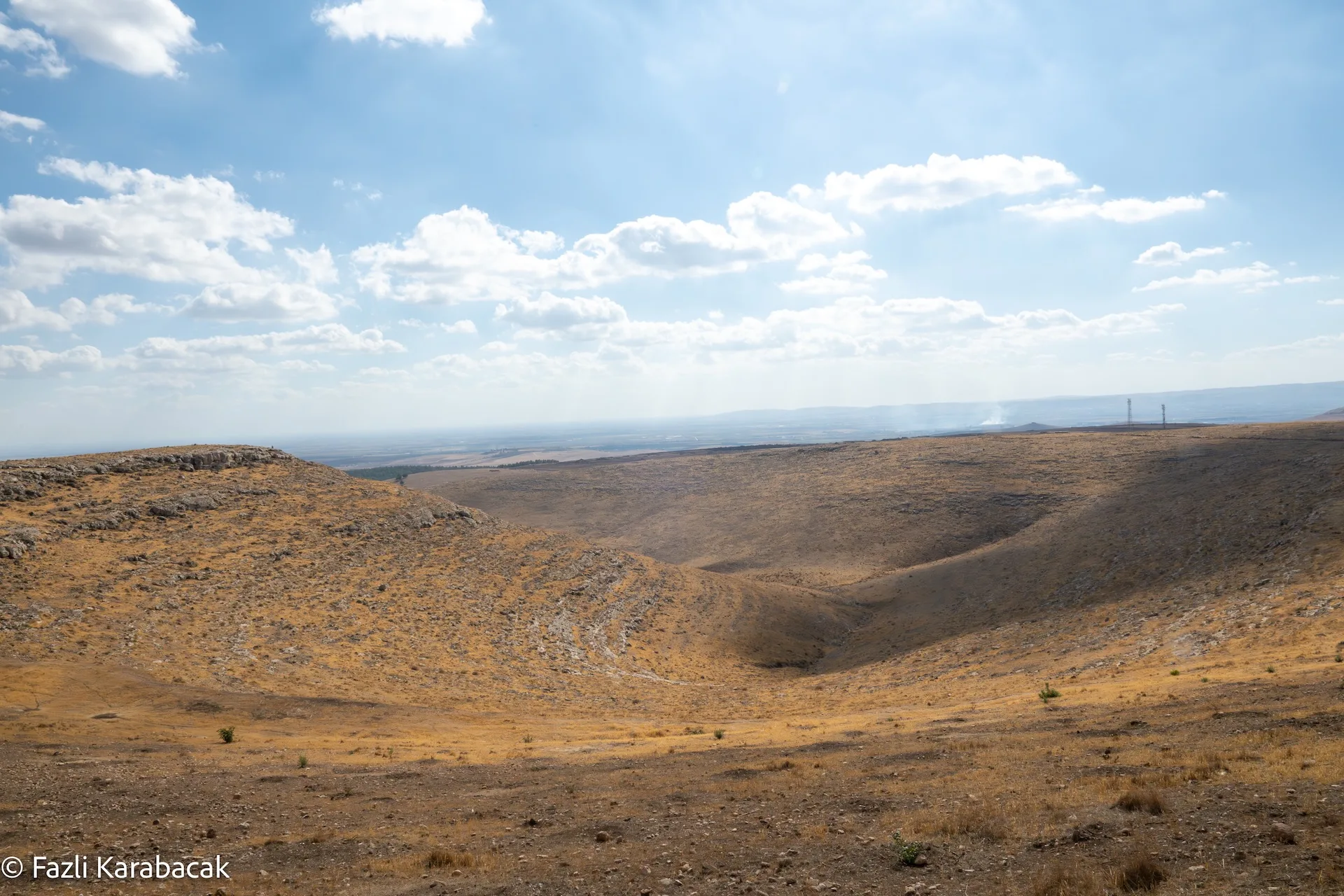
The genetic evidence is equally striking. In 1997, Manfred Heun and colleagues demonstrated in Science that the wild einkorn populations most closely related to domesticated varieties grew on the Karacadağ mountain slopes — visible from Göbekli Tepe on a clear day.
The site’s own archaeobotanical record confirms the proximity: grinding stones, mortars, and pestles appear throughout. Wild einkorn and wild barley have been identified in the assemblage. But crucially, no domesticated crops have been found. The builders were harvesting and processing wild grains — likely in large quantities for feasting and brewing — but they had not yet crossed the threshold into farming.
On the ground: When you visit Göbekli Tepe and look toward Karacadağ, you are looking at the landscape where wheat was first domesticated. On our Göbekli Tepe and Karahan Tepe day tour, we pause at this viewpoint to let the connection sink in — the same hills that fed the builders may have supplied the grain that eventually changed the world.
What Is Pre-Domestication Cultivation?
Pre-domestication cultivation is a phase lasting roughly 1,500 years during which communities deliberately managed wild plant populations — sowing, tending, harvesting — without those plants yet developing the physical traits that define domestication (non-shattering seed heads, larger grains, loss of dormancy).
Fuller, Willcox, and Allaby documented this phase in their 2011 study in World Archaeology, showing a clear peak during the Pre-Pottery Neolithic A and Early PPNB periods — precisely the era when Göbekli Tepe’s most impressive enclosures were being built.
This matters because it means the transition to farming was not a sudden “revolution.” It was a gradual, multi-generational process. Göbekli Tepe was built and used during precisely this transitional window — when people were investing enormous labour in wild cereal harvesting but had not yet become farmers in the full sense.
The debate about how this unfolded remains active. Abbo and Gopher (2020) argue for conscious, rapid domestication by skilled plant managers. Fuller and colleagues argue for multiple parallel processes across the Fertile Crescent. But both camps agree: Göbekli Tepe sits squarely within the temporal and geographic window where the most momentous economic transformation in human history was taking shape.
Did Temples Come Before Agriculture?
Klaus Schmidt himself articulated the most radical implication of his discovery. If the conventional sequence was correct, Göbekli Tepe should not exist. A pre-agricultural society should not have been capable of quarrying, transporting, and erecting pillars weighing up to sixteen tonnes, carving them with elaborate reliefs, and maintaining a complex over more than a millennium.
Yet they did. And the absence of permanent habitation deepens the paradox — no houses, no hearths, no storage. This was purely a ceremonial centre, provisioned by what appears to be large-scale communal effort.
The temple-first hypothesis runs as follows: building monumental architecture required mobilising large labour forces. Feeding those forces required accumulating wild cereals and game far beyond ordinary subsistence needs. This demand, driven by ritual rather than hunger, created conditions under which intensive grain harvesting became necessary. Over generations, this intensification — harvesting the largest stands, possibly replanting seeds near the construction site, weeding competitors — set the stage for domestication.
In this reading, religion did not follow agriculture. Religion drove agriculture.
The mechanism becomes clearer through the work feast model. As I explored in detail in Was Beer Brewed at Göbekli Tepe?, Oliver Dietrich and colleagues proposed that construction was organised through communal feasting — the promise of food and drink drawing workers from surrounding communities. Each building season required a feast. Each feast required grain. As projects grew more ambitious, demand increased, pushing communities to manage their wild cereals more intensively. Over centuries, this ritual-driven intensification nudged wild populations toward domestication.
What Do the Sceptics Say?
I would not do justice to this topic if I presented the temple-first hypothesis as settled fact. Two important objections deserve consideration.
Representativeness: Göbekli Tepe is spectacular but may not be typical. Most Pre-Pottery Neolithic sites are settlements — villages with houses, hearths, and storage. The transition to agriculture played out primarily in these domestic contexts, not in monumental ritual centres. Abbo and Gopher’s emphasis on conscious, knowledge-based domestication implicitly locates the innovation with skilled plant managers, not ritual congregations.
Chronology: The earliest firm evidence for morphologically domesticated crops postdates Göbekli Tepe’s main construction phases by several centuries. If the temple drove agriculture, the effect was indirect and slow — consistent with pre-domestication cultivation, but not a simple cause-and-effect.
Perhaps most importantly, framing the question as “temple first versus agriculture first” may be misleading. The emerging picture is one of mutual reinforcement: ritual gatherings demanded food surpluses; surplus production enabled larger gatherings; larger gatherings required more elaborate coordination; and that coordination found expression in grander architecture. Each element fed the others in a cycle of intensification that, over centuries, transformed every aspect of life.
How Does Göbekli Tepe Fit the Bigger Picture?
Within roughly a hundred kilometres of where you stand at Göbekli Tepe, the following things occurred: the domestication of einkorn wheat, the domestication of emmer wheat, some of the earliest barley cultivation, the construction of the world’s first monumental architecture, and the development of one of the earliest known complex symbolic systems.
This is not a scatter of unrelated events. It is a cluster — and its compactness demands explanation.
Part of the answer is environmental: the upland Fertile Crescent provided wild crop progenitors, abundant game, reliable water, and a climate shifting from cool-dry to warm-wet at the end of the Younger Dryas, expanding wild cereal stands dramatically. But environment alone cannot explain the timing or intensity.
The social and ritual dimension adds the missing element. These communities were not passively responding to their environment. They were actively transforming their landscape through ambitious ritual practices that demanded — and eventually produced — new ways of interacting with the plant and animal world around them.
What makes Göbekli Tepe so powerful is that it captures a moment of profound transition. The people who carved these pillars were not yet farmers, but they were no longer simply foragers. They were communities in the process of becoming something new, and the rituals performed in these enclosures were part of the process of becoming.
The wild grains they harvested were the same species their descendants — perhaps only a few generations later — would learn to cultivate. The animals they feasted upon would, in time, be domesticated or replaced. The social organisation that allowed them to coordinate hundreds of labourers was a precursor to the hierarchies that settled agricultural life would demand.
Göbekli Tepe does not give us a neat answer to whether religion invented agriculture. It gives us something more valuable: evidence that these two transformations — the spiritual and the economic — were aspects of a single, profound shift in the human relationship with the natural world.
Klaus Schmidt himself reached the same conclusion in his 2010 excavation report, explicitly endorsing Jacques Cauvin’s theory: “the factor that allowed the formation of large, permanently co-resident communities was the facility to use symbolic culture.” The excavator of Göbekli Tepe, in other words, believed that symbolic and ritual life was the engine — not the byproduct — of the Neolithic transition.
Key Takeaways
- Göbekli Tepe sits within the “Golden Triangle” where wild ancestors of wheat, barley, and other founder crops overlap — the geographic epicentre of the agricultural revolution.
- Einkorn wheat was first domesticated near the Karacadağ mountains, ~30 km from Göbekli Tepe (Heun et al., 1997).
- Wild einkorn and wild barley are present at the site, but no domesticated crops — the builders were harvesters, not farmers.
- The site was built during the “pre-domestication cultivation” phase (~9700–8200 BC), when communities managed wild crops without yet producing morphological domestication.
- The “temple-first” hypothesis proposes that labour demands of ritual construction drove grain intensification, eventually pushing wild populations toward domestication.
- Rather than a simple reversal of the old narrative, the evidence points to mutual reinforcement between ritual activity and agricultural innovation over many centuries.
Planning Your Visit
The connection between Göbekli Tepe and the birth of agriculture is something you feel most powerfully when you stand on the ridge and look toward Karacadağ. It is a view that makes twelve thousand years of history feel immediate — but only if someone can explain what you are looking at.
Our Göbekli Tepe and Karahan Tepe guided day tour covers both sites with the archaeological context that transforms a hilltop visit into an encounter with the moment humanity changed forever.
Your Next Read
Suggested path: Was Beer Brewed at Göbekli Tepe? → Why Was Göbekli Tepe Buried? → The T-Shaped Pillars → What Is Göbekli Tepe?. Planning a trip? Start with Plan Your Göbekli Tepe Trip.
Frequently Asked Questions
Did the people at Göbekli Tepe practice agriculture? No. Wild einkorn and wild barley are present at the site, but no domesticated crops. The builders were in the “pre-domestication cultivation” phase — actively harvesting wild plants but not yet farming.
How close is Göbekli Tepe to where wheat was first domesticated? About thirty kilometres. Genetic analysis (Heun et al., 1997) showed the wild einkorn most closely related to domesticated varieties grew on the Karacadağ mountains, visible from the site on a clear day.
What is the Golden Triangle of plant domestication? The compact region in southeastern Turkey where wild progenitors of the major Near Eastern founder crops overlap — einkorn, emmer, barley, lentil, pea, chickpea, bitter vetch, and flax. Göbekli Tepe sits within this zone.
What is the temple-first hypothesis? The idea that complex ritual activity preceded and potentially drove the development of agriculture. Göbekli Tepe is the strongest evidence: monumental architecture predating any known farming, built in the very region where farming soon emerged.
Did feasting at Göbekli Tepe contribute to the origins of farming? This is a leading interpretation. The “work feast” model proposes that feeding large construction crews created recurring demand for surplus grain, driving increasingly intensive wild cereal management over centuries.
Can I see the landscape where agriculture began? Yes. From Göbekli Tepe’s hilltop you can see the Karacadağ mountains and the surrounding plateau where wild cereals still grow. On our guided day tours, we explain this connection on site — it is one of the most powerful moments of the visit.
Fazlı Karabacak is a licensed Turkish tour guide with over 25 years of experience and the founder of Serendipity Turkey. He specialises in archaeological and cultural tours across Turkey, with particular expertise in Göbekli Tepe and the Pre-Pottery Neolithic sites of southeastern Anatolia.