Quick Answer
DNA fingerprinting by Heun et al. traced all domesticated einkorn wheat to wild populations on Karacadağ — a volcanic mountain range just 30 km from Göbekli Tepe. Subsequent research confirmed southeastern Turkey as the origin of emmer and hard wheat too. The Şanlıurfa region, where Göbekli Tepe’s builders processed wild cereals at massive scale, is the genetic birthplace of wheat.
At a Glance
- Karacadağ: Volcanic massif ~30 km northeast of Göbekli Tepe; confirmed origin of domesticated einkorn wheat
- Key study: Heun et al. (Science, 1997/2000) — AFLP DNA fingerprinting of 338 wild einkorn lines
- Emmer and hard wheat: Also traced to southeastern Turkey by Özkan et al. (2002)
- The “Cradle of Agriculture”: Term used by Lev-Yadun, Gopher & Abbo (2000) for this exact region
- 8 Neolithic founder crops: All have wild progenitors overlapping in southeastern Turkey
- Processing scale: Over 7,200 grinding tools at Göbekli Tepe confirm intensive pre-domestication cereal exploitation
- No cultivation yet: All cereals at Göbekli Tepe are wild — domestication followed the ritual intensification
What Am I Looking at When I Point Toward Karacadağ?
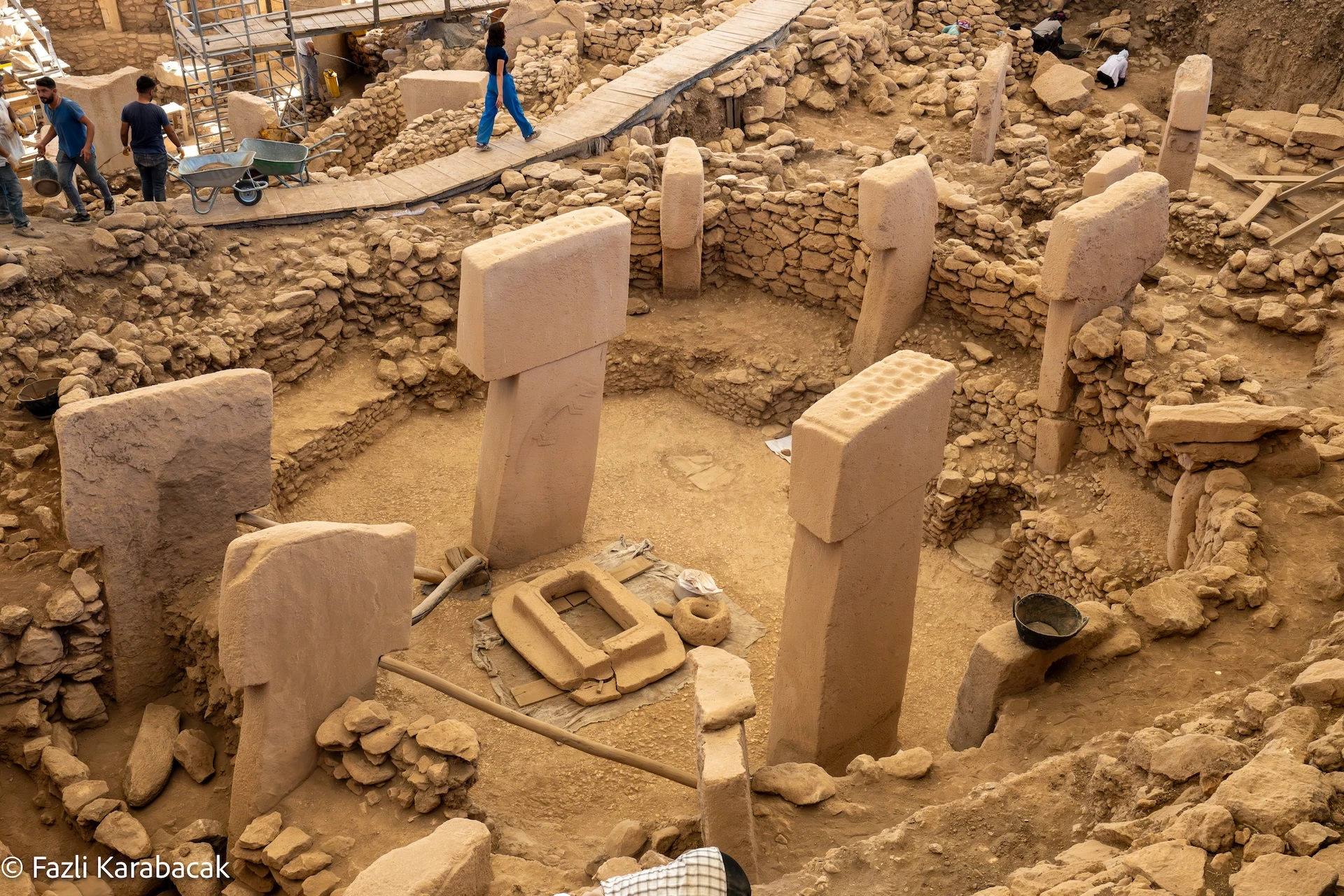
There is a moment on every tour I lead in Şanlıurfa Province when the landscape itself becomes the most powerful exhibit. We stand on the limestone ridge of Göbekli Tepe, looking northeast across the undulating steppe of the Harran Plain, and I point toward the dark, jagged silhouette of Karacadağ — a volcanic massif rising to nearly 1,920 metres, roughly 30 kilometres from where we stand.
Most visitors assume I am pointing out a geological feature. I am, in fact, pointing at the birthplace of wheat — the single crop that more than any other has shaped the course of human civilisation. And the fact that it was born within walking distance of the world’s oldest monumental sanctuary is not a coincidence. It is a clue.
How Did DNA Fingerprinting Reveal Where Wheat Was First Domesticated?
The connection between Karacadağ and wheat domestication was established through one of the most elegant applications of molecular biology to archaeology. In 1997, Manfred Heun, a geneticist at the Agricultural University of Norway, and his international team collected 338 lines of wild einkorn wheat (Triticum monococcum subsp. boeoticum) from across the Fertile Crescent — from western Turkey through Syria, Lebanon, Iraq, and Iran. They also gathered 68 cultivated einkorn lines from various sources.
Using AFLP DNA fingerprinting, Heun’s team compared the genetic profiles of all samples to determine which wild population was the closest relative of cultivated einkorn. The results were remarkably precise. Of all the wild einkorn populations tested across the entire Fertile Crescent arc, the one growing on the volcanic slopes of Karacadağ showed the closest genetic match to domesticated einkorn. The analysis was unambiguous: the Karacadağ population was not just one possible source among many. It was the source.
When I explain this to visitors, I often see the same reaction: a slow dawning of recognition. They came to Şanlıurfa to see ancient stones. They are discovering they are standing in the landscape where humanity’s most consequential agricultural experiment began.
Standing in the landscape: On our Göbekli Tepe guided tour, we take time to orient visitors within this extraordinary geography — explaining how Göbekli Tepe, Karacadağ, and the Harran Plain form a single archaeological landscape that changed human civilisation.
Was Einkorn the Only Wheat Domesticated Here?
Einkorn was not the only wheat domesticated in this region. In 2002, Hakan Özkan and colleagues at Çukurova University published an AFLP analysis of tetraploid wheats — the group that includes emmer (Triticum dicoccum) and hard wheat (Triticum durum, ancestor of modern pasta wheat). Their study compared 46 accessions of wild emmer with cultivated forms and concluded that the origin of both emmer and hard wheat domestication lay in southeastern Turkey.
The implications are extraordinary. The Şanlıurfa-Diyarbakır corridor — the very region where Göbekli Tepe, Karahan Tepe, and the broader Taş Tepeler network are located — was the genetic homeland not just of one wheat species but of the entire wheat complex that would become the foundation of Old World agriculture. Einkorn, emmer, and durum wheat: all three trace their cultivated origins to this landscape.
Simcha Lev-Yadun, Avi Gopher, and Shahal Abbo reinforced this picture in their widely cited 2000 article in Science, where they mapped the overlapping natural habitats of the wild progenitors of all eight Neolithic “founder crops” — einkorn, emmer wheat, barley, lentil, pea, chickpea, bitter vetch, and flax. The zone of maximum overlap fell squarely in southeastern Turkey, with the area around Karacadağ near its centre. They titled their paper, with appropriate drama, “The Cradle of Agriculture.”
What Is the Evidence for Pre-Domestication Cereal Knowledge at Göbekli Tepe?
The evidence from Göbekli Tepe itself provides critical support for the idea that these communities possessed deep botanical knowledge long before formal domestication occurred. As Reinder Neef reported in his 2003 preliminary archaeobotanical study, wild forms of einkorn, wheat, and barley were all present at the site. More dramatically, as Laura Dietrich and colleagues demonstrated in their 2019 cereal processing study, over 7,200 grinding tools have been recovered — the vast majority showing use-wear patterns diagnostic of cereal processing.
The phytolith analysis confirmed what the tools suggested: grass phytoliths, predominantly from wheat and barley inflorescences, were abundant on grinding surfaces and in associated sediments across all occupation layers. These people were not casually nibbling on wild grains. They were harvesting, transporting, and processing cereals at a scale that dwarfs anything documented at contemporary sites.
And they were doing this on a hilltop with no permanent water source, no arable land, and no evidence of on-site cultivation. The wild cereals processed at Göbekli Tepe were gathered from the surrounding lowlands and brought to the site specifically for communal consumption during seasonal gatherings. As I discussed in detail in Who Started Agriculture? Hunter-Gatherers or Temple Builders?, this pattern of intensive wild cereal exploitation within a ritual context represents exactly the kind of “pre-domestication cultivation” phase that preceded the genetic transformation of the crops themselves.
Why Did Domestication Happen Here — What Made This Landscape Special?
To appreciate why domestication happened here, you need to understand the ecology of this specific landscape. The Şanlıurfa region sits at the northern edge of the Fertile Crescent, where the Mesopotamian steppe meets the foothills of the Taurus Mountains. It is a transitional zone — ecologically diverse, with multiple habitat types compressed into a relatively small area.
Karacadağ itself is a basaltic shield volcano, geologically distinct from the surrounding limestone plateau. Its slopes create a range of microclimates and soil types that support exceptional plant diversity. Wild einkorn thrives on the well-drained volcanic soils at elevations between 600 and 1,200 metres. Wild barley prefers slightly different conditions. The result is that within a day’s walk of Göbekli Tepe, ancient foragers had access to naturally occurring stands of virtually every wild cereal and pulse that would later become the foundation of agriculture.
The region also had another crucial advantage: seasonal abundance. Wild cereals in this part of Turkey ripen between late May and July, depending on elevation and species. Gazelle — the primary animal prey documented at Göbekli Tepe — migrated through the region between midsummer and autumn. This convergence of plant and animal resources during a concentrated seasonal window is precisely what made the work feasts model viable. As Peters and Schmidt argued, a sedentary acquaintance with wild forms was an essential prerequisite for domestication. The Şanlıurfa landscape provided the ideal conditions for developing exactly this kind of intimate, sustained relationship with wild crop progenitors.
Drive the wheat road: When we leave Göbekli Tepe heading northeast on our full-day tour, the landscape shifts perceptibly from pale limestone steppe to darker basaltic soils. In spring, wild grasses cover the lower slopes in an undulating carpet of green and gold. I take time to explain this transition — from the land of rituals to the land of wheat’s origin — because seeing it changes how people understand both.
Was Domestication One Event or Many? What Does the Debate Tell Us?
This question sits at the heart of one of the liveliest debates in Near Eastern archaeobotany. On one side stand scholars like George Willcox and Dorian Fuller, who favour a protracted, geographically diffused model: multiple communities across the Fertile Crescent independently began cultivating wild plants, and the morphological changes associated with domestication accumulated slowly over centuries through unconscious selection.
On the other side stand Shahal Abbo, Simcha Lev-Yadun, and Avi Gopher, who argue for a highly localised, relatively fast domestication event carried out by knowledgeable human actors. They make the case that the protracted model implicitly underestimates the botanical knowledge of Neolithic foragers — assuming they were incapable of recognising desirable plant traits and selecting for them deliberately. Abbo and colleagues point to the legume evidence as particularly telling: wild peas, lentils, and chickpeas rarely produce harvestable yields when sown, meaning their domestication must have involved deliberate selection of specific genotypes.
As a guide who walks this landscape regularly, I find the Abbo model intuitively compelling. The people who built Göbekli Tepe were clearly not simple opportunists. They were sophisticated observers of nature who carved detailed, accurate representations of dozens of animal species, organised massive communal construction projects, and processed wild cereals at an industrial scale. The idea that such people could also be astute botanists — recognising and propagating superior plant varieties — seems entirely consistent with what the archaeological record tells us.
How Did Wheat Spread from Southeastern Turkey to the World?
The story does not end with the initial domestication event. Once cultivated wheat varieties emerged in the Karacadağ area, they began to spread — and the archaeological record allows us to trace their journey.
Çayönü, a major Pre-Pottery Neolithic settlement roughly 100 kilometres east of Göbekli Tepe near modern Diyarbakır, provides some of the earliest evidence of cultivated einkorn and emmer in a village context. The site was occupied from approximately 8,600 to 6,200 BCE, and its archaeobotanical record documents the transition from wild to cultivated cereals over time.
From southeastern Turkey, cultivated wheat spread in multiple directions: westward into central Anatolia and eventually Europe, southward into the Levant, eastward into the Zagros foothills of Iran and Iraq, and ultimately across the entire Old World over several thousand years.
Every loaf of bread baked today, every bowl of pasta, every field of golden wheat stretching across the plains of Kansas or the steppes of Ukraine — all trace their genetic ancestry back to the volcanic slopes visible from Göbekli Tepe. This is not metaphor. It is molecular fact.
What Is the Chronological Puzzle — Why Did Domestication Come After the Temple?
One of the most thought-provoking aspects of the Şanlıurfa connection is the gap between the intensive wild cereal use at Göbekli Tepe and the appearance of morphologically domesticated wheat in the archaeological record.
Göbekli Tepe’s earliest phase dates to approximately 9,500–8,700 cal BCE. All cereal evidence from this period involves morphologically wild plants. The earliest widely accepted evidence for domesticated einkorn appears somewhat later — roughly in the ninth to eighth millennium BCE — with the full domestication syndrome consolidating over subsequent centuries.
This gap is exactly what Schmidt’s “temple first” model predicts. The social pressures created by large-scale ritual gatherings — the need to feed hundreds of workers, the intensification of wild cereal harvesting, the development of sophisticated processing technologies — preceded domestication rather than following it. The technology, the knowledge, and the motivation were all in place at Göbekli Tepe. What had not yet occurred was the genetic transformation of the plants themselves — a process that required sustained cultivation pressure over generations.
In this reading, Göbekli Tepe represents the incubation period of agriculture: the critical phase when human communities developed the social organisation, ecological knowledge, and processing infrastructure that made domestication possible.
Key Takeaways
- DNA fingerprinting by Heun et al. traced all domesticated einkorn wheat to a wild population on Karacadağ, approximately 30 km from Göbekli Tepe.
- Özkan et al. (2002) confirmed that emmer and hard wheat were also domesticated in southeastern Turkey, making the Şanlıurfa-Diyarbakır region the origin point of the entire cultivated wheat complex.
- The overlapping natural habitats of all eight Neolithic founder crops centre on southeastern Turkey — the “Cradle of Agriculture.”
- Over 7,200 grinding tools at Göbekli Tepe confirm massive wild cereal processing centuries before morphological domestication, representing a critical pre-domestication cultivation phase.
- The chronological gap between Göbekli Tepe’s wild cereal use and the first domesticated wheat is exactly what Schmidt’s “temple first” model predicts.
Planning Your Visit
Some of the wild einkorn populations that Heun sampled for his DNA study still grow on Karacadağ’s slopes. They are small, unassuming plants — nothing like the tall, heavy-headed wheat of modern fields. Their seed heads shatter easily when ripe, scattering their grains — the very trait domestication would eventually breed out.
On our Göbekli Tepe and Karahan Tepe guided tour, we orient you in this landscape and explain the wheat story in the field, connecting what you see at the site to what happened in the hills behind it.
Your Next Read
Suggested path: Who Started Agriculture? → Did Religion Invent Agriculture? → Was Beer Brewed at Göbekli Tepe? → What Is Göbekli Tepe?. Planning a trip? Start with Plan Your Göbekli Tepe Trip.
Frequently Asked Questions
Where was wheat first domesticated? Genetic studies traced the domestication of einkorn wheat to the slopes of Karacadağ in southeastern Turkey, approximately 30 km from Göbekli Tepe. Emmer wheat and hard wheat were also domesticated in the broader southeastern Turkish region. This makes the Şanlıurfa-Diyarbakır corridor the primary origin zone for cultivated wheat.
What is the connection between Göbekli Tepe and Karacadağ? Karacadağ is a volcanic mountain range roughly 30 km northeast of Göbekli Tepe, where the wild ancestor of domesticated einkorn wheat has been genetically identified. The people who built Göbekli Tepe harvested wild cereals from this area and processed them at massive scale. This intensive exploitation may have been a precursor to deliberate cultivation and eventual domestication.
What are the Neolithic founder crops? The eight Neolithic founder crops are: einkorn wheat, emmer wheat, barley, lentil, pea, chickpea, bitter vetch, and flax. These were the first plants domesticated in the Near East and formed the agricultural foundation of all subsequent farming societies in the region. The natural habitats of their wild progenitors overlap in southeastern Turkey.
Did the builders of Göbekli Tepe grow wheat? No. All cereal evidence from Göbekli Tepe consists of wild species — none show the morphological changes associated with domestication. However, the builders processed wild cereals at an enormous scale, and this intensive exploitation likely contributed to the eventual domestication of wheat in the surrounding region in the centuries following Göbekli Tepe’s main period of use.
Can you still see wild wheat growing near Göbekli Tepe? Yes. Wild einkorn (Triticum boeoticum) still grows on the slopes of Karacadağ and in other parts of the Şanlıurfa landscape. The populations that Heun et al. sampled for their DNA study are the same ones that ancient foragers would have harvested over 10,000 years ago.
How did wheat spread from Turkey to the rest of the world? From its origin in southeastern Turkey, cultivated wheat spread through successive waves of migration and exchange over several thousand years — westward into Europe, southward into the Levant, and eastward into Central Asia. This dispersal was part of the broader “Neolithic expansion” that carried farming practices across the Old World.
Fazlı Karabacak is a licensed Turkish tour guide with over 25 years of experience and the founder of Serendipity Turkey. He specialises in archaeological and cultural tours across Turkey, with particular expertise in Göbekli Tepe and the landscapes of southeastern Anatolia.