
Standing Figures in Stone
The T-shaped pillar is the signature architectural element of Göbekli Tepe — and of the broader Taş Tepeler network of Pre-Pottery Neolithic sites in southeastern Turkey. Over 200 such pillars have been identified at Göbekli Tepe through excavation and geophysical survey, with the tallest standing approximately 5.5 metres and weighing up to 10 tonnes.
The pillars take their name from their cross-section: a tall, narrow rectangular shaft topped by a wider, flat capstone that extends to either side, forming a T-shape when viewed from the front. This form is not arbitrary. It represents a stylised human figure, with the horizontal cap serving as the head and the shaft as the body.
That these stones are human figures — not abstract columns or structural supports — is confirmed by the carved details found on many of them: arms, hands, fingers, belts, buckles, loincloths, and fox-pelt accessories. They are, in effect, the oldest known monumental depictions of the human form.
Peripheral T-shaped pillars set into the walls of Enclosure D, showing the characteristic T-profile and carved animal reliefs.
Arms, Hands, Belts & Loincloths
The most striking feature of the central pillars — the taller pair at the heart of each circular enclosure — is the presence of clearly carved human anatomy. On the twin central pillars of Enclosure D (Pillar 18 and Pillar 31), the carvings are unmistakable:
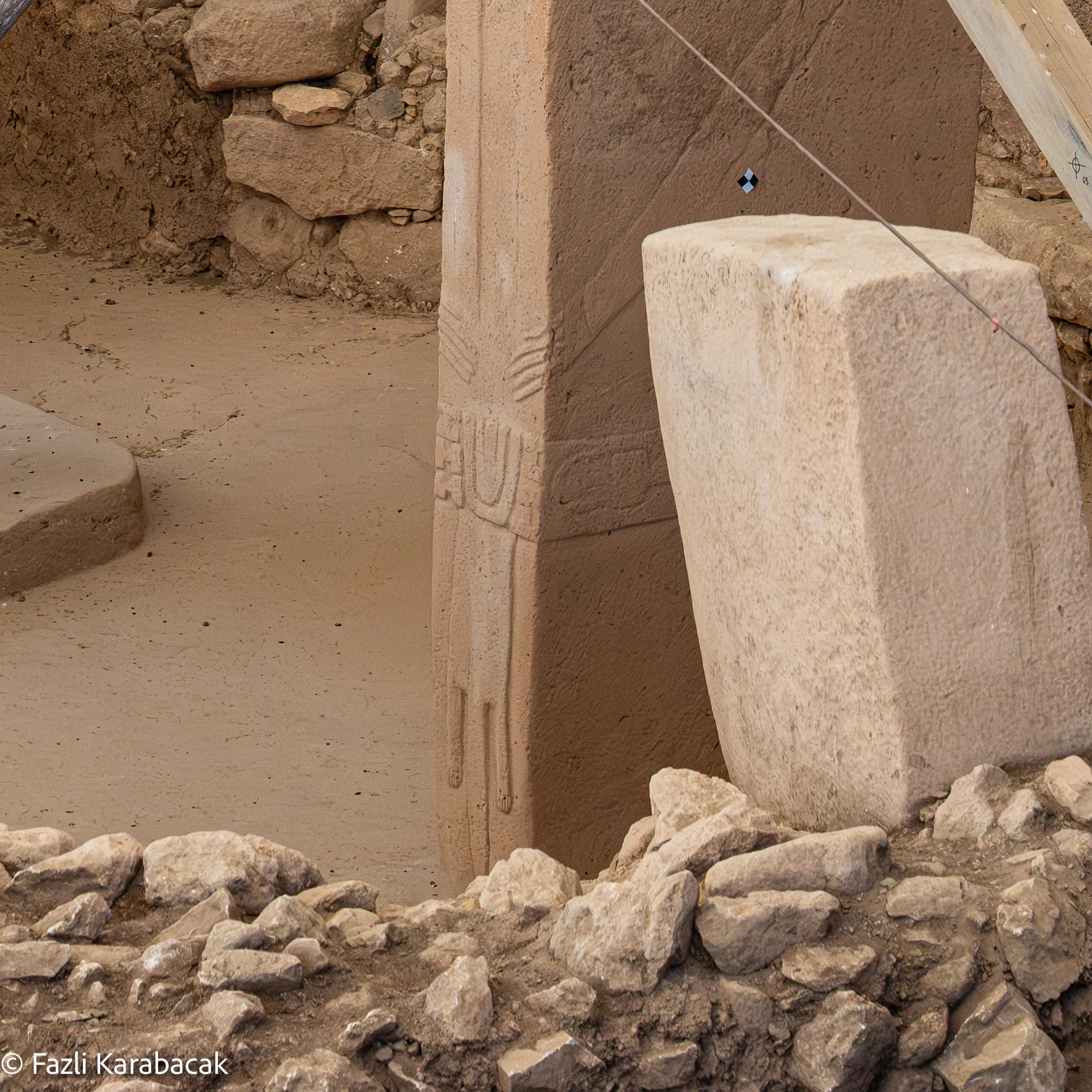
Carved arms, hands, belts and loincloths on the central pillars of Enclosure D.
Arms & Hands
Long, slender arms are carved in low relief along the narrow sides of the pillars, bending at the elbow and meeting at the front of the shaft. Individual fingers are clearly visible on the hands, which rest on or just above the belt. The arms confirm that the T-shape is an intentional abstraction of the human body.
Belts & Buckles
Many central pillars feature a wide belt carved across the midsection, sometimes with a circular buckle. These belts may represent leather or woven garments. Their consistency across multiple pillars and enclosures suggests a standardised symbolic code — perhaps indicating rank, ritual role, or identity.
Loincloths
Below the belt, a loincloth or garment is often carved, hanging from the waist. On Pillar 31, a fox-pelt garment appears to hang from the belt — an intriguing detail, given the prominence of fox imagery across the entire site. Were these figures clothed in animal skins? Were the foxes totemic?
Faceless Heads
Notably, the T-shaped "heads" of the pillars are entirely blank — no eyes, nose, or mouth. This deliberate facelessness is one of the most debated aspects of the pillars. Are they intentionally anonymous? Do they represent ancestors whose individual identity has been absorbed into a collective? Or is the face simply elsewhere — perhaps on a separate sculpted head, like those found at Karahantepe?
Quarrying & Transport
One of the most remarkable aspects of the T-shaped pillars is the logistics of their creation. These are not small carvings — the largest weigh up to 10 tonnes and stand over 5 metres tall. They were quarried from the natural limestone plateau located a few hundred metres southwest of the main mound.
At the quarry site, archaeologists have found unfinished pillars still attached to the bedrock, including one enormous roughed-out pillar estimated at approximately 7 metres long — which, had it been completed, would have been the largest at the site. The quarry provides invaluable evidence of the techniques used: channels were cut around the pillar using flint tools, and the stone was then levered free from below.
How Did They Move Them?
Without wheels, draft animals, or metal tools, how did hunter-gatherers transport 10-tonne stones several hundred metres and then erect them in precise positions? The answer almost certainly lies in collective human labour — possibly hundreds of people using ropes, wooden sledges, and prepared trackways. Experimental archaeology suggests that a group of 50–500 people could manage the task, depending on the terrain.
The sheer labour required implies sophisticated social organisation: the ability to mobilise, feed, and coordinate large groups of people for an extended period. This in turn suggests that whoever commissioned the pillars had significant social authority — whether that was a religious leader, a council of elders, or something entirely different from our modern categories.
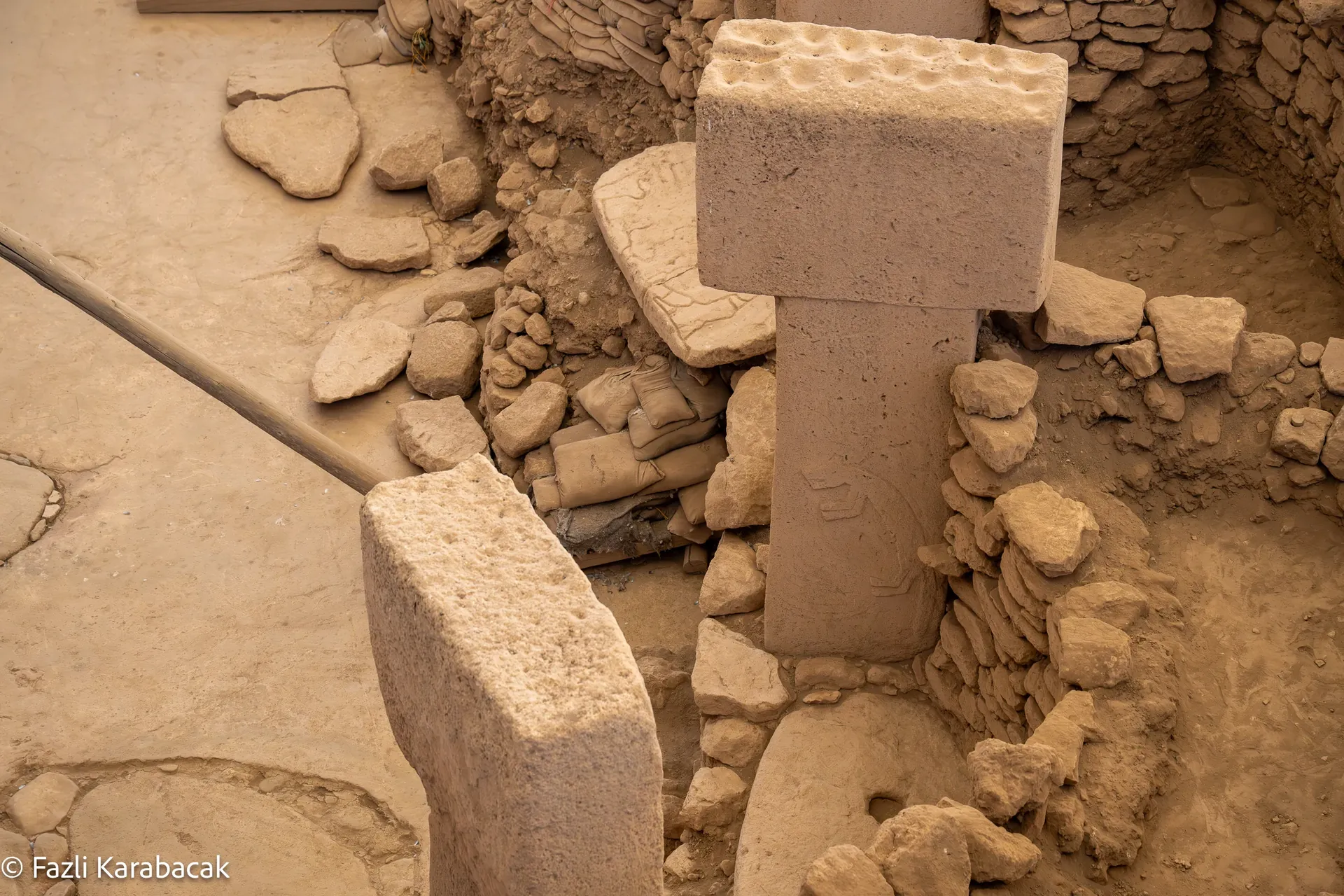
Left: The quarry site with an unfinished pillar still attached to bedrock. Right: Detail of carved arms and belt on a central pillar.
Göbekli Tepe vs. Karahantepe Pillars
The discovery of T-shaped pillars at Karahantepe — 35 kilometres to the southeast — confirmed that this architectural form was not unique to Göbekli Tepe but part of a regional tradition. However, the two sites show significant differences in how the pillar concept was executed:
| Feature | Göbekli Tepe | Karahantepe |
|---|---|---|
| Scale | Up to 5.5 m tall, 10 tonnes | Generally smaller, more varied sizes |
| Setting | Free-standing in circular enclosures | Often carved from bedrock in situ |
| Faces | Faceless T-cap heads | Some pillars have carved faces and heads |
| Animal carvings | Foxes, snakes, boar, vultures in relief | Snakes, phallus shapes, leopards; different emphasis |
| Unique element | Narrative scenes (e.g. Pillar 43) | Pillar shrine with carved head emerging from floor |
The differences suggest that while the communities shared a broad symbolic vocabulary and architectural tradition, each site had its own local expression — much as Gothic cathedrals across medieval Europe shared a structural logic but varied enormously in their details and decoration.
What Do the Pillars Mean?
The central question — who or what do these T-shaped figures represent? — has no definitive answer. Klaus Schmidt believed them to be depictions of supernatural beings or ancestors, presiding over the ritual activities conducted within the enclosures. He drew parallels with later Mesopotamian traditions of divine statues in temples.
Other scholars have proposed that the pillars represent specific individuals — perhaps important leaders or ritual specialists who were commemorated in stone after death. The animal carvings on the pillars might then represent the totemic animals associated with that individual or their clan.
A third possibility is that the pillars are not portraits of anyone, living or dead, but rather embody abstract concepts — forces of nature, cosmic principles, or social categories. Their deliberate facelessness may be the key: they are meant to be universal, not personal. They are the idea of the human, not any particular human.
Whatever interpretation proves closest to the truth, the T-shaped pillars remain extraordinary. Twelve thousand years ago, communities of hunter-gatherers invested enormous labour and creative energy to carve these stone beings, raise them upright, and surround them with walls, benches, and animal imagery. That effort speaks to something deep in the human story — the need to make the invisible visible, to give form to belief, and to gather in the presence of something larger than oneself.
Continue Exploring
Discover more of Göbekli Tepe's structures and symbols.