
A Stone That Speaks
Of the more than 200 pillars identified at Göbekli Tepe, none has captured the public and scholarly imagination like Pillar 43. Located in Enclosure D — the largest and best-preserved circular structure — this T-shaped monolith bears the most complex carved scene found anywhere at the site.
The pillar's broad face is covered in deeply carved reliefs: vultures with outstretched wings, a headless human figure, a scorpion, a disc (possibly representing the sun), and a collection of other animals and geometric symbols. No other pillar at Göbekli Tepe carries such a dense, apparently narrative composition.
It is this density — and the tantalising sense that the scene is telling a story — that has made Pillar 43 a lightning rod for theories about the meaning of Göbekli Tepe.
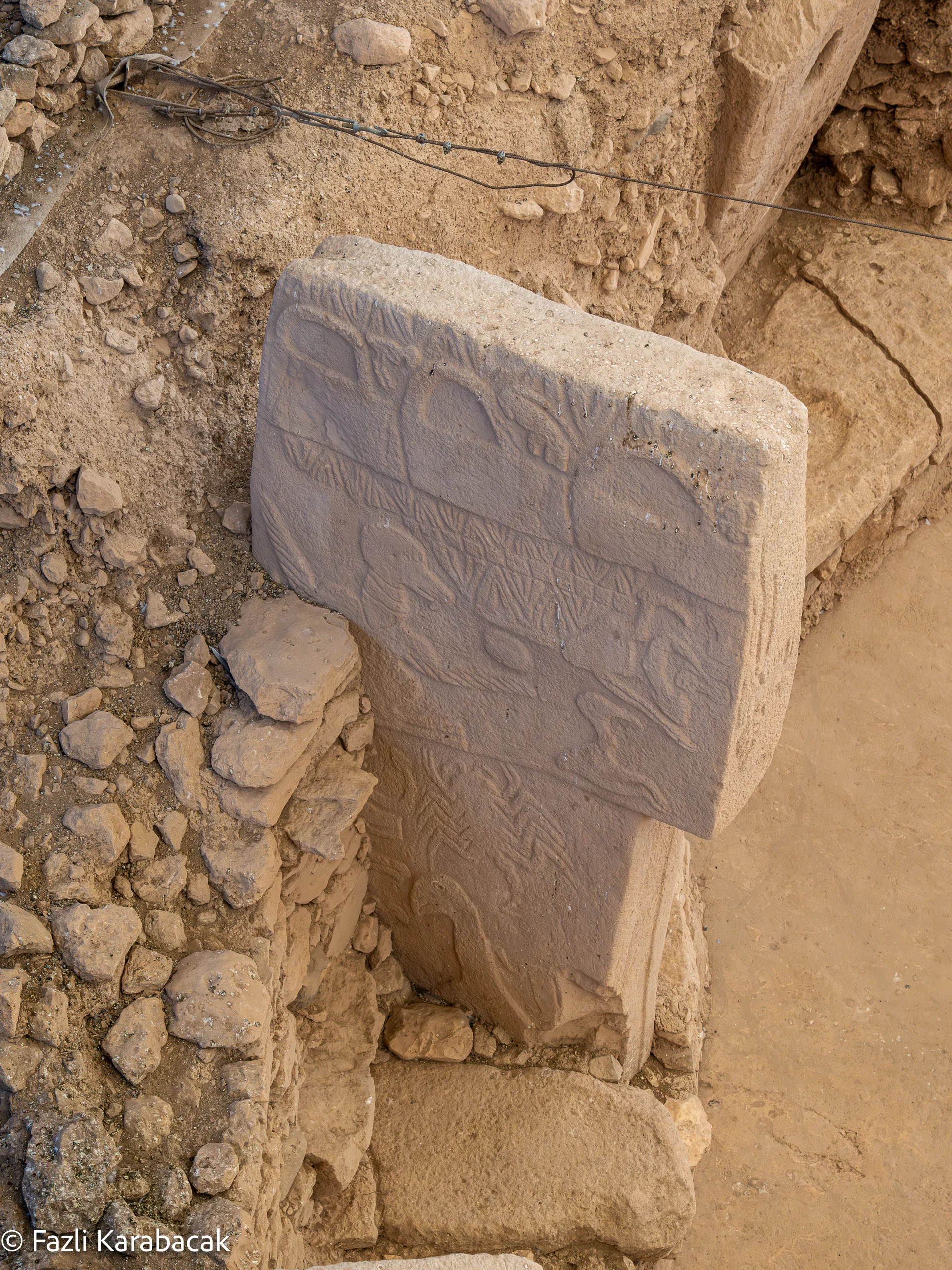
Pillar 43 in Enclosure D, showing the vulture scene in high relief.
Reading the Carvings
The reliefs on Pillar 43 are arranged across the full face of the pillar. From top to bottom, the scene includes:
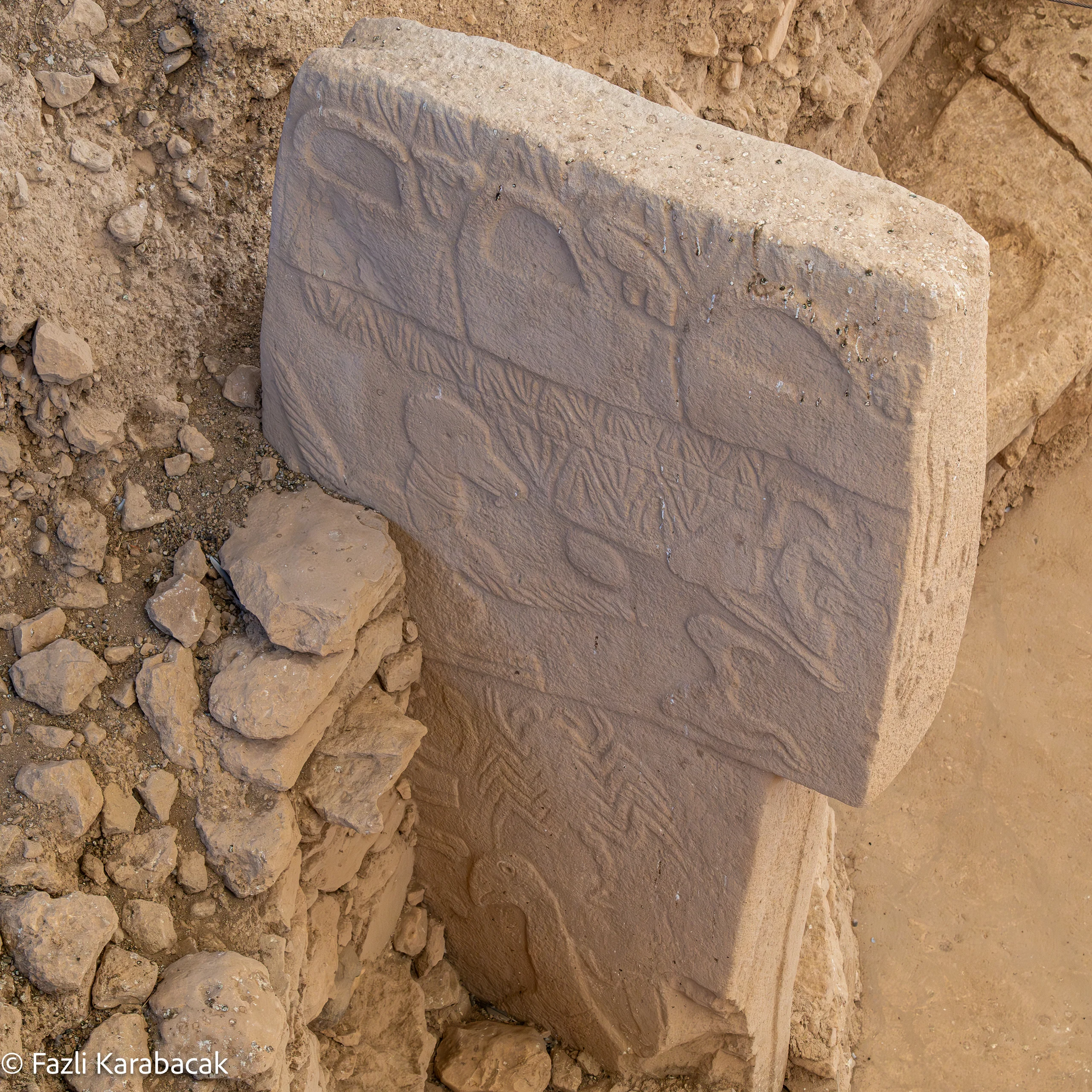
The reliefs on Pillar 43 arranged from top to bottom.
Vultures
Three large vultures dominate the composition. The central vulture, wings outstretched, appears to hold or carry a circular disc — often interpreted as the sun or a severed head. Vultures in many ancient Near Eastern cultures are associated with excarnation — the practice of exposing the dead so that birds strip the flesh from the bones.
The Headless Figure
Below the vultures, a small human figure is depicted without a head. This is consistent with evidence of skull cult practices found across Pre-Pottery Neolithic sites — including at Göbekli Tepe itself, where several skulls with carved modifications (drilled holes, incised lines, and ochre staining) have been recovered. The headless figure may represent a deceased individual undergoing excarnation rites.
The Scorpion
A large scorpion occupies the lower portion of the scene. It is one of the most clearly rendered motifs on the pillar. Scorpions appear on other pillars at Göbekli Tepe as well, suggesting they held particular symbolic weight in the builders' world — whether as creatures of danger, the underworld, or as markers of something else entirely.
Other Animals & Symbols
The scene also includes snakes, an ibis-like bird, and several smaller creatures. Abstract H-shaped and bag-like symbols appear at the top, along with the mysterious disc. The overall composition gives the impression of a carefully constructed tableau — not random decoration but a deliberate visual narrative.
The Comet Impact Hypothesis
In 2017, engineers Martin Sweatman and Dimitrios Tsikritsis of the University of Edinburgh published a provocative paper arguing that the animals on Pillar 43 represent constellations — and that the entire scene records a catastrophic comet impact that triggered the Younger Dryas cold period around 10,800 BCE.
Their analysis mapped the vulture to the constellation Sagittarius, the scorpion to Scorpius, and other animals to recognisable star patterns. The disc held by the central vulture, they argued, represents the sun at the summer solstice — pinpointing a specific date in the sky. Combined with the Younger Dryas impact hypothesis (which proposes that a cometary bombardment caused rapid global cooling), they suggested that Pillar 43 is effectively a date-stamp of a remembered catastrophe.
The paper, published in Mediterranean Archaeology and Archaeometry, attracted enormous media attention but also significant criticism from mainstream archaeologists. The hypothesis remains unproven and controversial — but it brought Pillar 43 to a global audience.
Alternative Interpretations
Most archaeologists working at Göbekli Tepe are cautious about the astronomical reading of Pillar 43. Several alternative interpretations have been proposed:
Funerary / Excarnation Scene
The most widely accepted archaeological interpretation is that the scene depicts death-related rituals. The headless figure, the vultures (agents of excarnation), and the disc (possibly a skull) together form a coherent image of mortuary practice. This interpretation is supported by the discovery of modified skulls at the site and by ethnographic parallels with sky-burial practices in Central Asia and Tibet.
Mythological Narrative
Some scholars see the scene as a mythological tableau — perhaps a creation story, a hero narrative, or a depiction of cosmological order. The arrangement of animals may represent different realms (sky, earth, underworld) in a pre-literate worldview. Without written records, any mythological reading remains speculative but is consistent with the symbolic complexity of the carvings.
Totemic or Clan Markers
Another possibility is that the animals represent totemic identities — different animal species associated with different social groups or clans. If various hunter-gatherer bands gathered at Göbekli Tepe for communal rituals, each group may have been identified by a specific animal, and the pillar might depict the groups present at a particular gathering or ceremony.
Why Pillar 43 Captivates
Pillar 43's hold on the imagination goes beyond its archaeological significance. In an era of smartphones and satellites, there is something deeply stirring about a carved stone that may encode a 12,000-year-old message we cannot yet fully read.
The pillar challenges our assumptions about "primitive" people. These were hunter-gatherers without writing, metals, or the wheel — and yet they created a symbolic composition of stunning complexity. Whether it records a cosmic event, a death ritual, or a myth we will never recover, it is proof that the human impulse to make meaning through art is as old as civilisation itself — and perhaps older.
That is why Pillar 43 appears in documentaries, textbooks, and news articles more than any other artefact from Göbekli Tepe. It is not just a stone with carvings. It is a message from the deep past — and we are still learning to listen.
Detail views of Pillar 43: the vulture with disc (left), the scorpion (centre), and the headless figure (right).
Continue Exploring
Discover more of Göbekli Tepe's structures and symbols.