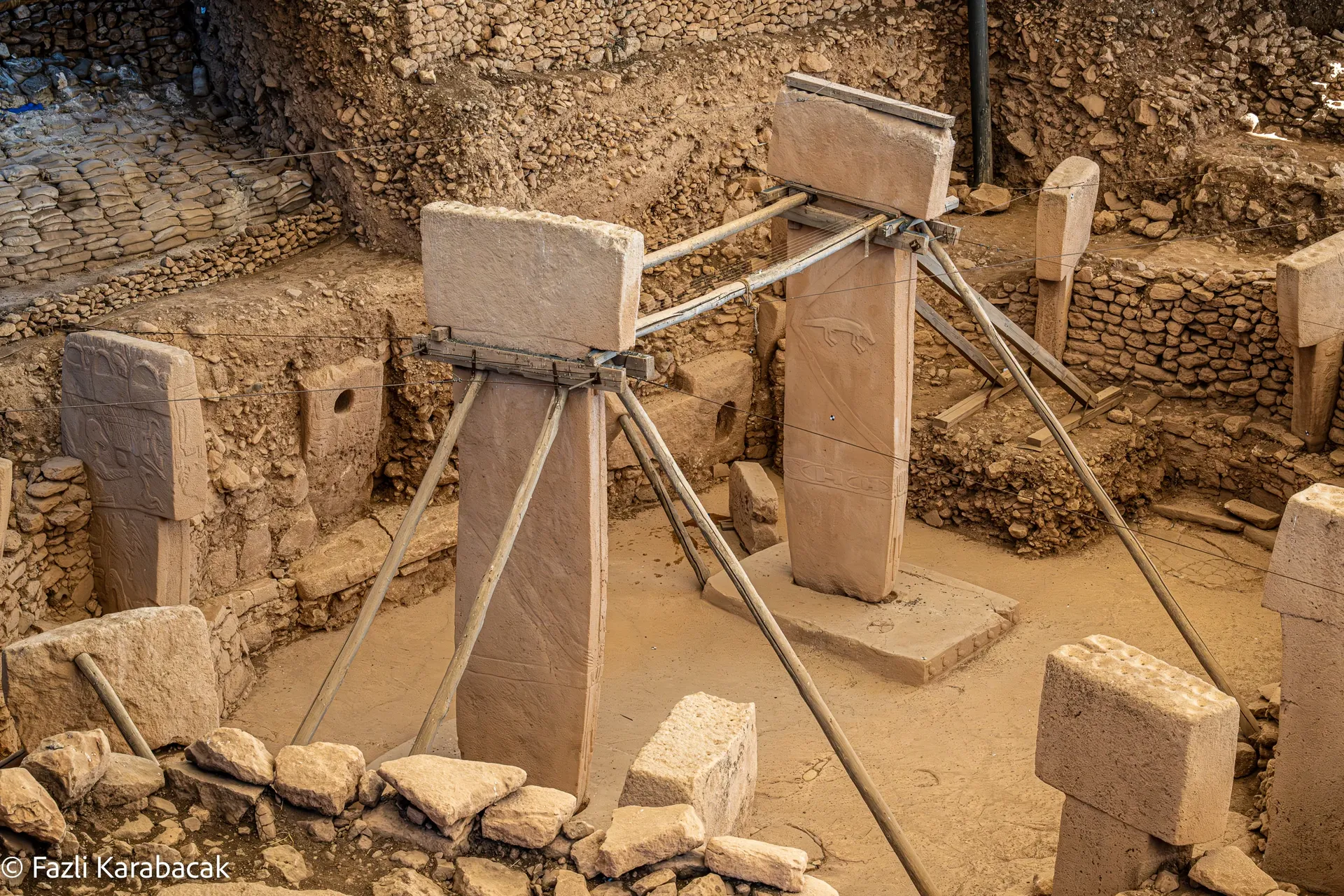
Enclosure
Enclosure D
The largest and best-preserved circular enclosure — twin central pillars over 5 metres tall, surrounded by a ring of carved monoliths depicting foxes, snakes, boar, and cranes.
Explore →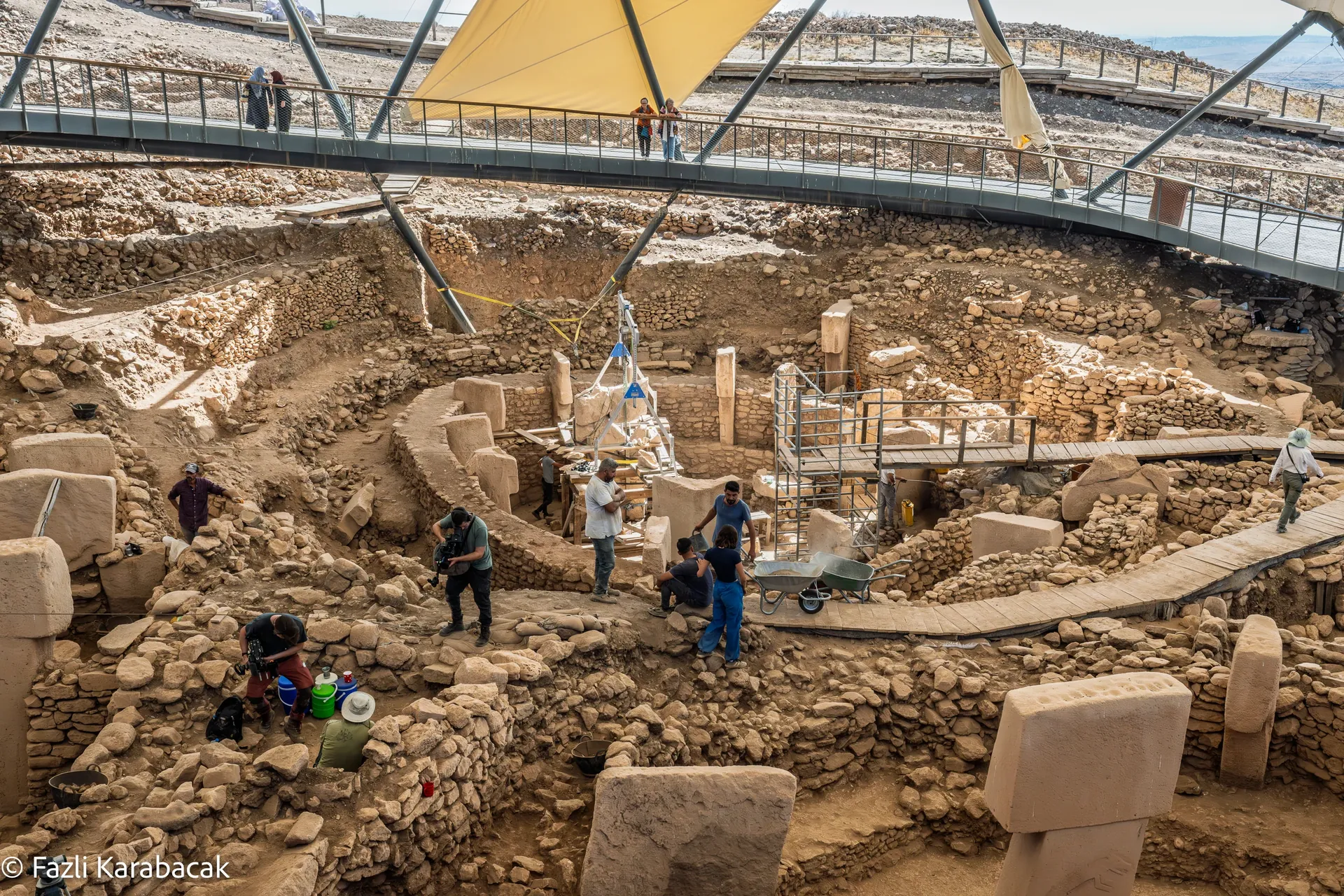
Göbekli Tepe's structures fall into two broad phases, distinguished by the German Archaeological Institute as Layer III (older) and Layer II (younger). Understanding this stratigraphy is essential to grasping the site's evolution.
Older Phase
The monumental phase. Large circular or oval enclosures up to 20 metres in diameter, with rings of T-shaped pillars surrounding a pair of taller central pillars. The pillars in this phase are the largest and most elaborately carved, bearing high-relief depictions of animals and abstract symbols. At least four major enclosures (A, B, C, D) have been excavated from this phase, with geophysical surveys suggesting many more remain buried.
Younger Phase
Smaller, rectangular rooms with smaller pillars — often set into walls rather than standing free in circles. The carvings become less elaborate, and the architectural ambition appears to diminish. Some archaeologists interpret this as a shift from communal ritual gatherings to more privatised or domestic ritual activity. The site was eventually deliberately buried during or after this phase.
The circular enclosures are designated by letters — Enclosure A, B, C, D, and so on — following the order of their discovery, not their age. Enclosure D, for example, was the fourth discovered but is among the oldest and largest.
Individual pillars are numbered sequentially within each enclosure. Pillar 43, the famous "Vulture Stone," is the 43rd pillar catalogued across the site and is located in Enclosure D. The twin central pillars of Enclosure D are designated Pillar 18 and Pillar 31.
To date, over 200 pillars have been identified through excavation and geophysical survey. The excavated enclosures represent only a small fraction of what lies beneath the artificial mound — the full scope of the site remains unknown.
Deep dives into three of the most celebrated and studied elements of Göbekli Tepe.
Enclosure
The largest and best-preserved circular enclosure — twin central pillars over 5 metres tall, surrounded by a ring of carved monoliths depicting foxes, snakes, boar, and cranes.
Explore →
Pillar
The most famous carved pillar in the Neolithic world — vultures, a headless figure, a scorpion, and symbols that some scholars believe encode an astronomical event.
Explore →
Architecture
Massive limestone monoliths with carved arms, hands, belts, and loincloths — anthropomorphic figures that define the visual language of Göbekli Tepe and the entire Taş Tepeler network.
Explore →