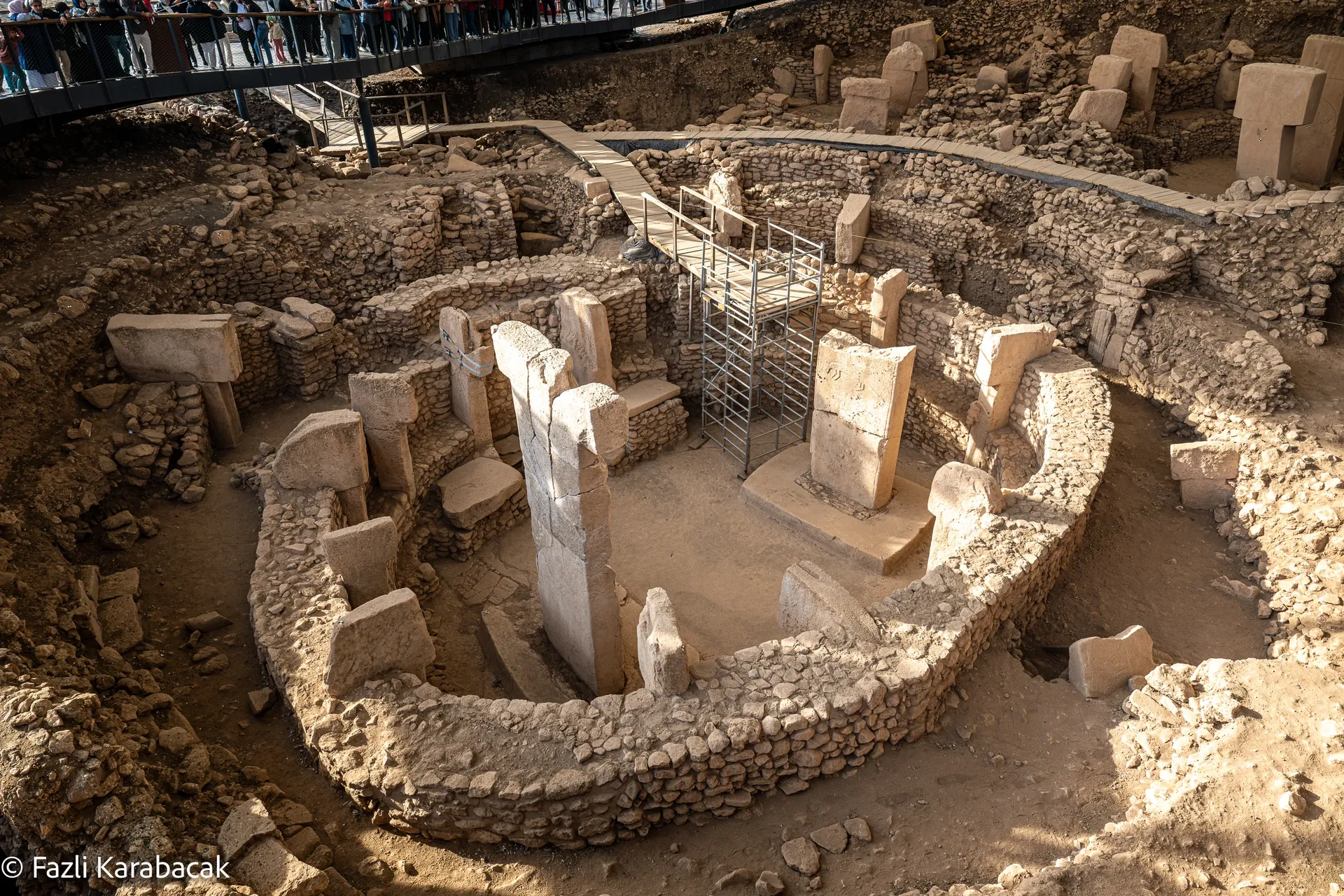
An Ancient Hilltop Sanctuary
Göbekli Tepe sits atop an artificial mound roughly 12 kilometres northeast of the city of Şanlıurfa in southeastern Turkey, at an elevation of about 760 metres. The name means "Potbelly Hill" in Turkish — a deceptively modest label for the most important archaeological discovery of the past half-century.
Beneath the surface of this unassuming ridge lies a complex of massive circular enclosures built with T-shaped limestone pillars — some standing over 5.5 metres tall and weighing up to 10 tonnes. These structures were raised not by settled farmers but by mobile hunter-gatherer communities during the Pre-Pottery Neolithic A period, around 9500 BCE.
To date, geophysical surveys have identified at least 20 such enclosures across the mound, though only a handful have been excavated. Less than 5% of the site has been unearthed. Whatever has been found is only a fraction of what remains buried.
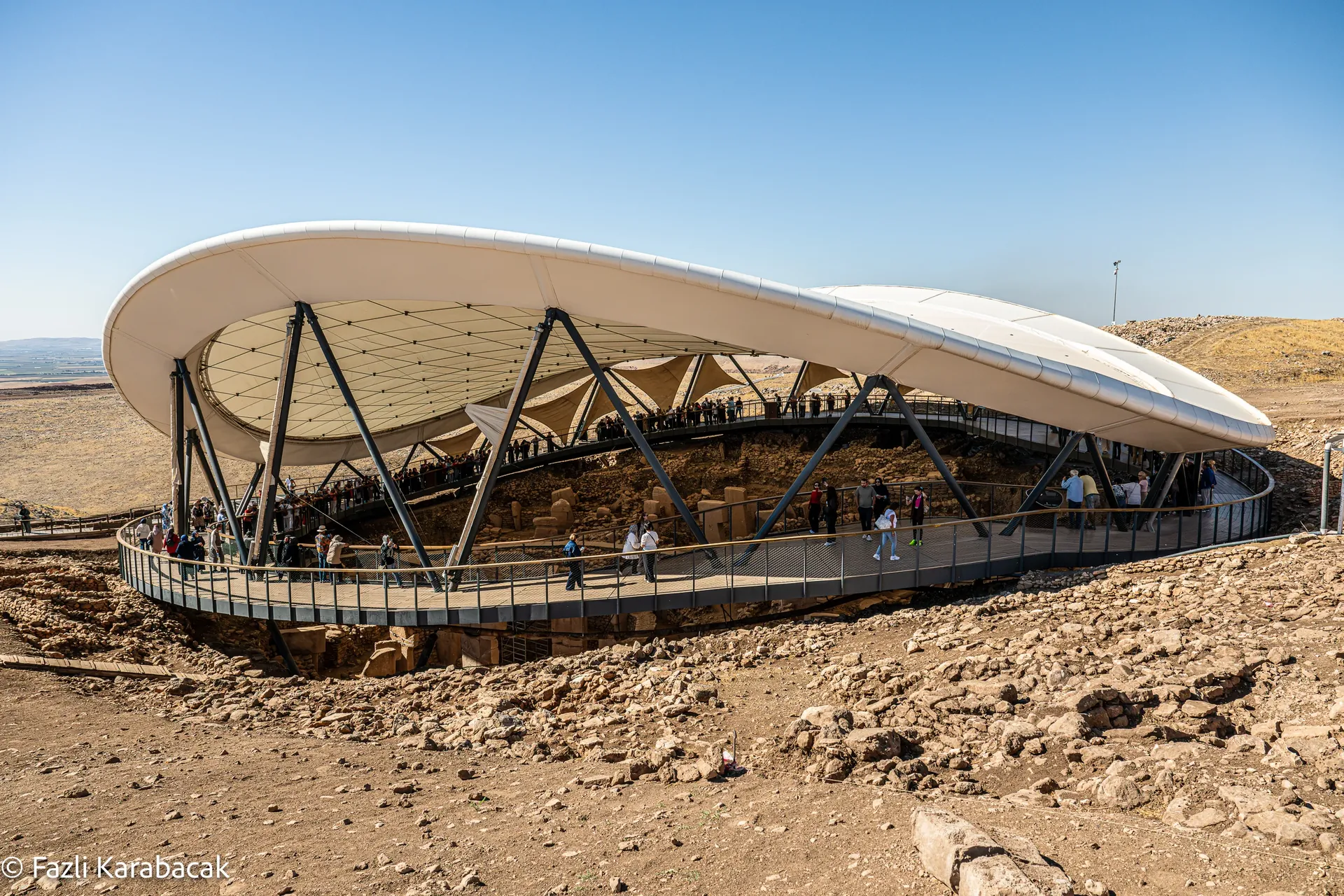
The hilltop mound of Göbekli Tepe, viewed from the southeast, with the modern shelter protecting Enclosures C and D.
Why Göbekli Tepe Changed Everything
For most of the 20th century, the accepted narrative of the Neolithic Revolution was simple: humans settled down, invented agriculture, built permanent villages, and only then — with surplus grain and stable communities — did they develop the social complexity needed to construct monumental buildings, organise religion, and create art.
Göbekli Tepe demolished that sequence. Here was monumental architecture, sophisticated symbolic art, and apparent ritual activity — all created by people who still hunted wild game and gathered wild plants. There was no evidence of permanent settlement at the site itself, no domesticated grains, no pottery.
The implication was revolutionary: the impulse to build sacred spaces may have come before agriculture, not after it. As Klaus Schmidt himself put it, "First came the temple, then the city." It was ritual, belief, and communal gathering that may have driven hunter-gatherers to settle in one place — eventually leading them to cultivate the wild grains that grew on the surrounding hillsides.
"First came the temple, then the city."
— Klaus Schmidt (1953–2014), excavation director
Klaus Schmidt's Discovery
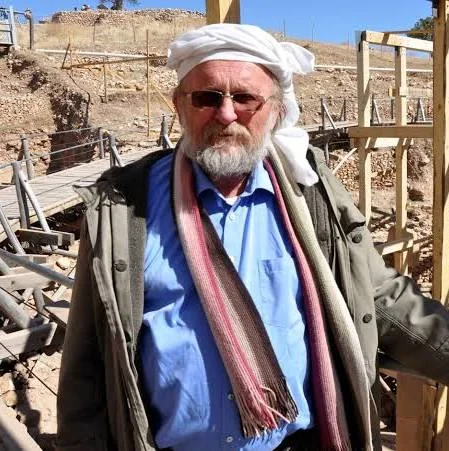
The hilltop was first noted in a 1963 survey by the Universities of Istanbul and Chicago. The survey team catalogued the mound as a possible medieval cemetery and moved on. For three decades, the world's oldest temple sat in plain sight, dismissed and forgotten.
That changed in 1994 when German archaeologist Klaus Schmidt, working for the German Archaeological Institute (DAI), visited the site. Schmidt immediately recognised the large limestone slabs protruding from the surface as T-shaped pillars — and understood their potential significance. He launched systematic excavations that same year.
What Schmidt unearthed over the next two decades would fundamentally alter our understanding of prehistory. He dedicated the rest of his life to the site, leading excavations until his sudden death in 2014. Today, the German Archaeological Institute continues the work under the direction of Lee Clare, with close collaboration from Turkish authorities and the Şanlıurfa Museum.
UNESCO World Heritage Site
In July 2018, the UNESCO World Heritage Committee inscribed Göbekli Tepe on the World Heritage List. The nomination dossier described it as "one of the first manifestations of human-made monumental architecture" and noted its "outstanding universal value" as evidence that complex social organisation predates settled life.
The inscription was a milestone not just for the site but for Turkey's southeastern heritage region. A modern visitor shelter now protects the main excavation area, and the Şanlıurfa Archaeology Museum — one of the largest in Turkey — houses many of the finds, including a full-scale replica of Enclosure D.
The Taş Tepeler Network
Göbekli Tepe is not alone. Since 2019, the Turkish Ministry of Culture and Tourism has coordinated the Taş Tepeler ("Stone Hills") research project, revealing a network of contemporary Neolithic sites scattered across the Şanlıurfa region. These include Karahantepe, Harbetsuvan Tepesi, Sayburç, Gürcütepe, and others.
Among them, Karahantepe — located just 35 kilometres southeast of Göbekli Tepe — has emerged as perhaps the most spectacular. Its carved pillar shrine, with a ring of phallus-shaped pillars surrounding a carved head emerging from the bedrock, is unlike anything else in the Neolithic world. Together, these sites suggest a far more complex and interconnected society than anyone had imagined for 10,000 BCE.
Walk Among the Pillars
Stand where hunter-gatherers raised the first monumental stones 12,000 years ago. Plan your visit or join a guided archaeology tour with Serendipity.