The Most Studied Stone in Prehistory
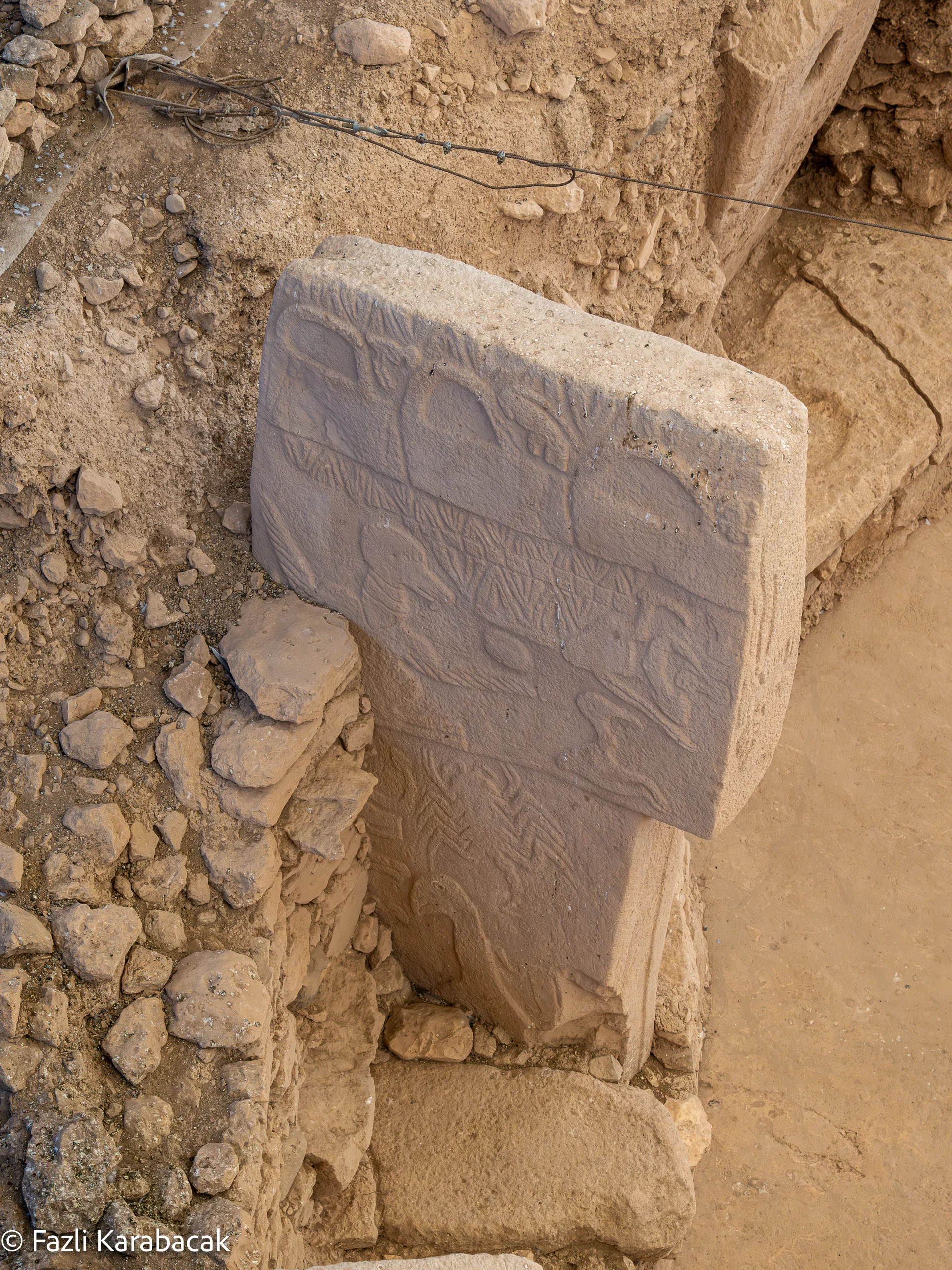
In Enclosure D of Göbekli Tepe — one of the oldest and most elaborately decorated structures on the site — stands a pillar that has generated more scholarly debate, more media headlines, and more imaginative speculation than perhaps any other carved stone in the ancient world. Known formally as Pillar 43 and popularly as the “Vulture Stone,” it is a limestone slab covered in a dense composition of animal reliefs and enigmatic symbols.
To stand before it is to confront a visual puzzle carved over 11,000 years ago by people who left no written language and no Rosetta Stone to help us. Yet the carvings are so specific, so carefully composed, that the overwhelming feeling is one of deliberate meaning — a message we cannot quite read.
What the Stone Shows
The pillar’s face is dominated by a large vulture, wings spread, with a round disc or sphere balanced on one wing. Below the vulture, a headless human figure appears — a body without a head, one of the most arresting images at the site. Surrounding these central figures is a menagerie of other animals carved in relief: a scorpion with its tail raised, a snake, a crane-like bird, and several smaller creatures that are harder to identify.
Across the top of the pillar runs a row of handbag-like shapes — rectangular containers with curved handles — that appear on carved stones at other sites around the world, from ancient Mesopotamia to Mesoamerica. Their meaning is unknown, but their recurring appearance across cultures and millennia makes them one of art history’s more persistent enigmas.
At the base of the pillar, a severed head rests on a surface — or so one common reading goes. The theme of decapitation appears elsewhere at Göbekli Tepe: skull fragments with cut marks have been found on site, and modified skulls are known from other Pre-Pottery Neolithic sites across the region, pointing to skull cult practices.
The Astronomical Hypothesis
In 2017, Martin Sweatman and Dimitrios Tsikritsis of the University of Edinburgh published a paper arguing that Pillar 43 is, in essence, an astronomical record. Using stellarium software, they mapped the animals on the pillar to constellations as they would have appeared in the sky around 10,950 BCE.
The vulture, they proposed, corresponds to the constellation Sagittarius. The scorpion maps to Scorpius. The disc held on the vulture’s wing represents the sun. If these identifications are correct, the carving records the position of the sun at the summer solstice — specifically during or shortly after the Younger Dryas event, a sudden return to glacial conditions around 10,800 BCE that lasted over a thousand years and caused widespread ecological disruption.
Sweatman and Tsikritsis suggested the pillar might commemorate a cosmic impact event — possibly a comet strike — that triggered the Younger Dryas. The headless man, in this reading, could symbolise catastrophe and mass death.
Alternative Readings
The astronomical interpretation is striking but far from universally accepted. Critics point out that mapping animal carvings to constellations involves a high degree of subjective judgment. We do not know whether the builders of Göbekli Tepe identified constellations at all, let alone whether they used the same groupings that later cultures would develop.
Other scholars prefer to read the pillar in the context of Neolithic belief systems. The vulture carrying the disc may relate to funerary practices — in many ancient Near Eastern cultures, vultures were associated with excarnation, the ritual exposure of the dead so that birds could strip the flesh from bones. The disc could represent the soul being carried skyward. The headless figure reinforces this mortuary reading: death, transformation, and the passage from the physical to the spiritual.
A third perspective focuses on shamanic imagery. The dense composition of animals, the ecstatic posture of certain figures, and the overall visual intensity of the carvings recall what anthropologists have identified as “therianthropic” art — imagery produced in or inspired by altered states of consciousness, where human and animal worlds merge.
Why It Captivates
Pillar 43 captivates because it sits at the intersection of art, religion, astronomy, and the deep human desire to find meaning in catastrophe. Each interpretation reveals as much about the interpreter as about the stone. Astronomers see star maps. Mortuary archaeologists see death rites. Mythologists see cosmic narratives.
What we can say with certainty is that the stone was carved with extraordinary skill and intention. The composition is not random. The figures relate to one another in ways that were clearly meaningful to their creators. Whether that meaning was calendrical, ritual, narrative, or something else entirely, we may never know for sure.
But that uncertainty is precisely what makes Pillar 43 — and Göbekli Tepe as a whole — so endlessly compelling. It is a window into a mind we can glimpse but never fully enter, a reminder that human symbolic thinking runs far deeper than we once supposed.