Quick Answer
No credible archaeological evidence supports the claim that Göbekli Tepe was built by a lost advanced civilisation such as Atlantis. The site’s monumental architecture was created by organised hunter-gatherer communities using locally quarried limestone and techniques consistent with the Pre-Pottery Neolithic toolkit. The “lost civilisation” narrative, popularised by authors such as Graham Hancock, misrepresents the archaeological record and, ironically, diminishes the genuine achievement of the people who actually built the site.
At a Glance
- The claim: Göbekli Tepe required an advanced pre-Ice Age civilisation (Atlantis / Hancock’s “lost” culture)
- Archaeological consensus: no evidence whatsoever — this is categorised as pseudoarchaeology
- Construction materials: local limestone, quarried on the ridge itself (unfinished pillars still visible)
- Tools used: flint picks, stone hammers, abrasive sand — all attested in excavated assemblages
- Cultural context: 12+ sites in the Taş Tepeler network show a regional tradition, not a one-off anomaly
- Key critique: Banning 2023 (Open Archaeology) — Atlantis/lost-civilisation claims are pseudoscientific
- Why the real story is better: hunter-gatherer communities independently invented monumental architecture — driven by belief, not imported technology
In my twenty-five years of guiding at Göbekli Tepe, no question comes up more often than this one: “Was this built by a lost civilisation?” Sometimes it is phrased as “Could this be connected to Atlantis?” or “Did an advanced civilisation teach these people how to build?” The question comes from intelligent, curious visitors who have read popular books or watched documentaries that present Göbekli Tepe as evidence for a sophisticated predecessor culture wiped out by catastrophe.
I understand the appeal of these ideas. Göbekli Tepe is genuinely astonishing — monumental architecture built before agriculture, before pottery, before metal, before writing. The emotional logic runs: how could “primitive” hunter-gatherers possibly have done this? There must be a missing piece, a hidden civilisation, a lost chapter of human history.
But the archaeological evidence tells a different — and far more interesting — story. Göbekli Tepe was not built by outsiders, by survivors of a drowned civilisation, or by anyone other than the hunter-gatherer communities of the Şanlıurfa uplands. And understanding why they could do it, without any help from Atlantis, is more remarkable than any lost civilisation narrative.
The Claim
The most influential proponent of the lost civilisation theory in relation to Göbekli Tepe is the British journalist Graham Hancock, whose books and Netflix series have brought the idea to millions. The argument, in simplified form, runs as follows: a technologically advanced civilisation existed before the end of the last Ice Age, was destroyed by the Younger Dryas catastrophe (approximately 12,800 years ago), and survivors dispersed across the globe, carrying knowledge to “primitive” peoples who could not otherwise have produced monumental architecture. Göbekli Tepe, in this narrative, is evidence of transferred knowledge from this lost civilisation.
Other versions connect Göbekli Tepe to Atlantis directly — identifying Plato’s sunken continent with a real civilisation that supposedly built or inspired the site. Some link Göbekli Tepe to extraterrestrial intervention, though this is a more fringe position that even most alternative history enthusiasts reject.
What the Archaeology Actually Shows
The archaeological record at Göbekli Tepe is extensive, well-documented, and unambiguous on several critical points.
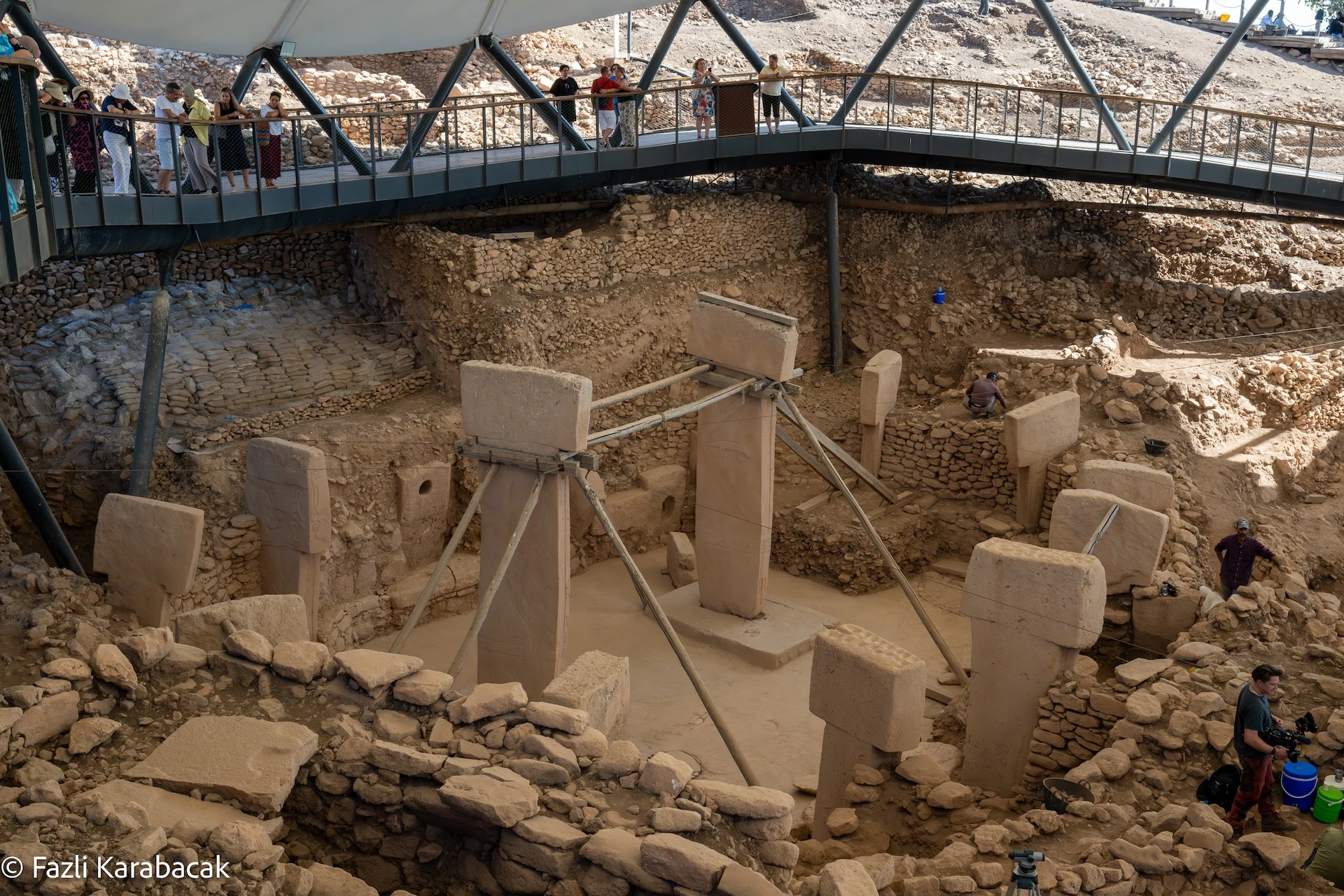
The construction technology is entirely local. The T-shaped pillars were quarried from limestone bedrock on the ridge itself and from outcrops within a few hundred metres of the enclosures. Unfinished pillars still attached to the bedrock have been found in the quarry areas, showing the extraction process in mid-execution. The tools used — large flint picks, stone hammers, and abrasive sand — are found in abundance at the site and are consistent with the Pre-Pottery Neolithic toolkit found across the region. There is no trace of metal tools, no evidence of technologies beyond what the archaeological record documents for this period, and no anomalous materials. For the engineering detail, see how Göbekli Tepe was built.
As Edward Banning noted in his thorough 2023 critique of sensationalised claims about Göbekli Tepe (Open Archaeology), the construction methods are entirely explicable within the capabilities of organised Neolithic communities. The pillars are impressive but not impossibly large — the biggest weigh an estimated ten to fifteen tonnes, comparable to stones moved by documented pre-industrial societies around the world without any advanced technology.
The cultural context is well established. Göbekli Tepe does not appear in isolation. It sits within a network of contemporary or near-contemporary sites — Karahan Tepe, Harbetsuwan Tepe, Sayburç, Gürcütepe, and others — collectively known as the Taş Tepeler. These sites share architectural features (T-shaped pillars, circular enclosures), symbolic motifs (anthropomorphic pillars, animal carvings), and material culture (flint tools, stone vessels, bone implements). The network demonstrates a regional tradition of monumental building, not a sudden, unexplained technological leap.
Necmi Karul’s ongoing Taş Tepeler programme has now documented over a dozen related sites across the Şanlıurfa uplands, confirming that Göbekli Tepe was part of a flourishing cultural landscape, not an anomaly dropped into an otherwise “primitive” world.
The site shows clear developmental phases. Göbekli Tepe was not built in a single burst of activity. Excavations by Klaus Schmidt and subsequently by the German Archaeological Institute and Turkish teams have documented multiple construction phases spanning roughly two thousand years. The earlier Layer III enclosures (with the largest pillars and most elaborate carvings) were succeeded by smaller Layer II structures, suggesting a gradual shift in building practices rather than a single moment of “advanced” intervention.
There is no evidence of an external or superior culture. The artefact assemblage at Göbekli Tepe — the flint tools, the stone vessels, the bone implements, the obsidian fragments — is entirely consistent with Pre-Pottery Neolithic A and B material culture found across the Fertile Crescent. Obsidian sourcing studies show that the site’s inhabitants obtained volcanic glass from known sources in central and eastern Anatolia, using the same trade networks documented at other contemporary sites. There is nothing in the material culture that requires explanation by a “superior” civilisation.
Why the Lost Civilisation Narrative Persists
If the evidence is so clear, why does the Atlantis connection remain popular? In my experience, three factors are at work.
A failure of imagination about hunter-gatherers. Modern people — including many educated, well-travelled visitors — carry an unconscious assumption that hunter-gatherers were small, scattered, intellectually limited groups incapable of large-scale cooperation. This assumption is wrong. Ethnographic and archaeological research has documented complex social organisation, long-distance trade, ceremonial architecture, and sophisticated resource management among hunter-gatherer societies worldwide. The builders of Göbekli Tepe were not anomalous — they were the culmination of tens of thousands of years of cultural development by behaviourally modern humans.
The appeal of mystery. Göbekli Tepe’s genuine unknowns — why was it built, what ceremonies took place there, why was it deliberately buried — create a space that popular writers exploit by inserting dramatic narratives. The archaeological reality — that we are slowly, carefully reconstructing a picture from fragmentary evidence — is less exciting than the claim that everything can be explained by a single, dramatic hypothesis.
Effective storytelling. Writers like Hancock are skilled communicators who present their arguments persuasively, often by selectively quoting archaeological sources and omitting contradicting evidence. The resulting narrative is emotionally compelling even when scientifically unfounded. Jacques Cauvin, whose work on the symbolic origins of the Neolithic revolution remains foundational, argued convincingly that monumental building arose from a revolution in human symbolic thought — not from external technological transfer. The capacity for large-scale cooperative construction was an internal development, driven by belief and social organisation, not imported knowledge.
On the ground: On our Göbekli Tepe and Karahan Tepe day tour, I always walk visitors past the unfinished pillar still attached to the bedrock. It is the single best counter-argument to the Atlantis narrative. You can see the tool marks. You can see the quarry. You can see the work stopping mid-stroke. This site wasn’t gifted from the sea — it was carved out of this hill, by people using the stones they found here.
The Deeper Problem with the Atlantis Theory
Beyond the factual objections, the lost civilisation narrative carries an intellectual problem that I feel strongly about as someone who has spent decades in this landscape.
The theory takes one of the most extraordinary achievements in human history — the independent invention of monumental architecture by hunter-gatherer communities in southeastern Turkey — and credits it to someone else. It says, in effect, that the ancestors of the people who live in this region today could not have done what the archaeological record proves they did.
This is not just scientifically wrong. It is disrespectful. The builders of Göbekli Tepe used flint tools and their own muscles. They had no metal, no wheels, no draft animals. And yet they organised labour forces large enough to quarry, transport, and erect pillars weighing up to fifteen tonnes, then carved them with images of extraordinary beauty and complexity. They did this because they had a vision — a belief in the importance of communal ritual space — powerful enough to drive a construction programme spanning centuries.
That achievement deserves to be recognised for what it is: proof that human creativity, social organisation, and spiritual conviction can produce monumentality without any of the technological prerequisites we assume are necessary. Taking that achievement away from its actual creators and attributing it to a fictional lost civilisation is a failure not just of evidence but of respect.
What to Tell Fellow Visitors
When someone in my tour group raises the Atlantis question, I do not dismiss them. The question comes from genuine curiosity and often from genuine reading. I explain that the lost civilisation theory is not supported by any archaeological evidence from the site, and I walk them through the local quarries, the flint tools, the developmental phases, and the regional network of contemporary sites.
Then I tell them something more important: the real story is better than the alternative. A lost civilisation from Atlantis would be interesting. But hunter-gatherer communities independently inventing monumental architecture twelve thousand years ago, driven purely by belief and social cohesion, with nothing but stone tools and human determination — that is not just interesting. That is one of the most profound stories about human nature ever uncovered.
When you stand before those pillars, you are not looking at the remnants of a destroyed civilisation. You are looking at the beginning of one. Ours.
Key Takeaways
- No credible archaeological evidence links Göbekli Tepe to Atlantis, a lost advanced civilisation, or extraterrestrial intervention.
- The site’s construction technology — local limestone, flint tools, stone hammers — is entirely consistent with the Pre-Pottery Neolithic toolkit.
- Göbekli Tepe is part of a regional network of monumental sites (the Taş Tepeler), not an isolated anomaly requiring extraordinary explanation.
- The lost civilisation narrative persists due to misconceptions about hunter-gatherer capabilities, the appeal of mystery, and effective popular storytelling.
- Attributing Göbekli Tepe to a fictional civilisation diminishes the genuine and extraordinary achievement of its actual builders.
Planning Your Visit
If you want to see the actual evidence — the quarry, the unfinished pillar, the flint tools at the Şanlıurfa Museum, the regional network at Karahan Tepe — our Göbekli Tepe and Karahan Tepe guided day tour walks through all of it in a single day. By the end, the Atlantis narrative tends to dissolve on its own.
Your Next Read
Suggested path: Göbekli Tepe and the Garden of Eden → Why Was Göbekli Tepe Buried? → How Was Göbekli Tepe Built? → The Taş Tepeler Network.
Frequently Asked Questions
Was Göbekli Tepe built by a lost civilisation? No. All archaeological evidence indicates Göbekli Tepe was built by local Pre-Pottery Neolithic hunter-gatherer communities using locally available materials and tools. There is no evidence of external technological transfer or an unknown advanced culture.
What does Graham Hancock claim about Göbekli Tepe? Hancock argues that Göbekli Tepe’s monumental architecture could not have been produced by hunter-gatherers alone and therefore reflects knowledge transmitted by survivors of an advanced civilisation destroyed by the Younger Dryas event. Professional archaeologists do not support this claim, as the site’s construction methods and cultural context are fully consistent with Pre-Pottery Neolithic capabilities.
Could hunter-gatherers really build something this large? Yes. Ethnographic and archaeological evidence from around the world documents complex social organisation, long-distance trade, and monumental construction by hunter-gatherer societies. The stones at Göbekli Tepe, while impressive, are comparable in weight to stones moved by pre-industrial communities without advanced technology.
Is there any connection between Göbekli Tepe and Atlantis? No. Atlantis is a philosophical allegory created by Plato in the fourth century BCE. There is no archaeological, geological, or historical evidence for a sunken continent or advanced pre-Ice Age civilisation. Göbekli Tepe’s builders are well documented within the Pre-Pottery Neolithic archaeological record.
Did the Younger Dryas destroy an advanced civilisation? There is no evidence that any advanced civilisation existed before or during the Younger Dryas. The Younger Dryas was a real climate event that shaped the world Göbekli Tepe’s builders inherited, but it did not destroy a sophisticated predecessor culture — no such culture has ever been documented archaeologically.
Why do so many people believe the lost civilisation theory? It is an emotionally compelling story presented by skilled communicators. It exploits genuine gaps in our knowledge of the deep past and misrepresents the capabilities of hunter-gatherer societies. Once you see the local quarry at Göbekli Tepe, the Taş Tepeler network, and the developmental phases of the site, the need for an external explanation disappears.
Fazlı Karabacak is a licensed Turkish tour guide with over 25 years of experience and the founder of Serendipity Turkey. He specialises in archaeological and cultural tours across Turkey, with particular expertise in Göbekli Tepe and the Pre-Pottery Neolithic sites of southeastern Anatolia.