Quick Answer
The Epic of Gilgamesh — composed in its standard form around 1200 BCE but rooted in Sumerian traditions from the third millennium BCE — contains thematic echoes of the world Göbekli Tepe’s builders knew. Enkidu’s transformation from wild man to civilised being mirrors the Neolithic transition from hunter-gatherer to farmer. The Flood narrative recalls real climate catastrophes. And the epic’s central concern — the tension between wildness and civilisation, mortality and meaning — addresses the same existential questions the monumental builders of Göbekli Tepe confronted eight thousand years earlier. There is no direct historical link. The resonance is thematic — and, I think, real.
At a Glance
- Standard epic: Akkadian, 12 tablets, c. 1200 BCE (Sîn-lēqi-unninni)
- Sumerian roots: earlier cycles, c. 2100 BCE
- Gap from Göbekli Tepe: ~6,000 years — no direct transmission possible
- Key parallels: Enkidu’s wild-to-civilised transformation; the Flood and the Younger Dryas; the Cedar Forest and ecological loss; mortality and monumental building
- What’s not claimed: the epic is about Göbekli Tepe, or preserves specific Neolithic memories
- What is claimed: the epic and the site ask the same deep questions, because they sit on the same long arc of human experience
The oldest great story in the world begins with a man who built a wall.
Gilgamesh, king of Uruk, two-thirds divine and one-third mortal, built the great wall of his city from oven-fired brick. The epic that bears his name — composed in its standard twelve-tablet Akkadian version around 1200 BCE by a Babylonian priest named Sîn-lēqi-unninni — is humanity’s first masterpiece of literature. Recited for three millennia before being lost and then rediscovered in the ruins of Nineveh in 1853, the Epic of Gilgamesh speaks to every generation because it addresses the most fundamental questions of human existence: what does it mean to be mortal? What endures after death? And what is the relationship between the wild world we came from and the civilised world we built?
When I guide visitors through Göbekli Tepe and then bring them to the Şanlıurfa Museum to see the region’s extraordinary archaeological collections, I often find myself drawing connections between the carved pillars of the tenth millennium BCE and the cuneiform tablets of the second millennium BCE. These connections are not historical in the conventional sense — no chain of direct transmission links Göbekli Tepe to the scribal schools of Babylon. But thematically, the resonances are profound. The Epic of Gilgamesh is, in many ways, a literary meditation on the very transformation that Göbekli Tepe witnessed at its source.
Enkidu: The Wild Man and the Neolithic Threshold
The most striking parallel between Gilgamesh and the world of Göbekli Tepe lies in the figure of Enkidu. Created by the goddess Aruru from clay thrown into the wilderness, Enkidu is the primordial wild man — he runs with gazelles, drinks at waterholes with animals, and knows neither bread nor beer. His body is covered in hair. He has no homeland. He is, in the epic’s own terms, man-as-he-was-in-the-beginning.
Then Enkidu is civilised. Through his encounter with the temple courtesan Shamhat, he gains knowledge and self-consciousness. The wild animals flee from him — they no longer recognise him as one of their own. Shamhat teaches him to eat bread and drink ale. He washes, puts on clothing, and becomes, in the text’s words, a man. He travels to Uruk, the great city, and enters civilisation.
What the epic describes in narrative form — the passage from wild to civilised, from animal companion to city-dweller — is precisely the transition that archaeology documents in the Pre-Pottery Neolithic. The communities that built Göbekli Tepe were among the last great hunter-gatherer societies and among the first to take steps toward the settled, food-producing life that would eventually produce Uruk itself. They stood at exactly the threshold Enkidu crosses.
When I explain this to visitors at Göbekli Tepe, I am careful to note that I am not claiming the Enkidu story is “about” Göbekli Tepe. The epic was composed thousands of years later, in a very different cultural context. But the transformation it narrates — from gathering to farming, from wilderness to city, from a world shared with animals to a world dominated by humans — is the same transformation whose earliest monumental expression stands on this limestone ridge.
The Animals That Fled
There is a detail in the Enkidu narrative that always stops me. When Enkidu is transformed by his encounter with civilisation, the text says the wild animals scatter from him. He tries to run after them, but his knees fail. He is no longer fast enough, no longer wild enough, no longer one of them.
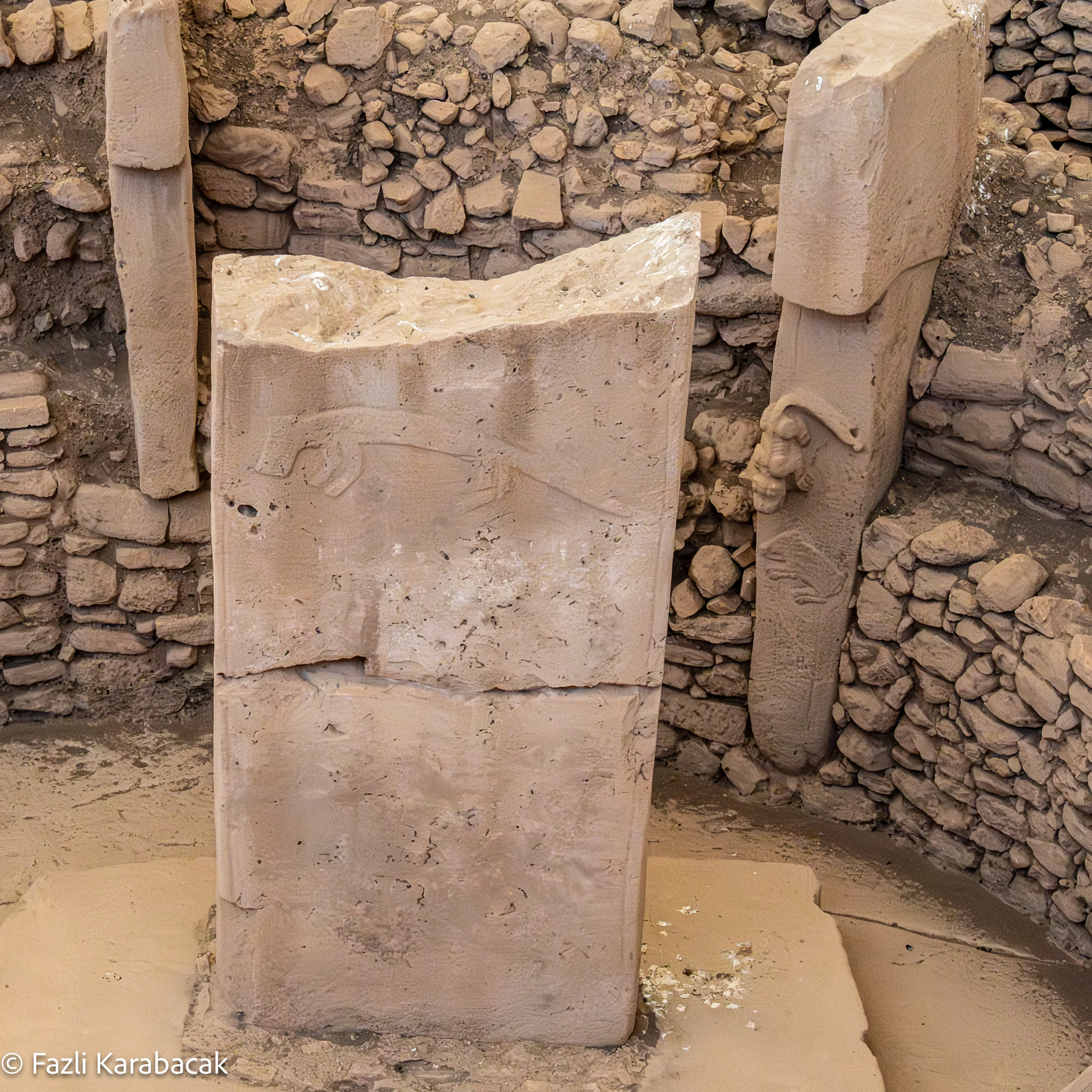
At Göbekli Tepe, the pillars are covered with animals — foxes, snakes, boars, aurochs, cranes, vultures, leopards. These are not domesticated animals. They are the wild fauna of the late Pleistocene and early Holocene, depicted with a vividness and naturalistic attention that speaks of intimate knowledge. The people who carved these reliefs knew these animals not as subjects but as partners in a shared landscape.
Within a few thousand years of Göbekli Tepe’s construction, most of these animals would be marginalised. The aurochs would be domesticated into cattle. The wild boar into pigs. The leopard and the vulture would retreat to ever-smaller patches of wilderness as farming communities cleared and ploughed the land. The world the pillars celebrate — a world of wild abundance and human-animal reciprocity — was already disappearing as the site was being built.
The Epic of Gilgamesh, written millennia later, remembers this loss. Enkidu’s separation from the animals is not presented as triumph but as tragedy — a necessary transformation that costs something irreplaceable. The tension between wildness and civilisation, between the world of the hunt and the world of the city, runs through the entire epic like a deep wound.
On the ground: On our Göbekli Tepe and Karahan Tepe day tour, I often read a short passage from the Enkidu episode aloud in front of one of the animal-dense pillars. Visitors tend to go quiet. It is one thing to know that the wild world was lost. It is another to stand next to its portrait, carved in limestone, while hearing the later culture mourn it.
The Flood: Shared Memory or Shared Experience?
Tablet XI of the Gilgamesh epic contains the most famous flood narrative in ancient literature. Utnapishtim, the Babylonian Noah, tells Gilgamesh how the gods decided to destroy humanity with a flood, how Ea warned him to build a boat, and how he survived with his family and animals while the rest of the world perished. After the waters receded, the gods granted Utnapishtim immortality.
As I discuss in my piece on the flood legend, this narrative draws on older Mesopotamian traditions — the Sumerian story of Ziusudra and the Akkadian Atrahasis epic — and may preserve distant memories of real catastrophic events, whether the Younger Dryas climate collapse, post-glacial meltwater pulses, or the possible Black Sea inundation around 5600 BCE.
The Sumerian King List, one of the oldest historical documents, divides all of human history into two eras: before the Flood and after. Before the Flood, kings ruled for impossibly long periods in mythic cities. After the Flood, history as we know it begins. This cosmological boundary — between a lost primordial age and the present age of civilisation — resonates with what we know about the real boundary of the Younger Dryas, when the world Göbekli Tepe’s ancestors knew was destroyed by cold and drought, and a new world — the world of farming, of permanent settlement, of temple-building — emerged from the ruins.
I do not claim that Utnapishtim’s flood “is” the Younger Dryas. The distances of time and culture are too great for such equations. But I do believe that the Gilgamesh epic, like all great literature, draws on deep strata of human experience — and that the experience of catastrophe and renewal that shaped the Pre-Pottery Neolithic is part of that stratum.
The Cedar Forest: Sacred Landscapes Lost
Another element of the Gilgamesh epic that echoes the Neolithic world is the journey to the Cedar Forest. Gilgamesh and Enkidu travel to a sacred grove guarded by the monstrous Humbaba, defeat the guardian, and fell the great cedars to bring back to Uruk. This act of environmental conquest — clearing sacred wilderness to build civilisation — was so shocking that even the gods were divided over whether to punish it.
The Cedar Forest episode has generally been interpreted as a literary reflection of Mesopotamian timber expeditions to the forests of Lebanon and the Amanus mountains — both of which lie in the broader region surrounding Göbekli Tepe. But the deeper theme — the destruction of a sacred natural landscape to serve the needs of civilisation — mirrors the actual environmental history of the Fertile Crescent. The forests and parklands that sustained the hunter-gatherer communities of the Pre-Pottery Neolithic were progressively cleared as agriculture expanded. By the time the Gilgamesh epic was composed, the deforestation of the Near East was already well advanced.
What the epic presents as a heroic but morally ambiguous adventure may encode a cultural memory of ecological transformation — the same transformation that began in the world of Göbekli Tepe.
Mortality and Meaning at the World’s Oldest Site
At its heart, the Epic of Gilgamesh is about mortality. Gilgamesh, devastated by Enkidu’s death, travels to the ends of the earth seeking immortality — and fails. He returns to Uruk with nothing but the knowledge that his wall, his city, his works will outlast him. The epic’s final lines circle back to its opening: look at the wall of Uruk, inspect its foundation, admire its brickwork. This is what endures.
Standing among the carved pillars of Göbekli Tepe, I sometimes think the builders were asking the same question twelve thousand years ago. Why build something this massive, this labour-intensive, if you are a mobile hunting community without permanent settlements? Why drag ten-tonne limestone blocks across a ridge and carve them with images of the animals and spirits of your world?
Perhaps because, like Gilgamesh, they understood that individual lives end but works of communal creation endure. The pillars of Göbekli Tepe have outlasted not just their builders but the entire civilisation that followed them. They have outlasted Sumer, Babylon, Assyria, Rome. They stand here still, speaking a language we are only beginning to learn.
The Epic of Gilgamesh ends with a hero who cannot defeat death but chooses to build something lasting. Göbekli Tepe may be the oldest expression of that same impulse — the human determination to leave a mark on the world that survives us. In that sense, the echoes between the epic and the site are not accidental. They arise from the same deep source: the awareness that we are mortal, and the refusal to accept that mortality is the final word.
Key Takeaways
- The Epic of Gilgamesh (standard version c. 1200 BCE, Sumerian roots c. 2100 BCE) contains thematic parallels with the world of Göbekli Tepe, though no direct historical link exists.
- Enkidu’s transformation from wild man to civilised being mirrors the Neolithic transition from hunting-gathering to farming — the very transition Göbekli Tepe’s builders witnessed.
- The Flood narrative in Tablet XI may encode distant memories of real climate catastrophes contemporary with or preceding Göbekli Tepe.
- The Cedar Forest episode reflects the ecological transformation — deforestation, landscape modification — that began in the Fertile Crescent during the Neolithic.
- Both the epic and the site address the fundamental human question of mortality and the desire to create something that endures beyond individual death.
Planning Your Visit
On our Göbekli Tepe and Karahan Tepe guided day tour, I try to connect the pillars you see in the morning with the cuneiform and cult objects you see in the Şanlıurfa Museum in the afternoon — the same long arc that runs from Enkidu’s wilderness to Gilgamesh’s wall.
Your Next Read
Suggested path: Roots of Mesopotamian Mythology at Göbekli Tepe → The Flood Legend and Göbekli Tepe → Göbekli Tepe and the Garden of Eden → Şanlıurfa Museum Guide.
Frequently Asked Questions
Is there a direct connection between Göbekli Tepe and the Epic of Gilgamesh? No direct historical link has been established. Göbekli Tepe predates the earliest Sumerian literary traditions by roughly six thousand years. However, the epic’s major themes — the transition from wildness to civilisation, the flood catastrophe, the destruction of sacred landscapes, and the confrontation with mortality — echo experiences and transformations rooted in the Neolithic period that Göbekli Tepe represents.
Who was Enkidu and why does he matter for understanding Göbekli Tepe? Enkidu is the wild man of the Gilgamesh epic, created to live among animals before being civilised through human contact. His transformation mirrors the Neolithic transition from hunter-gatherer to farmer — the same transition documented archaeologically at Göbekli Tepe and the surrounding Taş Tepeler sites.
How old is the Epic of Gilgamesh? The standard Akkadian version was composed around 1200 BCE, but it draws on Sumerian literary traditions dating to approximately 2100 BCE. These in turn likely preserve older oral traditions whose ultimate origins are unknown.
Does the Gilgamesh flood story refer to a real event? The flood narrative in Tablet XI likely draws on cultural memories of real catastrophic events, though which specific events is debated. Candidates include post-glacial flooding, the Younger Dryas climate collapse, and the possible Black Sea inundation around 5600 BCE.
What can Göbekli Tepe tell us about the world Gilgamesh describes? Göbekli Tepe provides archaeological evidence for the pre-civilisation world that the Gilgamesh epic remembers as a lost age — a world of wild animals, ritual landscapes, and communities at the threshold between hunting and farming. The site offers a tangible glimpse of the “time before” that Mesopotamian literature treats as mythic.
Fazlı Karabacak is a licensed Turkish tour guide with over 25 years of experience and the founder of Serendipity Turkey. He specialises in archaeological and cultural tours across Turkey, with particular expertise in Göbekli Tepe and the Pre-Pottery Neolithic sites of southeastern Anatolia.