Quick Answer
Göbekli Tepe was not destroyed or inspired by a biblical flood — but its story is deeply entwined with a real climate catastrophe. The Younger Dryas, a sudden cold-and-drought event lasting roughly 12,900 to 11,600 years ago, devastated ecosystems across the Near East and almost certainly accelerated the transition to agriculture. Mesopotamian flood narratives — Ziusudra, Atrahasis, Gilgamesh’s Utnapishtim — post-date Göbekli Tepe by thousands of years, so direct literary connections are speculative. What is real: Göbekli Tepe was built in the immediate aftermath of a climate apocalypse, and its builders were people rebuilding a world that had nearly broken.
At a Glance
- The myth: Göbekli Tepe = site of the biblical flood / pre-Flood civilisation
- The reality: no flood destruction, no water-deposited fill, deliberate ritual burial
- The real catastrophe: Younger Dryas (c. 12,900–11,600 BP) — severe cold and drought
- Göbekli Tepe’s dates: ~9600 BCE, built in the rapid Early Holocene recovery
- Mesopotamian flood texts: Ziusudra (c. 1600 BCE), Atrahasis (c. 18th c. BCE), Gilgamesh XI (c. 1200 BCE)
- Chronological gap: ~6,000+ years between Göbekli Tepe and the first written flood narratives
- Black Sea Deluge Hypothesis (c. 5600 BCE): a real but far-later event, not connected to the site
- Key critique: Banning (2023) treats flood/Eden claims as pseudoscientific; oral-memory chains across millennia remain unprovable
Every civilisation has a flood story. The Sumerians told of Ziusudra, the Babylonians of Utnapishtim, the Hebrews of Noah, the Greeks of Deucalion, the Hindus of Manu. From the Andes to the Arctic, from Aboriginal Australia to the Pacific Northwest, narratives of a great deluge destroying an earlier world appear with striking regularity. For many of the visitors I bring to Göbekli Tepe, the temptation to connect these ancient flood stories to this ancient place is almost irresistible.
In my twenty-five years of guiding groups through southeastern Turkey, I have heard the question in every possible form. Did the people who built Göbekli Tepe survive the great flood? Did they bury the site to protect it from rising waters? Is this the civilisation “before the Flood” referenced in the Sumerian King List?
The honest answer is that we do not know — and the connections people typically draw are far too simple. But behind the popular speculation lies something genuinely fascinating: a real climate catastrophe that shaped the world Göbekli Tepe’s builders inhabited, and a legitimate scientific debate about how far back human memory can reach.
The Real Catastrophe: The Younger Dryas
Before we can discuss myths, we have to discuss facts. And the most important fact for understanding Göbekli Tepe’s environmental context is the Younger Dryas — a climate event that, while it lacks the dramatic imagery of a wall of water, was every bit as devastating as any flood legend suggests.
Approximately 12,900 years ago, after several millennia of gradual warming following the last Ice Age, global temperatures plunged abruptly. The warm, moist conditions of the Bølling-Allerød interstade — which had allowed Mediterranean forests to expand, wild cereals to flourish, and hunter-gatherer populations to grow — collapsed within decades. What followed was a return to near-glacial conditions that lasted roughly 1,300 years, until about 11,600 years ago.
The impact on southeastern Turkey was severe. Cheryl Makarewicz’s work on hunter-gatherer transitions in the Near East documents sharp shifts in vegetation and resource availability across the region. Pollen cores from Lake Van, Eski Acıgöl, and Lake Zeribar tell a consistent story: arboreal pollen — particularly deciduous oak — declined around 12,800 cal BP, replaced by steppe indicators like Chenopodiaceae and Gramineae grasses. The lush parkland that had supported abundant wild game and cereal grasses contracted into something resembling semi-arid steppe.
Haldorsen, Akan, Çelik, and Heun, in their detailed 2011 study of the Karacadağ region — the volcanic plateau just northeast of Göbekli Tepe where wild einkorn wheat was first domesticated — painted a vivid picture. The cold itself may have been less of a problem than the drought: without adequate spring moisture, the growing season was too short and unreliable for cereal stands to thrive outside refugia in mountain foothills with basaltic soils.
When I stand with visitors at Göbekli Tepe and point northeast toward the dark bulk of Karacadağ on the horizon, I often explain that this very mountain — visible from the site on clear days — is where DNA analysis has traced the origin of domesticated einkorn. As Ofer Bar-Yosef and others have argued, the depletion of wild cereal resources during the Younger Dryas required new subsistence strategies — strategies that, over centuries, became agriculture.
This is the real catastrophe behind Göbekli Tepe’s story. Not a flood of water, but a flood of cold and drought that reshaped every aspect of human life in the Fertile Crescent.
When the Cold Broke: The Birth of a New World
Then, around 11,600 years ago, the Younger Dryas ended — and it ended fast. Speleothem data from northern Turkey, analysed by Fleitmann and colleagues, show that the transition to Early Holocene warmth took place within decades, possibly even years. Temperatures rose. Precipitation increased. Grasslands expanded massively across the uplands of southeastern Turkey from the very beginning of the new warm period.
It is precisely in this window of rapid climatic amelioration — the early centuries after 11,600 cal BP — that Göbekli Tepe’s great enclosures were being built. The site’s Layer III, with its massive T-shaped pillars and carved animal reliefs, dates to the Pre-Pottery Neolithic A, roughly 9600–8800 BCE. The builders of Göbekli Tepe were people of the post-catastrophe world — communities that had survived the Younger Dryas and were now reorganising themselves in a landscape that was, almost literally, being reborn.
What many visitors do not realise is that this timing is critical. The Younger Dryas was not ancient history to Göbekli Tepe’s builders. It was recent memory. Their grandparents and great-grandparents had lived through the worst of it. The oral traditions of these communities would almost certainly have carried stories of the “time before” — the warm, abundant Bølling-Allerød world — and the catastrophe that ended it.
Could those stories, passed down through hundreds of generations, have eventually contributed to the flood narratives we find in Sumerian and Babylonian literature? This is where science reaches its limits and speculation begins. It is, however, a question worth taking seriously.
The Mesopotamian Flood Tradition
The oldest written flood narratives come from Mesopotamia, and they are considerably younger than Göbekli Tepe. The Sumerian flood story featuring Ziusudra dates to approximately 1600 BCE in its earliest surviving form. The Akkadian Atrahasis epic, which embeds the flood within a broader creation narrative, was composed around the eighteenth century BCE. And the most famous version — Utnapishtim’s tale in Tablet XI of the Epic of Gilgamesh — reached its standard form around 1200 BCE, compiled by the Babylonian priest Sîn-lēqi-unninni from earlier traditions.
George Smith’s dramatic announcement in 1872 that he had found a Babylonian flood account among the Assyrian tablets at Nineveh electrified Victorian society. Here, it seemed, was independent confirmation of the Genesis narrative. What Smith had actually demonstrated was that the Hebrew flood story drew on much older Mesopotamian literary traditions, themselves rooted in Sumerian oral culture stretching back into the third millennium BCE.
The Sumerian King List is particularly suggestive. This ancient document records a sequence of rulers and cities, divided by a single momentous event: the Flood. Before the Flood, kings reigned for impossibly long periods — tens of thousands of years. After the Flood, reign lengths become more realistic. The Flood functions not as a weather report but as a cosmological boundary between mythic time and historical time, between one age of the world and the next.
This is strikingly similar to what the Younger Dryas actually was — a boundary between two fundamentally different worlds. The pre-Younger Dryas was a time of relative abundance and environmental stability. The post-Younger Dryas ushered in the Neolithic revolution, agriculture, permanent settlement, and eventually the civilisations that produced the King List itself.
The Gap Problem: Six Thousand Years of Silence
Here is the difficulty that any serious discussion must confront. Between the end of the Younger Dryas (roughly 9600 BCE) and the earliest Sumerian literary traditions (third millennium BCE), there stretches a gap of some six to seven thousand years. Göbekli Tepe’s builders left no written records. They had no writing system at all. Whatever stories they told were transmitted orally — and oral transmission, while remarkably durable in some documented cases, is not infinitely reliable.
Some researchers have pointed to Australian Aboriginal traditions that appear to preserve accurate memories of post-glacial coastline changes dating back seven to ten thousand years. Patrick Nunn and Nicholas Reid documented more than twenty Aboriginal oral traditions from different parts of Australia that describe places now submerged beneath the sea, correlating with geological evidence of sea-level rise between roughly 10,000 and 7,000 years ago. If Australian oral cultures could maintain geographical memories across such timescales, could Mesopotamian cultures have done something similar?
The analogy is suggestive but imperfect. Aboriginal Australian cultures maintained extraordinary continuity over millennia — the same peoples, in the same landscapes, speaking related languages. The transmission chain from Göbekli Tepe’s builders to Sumerian civilisation involves multiple linguistic shifts (Pre-Pottery Neolithic languages remain entirely unknown), several major cultural transformations, population movements, and the invention of writing itself — which inevitably reshapes any oral tradition it captures.
As I discuss in my piece on the Garden of Eden parallel, the archaeologist Edward Banning explicitly categorises popular attempts to link Göbekli Tepe with biblical narratives as pseudoscientific. The same caution applies to flood connections. We cannot draw a straight line from Neolithic experience to Sumerian literature. What we can do is note that the Fertile Crescent experienced genuine cataclysmic environmental change during the period when Göbekli Tepe was being conceived and built — and that the cultures which eventually emerged from this region produced the world’s oldest flood narratives.
On the ground: On our Göbekli Tepe and Karahan Tepe day tour, I always pause on the ridge when Karacadağ is visible on the horizon. That line — from the site we’re standing at to the mountain where wheat was first domesticated — is the physical geography of the post–Younger Dryas recovery. The story is more interesting than any flood myth.
Other Flood Candidates: The Black Sea and Beyond
The Younger Dryas is not the only real event that may lie behind Near Eastern flood myths. In 1997, the geologists William Ryan and Walter Pitman proposed that the Black Sea — which was a freshwater lake during the Ice Age, when sea levels were far lower — was catastrophically flooded around 5600 BCE when rising Mediterranean waters burst through the Bosporus strait. Ryan and Pitman estimated that seawater poured through at two hundred times the volume of Niagara Falls, drowning farmland and villages along the former lakeshore and displacing entire populations.
This “Black Sea Deluge Hypothesis” generated enormous public interest, with some suggesting it was the historical kernel of Noah’s flood. Subsequent research has complicated the picture — some studies support a gradual rather than catastrophic inundation — but the basic geological fact that the Black Sea expanded dramatically during the early Holocene is well established.
At roughly 5600 BCE, however, this event post-dates Göbekli Tepe by several thousand years. It belongs to a different chapter of Near Eastern prehistory. Still, for communities living along the Black Sea coast, a rapid marine transgression would have been genuinely apocalyptic — and refugees fleeing southward into Anatolia and Mesopotamia could well have carried stories of a world drowned by the sea.
The honest assessment is that there is no single “real flood” behind the myths. The end of the Ice Age brought a series of genuine inundations — meltwater pulses, marine transgressions, river floods amplified by newly destabilised climates — that affected different communities at different times. These experiences, layered and blended over millennia of retelling, likely converged into the composite flood narratives we find in cuneiform tablets and biblical texts.
The Burial Question
One of the most persistent popular theories connects the flood legend to Göbekli Tepe’s most distinctive archaeological feature: its deliberate burial. Sometime during the eighth millennium BCE, the great enclosures of Layer III were intentionally filled with limestone rubble, animal bones, flint tools, and earth. This is not disputed. The burial is real and deliberate. What is disputed is why it happened.
Popular writers have occasionally suggested that the burial was a response to flooding — an attempt to protect the site from rising waters. This theory has no archaeological support. The fill material shows no signs of water deposition; it was brought in deliberately and systematically. As Necmi Karul has documented at Karahan Tepe, the decommissioning of sacred structures in the Pre-Pottery Neolithic was a widespread ritual practice, not an emergency response. Buildings were “killed” and buried as part of their lifecycle, much as important individuals were given elaborate funerary treatment.
When I explain this to visitors, I compare it to the deliberate demolition and rebuilding of temples in later Mesopotamian tradition, where sacred structures were periodically torn down and reconstructed — a practice documented from Sumerian times onward. The burial of Göbekli Tepe’s enclosures belongs to this pattern of ritual decommissioning, not to any flood response.
The Comet Hypothesis
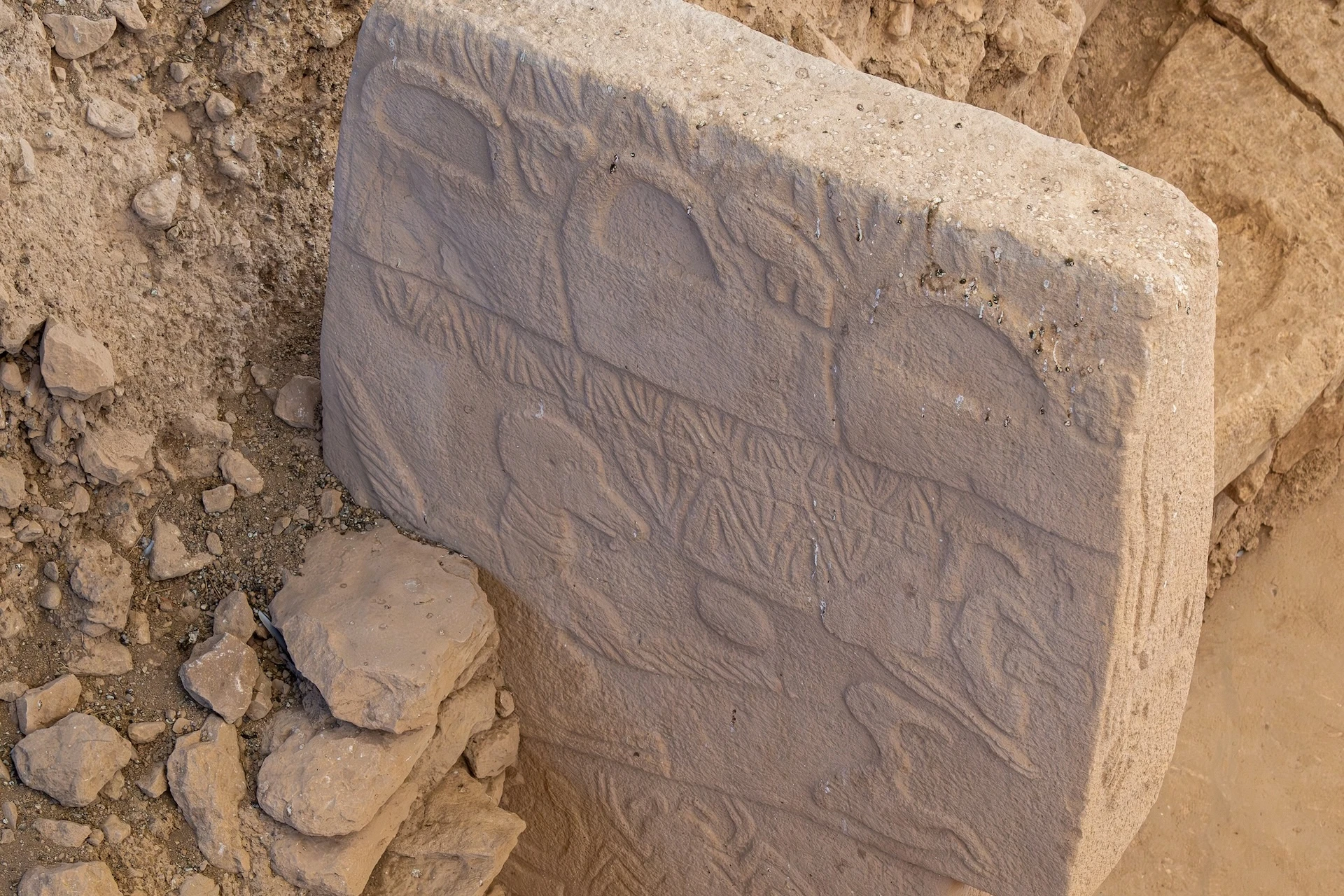
No discussion of Göbekli Tepe and catastrophe can quite avoid the comet. In a widely publicised 2017 paper, Martin Sweatman and Dimitrios Tsikritsis argued that the carvings on Pillar 43, the so-called Vulture Stone, encode a precise date commemorating a comet impact that they connect to the onset of the Younger Dryas — the “Younger Dryas Impact Hypothesis.” The theory is striking, but it is not mainstream archaeology. Subsequent critiques by Jens Notroff and other specialists have questioned both the astronomical dating and the interpretation of the carvings, and mainstream palaeoclimatology has not accepted a cosmic impact as the cause of the Younger Dryas cooling.
I mention this because it is the most prominent modern version of the “flood-as-cosmic-catastrophe” reading of Göbekli Tepe. Whether or not one accepts any part of it, the underlying point remains: the Younger Dryas was catastrophic, its cause is still debated, and it is not the same thing as the flood narratives that appear in Mesopotamian literature thousands of years later.
What Göbekli Tepe’s Builders Might Have Remembered
So where does this leave us? Not with a simple story, but with a layered and honest one.
The people who built Göbekli Tepe lived in the immediate aftermath of the most severe climate event since the last Ice Age. The Younger Dryas had devastated the landscape their ancestors knew. When the cold finally broke, around 9600 BCE, the recovery was rapid and dramatic — grasslands spread, wild cereals returned, animal populations rebounded. The communities that gathered on this limestone ridge to carve their extraordinary pillars were people who had every reason to see the world as newly remade.
Did they tell stories about the catastrophe? Almost certainly. Every human culture tells stories about disaster and renewal — it is one of the most fundamental narrative patterns our species possesses. Did those stories contribute, through thousands of years of retelling, to the flood traditions of Sumer and Babylon? It is possible but unprovable. The chain of transmission is too long and too broken for certainty.
What I tell my visitors is this. You do not need the flood legend to find Göbekli Tepe extraordinary. The real story — of communities that survived a climate apocalypse and responded by creating some of the most ambitious architecture in human history — is more dramatic than any myth. The pillars standing in those enclosures are not relics of a lost paradise. They are evidence that human beings, faced with the collapse of their world, chose to build something magnificent.
That, to me, is worth more than any legend.
Key Takeaways
- The Younger Dryas (12,900–11,600 years ago) was a real climate catastrophe that reshaped the Near East — not a flood, but a severe cold-and-drought event that devastated ecosystems and depleted cereal resources.
- Göbekli Tepe was built in the immediate aftermath of the Younger Dryas, during the rapid warming of the Early Holocene — its builders were people of a post-catastrophe world.
- Mesopotamian flood narratives (Ziusudra, Atrahasis, Gilgamesh Tablet XI) post-date Göbekli Tepe by thousands of years, making direct literary connections speculative.
- The Black Sea Deluge Hypothesis (c. 5600 BCE) offers another possible source for flood myths but post-dates Göbekli Tepe by several millennia.
- Göbekli Tepe’s deliberate burial was a ritual decommissioning practice, not a flood response — the fill material shows no signs of water deposition.
- The question of whether Neolithic memories could transmit across millennia into Sumerian literature is legitimate but currently unprovable.
Planning Your Visit
To understand Göbekli Tepe in its real climatic and cultural context — not draped in flood myth, but anchored in the post–Younger Dryas recovery — our Göbekli Tepe and Karahan Tepe guided day tour walks you through the site and the landscape that surrounds it, with Karacadağ on the horizon and the story of the world being rebuilt after catastrophe.
Your Next Read
Suggested path: Göbekli Tepe and the Garden of Eden → Why Was Göbekli Tepe Buried? → The Vulture Stone: Star Map or Comet? → The Taş Tepeler Network.
Frequently Asked Questions
Was Göbekli Tepe destroyed by a flood? No. There is no evidence of flood damage at Göbekli Tepe. The site was deliberately buried with intentionally deposited fill material as part of a ritual decommissioning process during the eighth millennium BCE. This practice has been documented at multiple Pre-Pottery Neolithic sites in the region.
Is the biblical flood connected to Göbekli Tepe? There is no scientifically supported connection. The biblical account draws on Mesopotamian literary traditions that post-date Göbekli Tepe by thousands of years. While the Younger Dryas was a real catastrophe contemporary with the site’s builders, linking it to specific flood myths requires a chain of oral transmission spanning millennia that cannot be verified.
What was the Younger Dryas and how did it affect Göbekli Tepe’s region? The Younger Dryas was a sudden return to near-glacial conditions lasting from approximately 12,900 to 11,600 years ago. In southeastern Turkey, it brought severe drought and cold, transforming lush parkland into arid steppe and severely depleting wild cereal resources. When the Younger Dryas ended abruptly around 9600 BCE, rapid warming created the conditions in which Göbekli Tepe was built.
Could ancient oral traditions really preserve memories for thousands of years? Research on Australian Aboriginal oral traditions suggests some cultures can maintain accurate geographical memories across seven to ten thousand years. However, the transmission chain from Göbekli Tepe’s Pre-Pottery Neolithic culture to Sumerian civilisation involves multiple language shifts and cultural transformations that make the comparison difficult.
Why was Göbekli Tepe buried if not because of a flood? Deliberate burial of sacred buildings was a widespread ritual practice in the Pre-Pottery Neolithic. Structures were ceremonially “killed” and filled as part of their lifecycle, similar to how later Mesopotamian cultures periodically demolished and rebuilt temples. This practice has been documented at Göbekli Tepe, Karahan Tepe, and other sites in the Taş Tepeler network.
Does the Vulture Stone record a comet impact that caused the flood? The comet-impact reading of Pillar 43 was proposed by Sweatman and Tsikritsis (2017), but it is not accepted by mainstream archaeology. Specialists have raised serious methodological objections to both the astronomical dating and the iconographic interpretation. Mainstream palaeoclimatology also does not accept a cosmic impact as the cause of the Younger Dryas cooling.
Fazlı Karabacak is a licensed Turkish tour guide with over 25 years of experience and the founder of Serendipity Turkey. He specialises in archaeological and cultural tours across Turkey, with particular expertise in Göbekli Tepe and the Pre-Pottery Neolithic sites of southeastern Anatolia.