Quick Answer
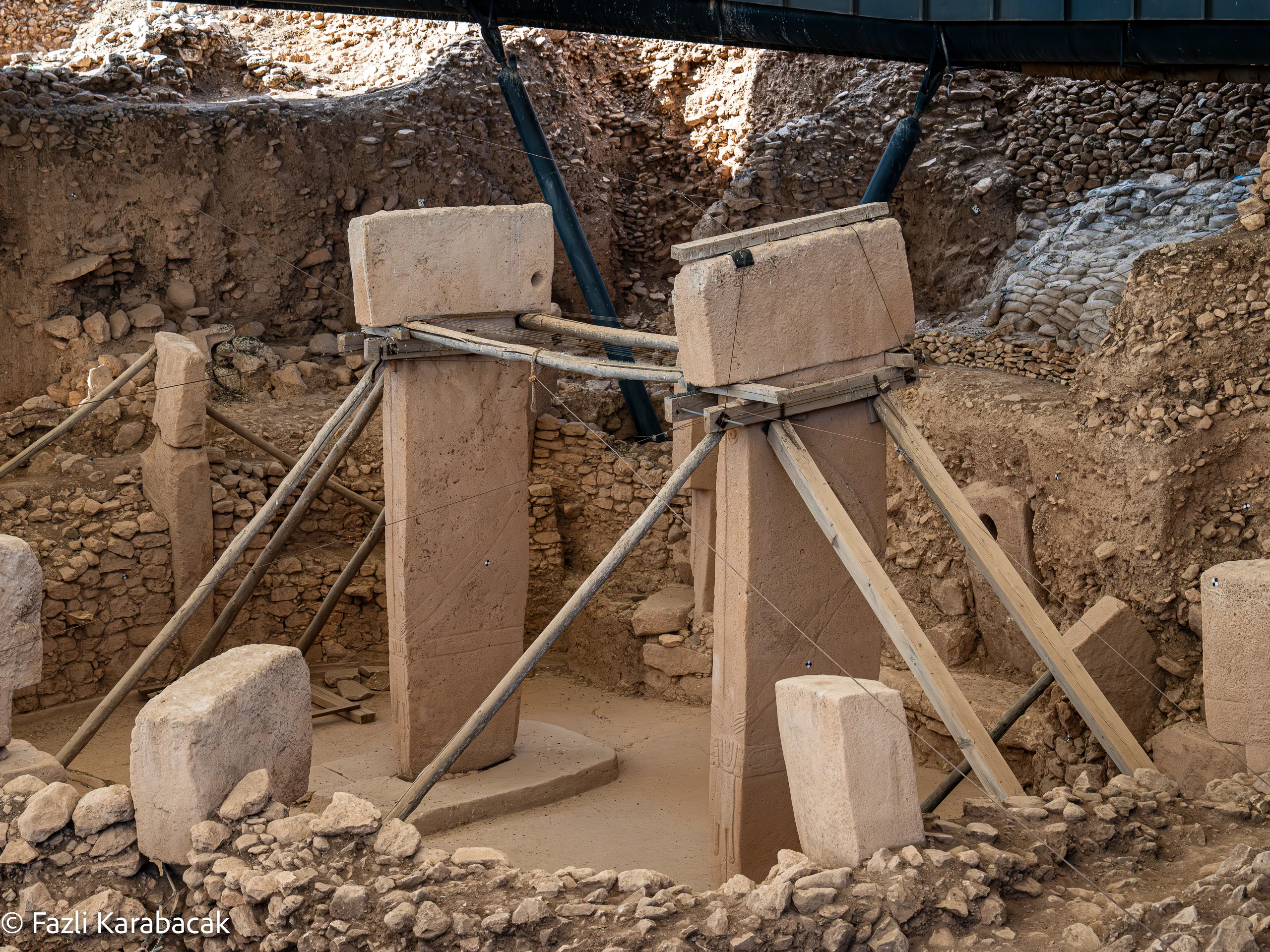
Göbekli Tepe was built by Pre-Pottery Neolithic communities between approximately 9,600 and 8,000 BCE using only stone tools, human labour, and an extraordinary degree of architectural planning. The monumental enclosures of Layer III follow a consistent “design language”: a pair of large, elaborately carved T-shaped central pillars surrounded by smaller peripheral pillars connected by stone masonry walls and interior benches. The largest pillars stand up to 5.5 metres tall and weigh an estimated 10 to 16 tonnes. They were quarried from the limestone plateau on which the site sits, shaped in situ, and transported without wheeled vehicles or draught animals.
Quick Facts
- Date: Approximately 9,600–8,000 BCE
- Builders: Pre-Pottery Neolithic communities
- Largest pillars: Up to 5.5 metres tall
- Estimated pillar weight: Roughly 10–16 tonnes
- Transport distance: About 100–500 metres
- Main engineering challenge: Quarrying, moving, and erecting multi-tonne pillars without metal or wheels
- Why it matters: It proves the story explained in What Is Göbekli Tepe? is even more extraordinary than it first appears
One of the most common questions visitors ask at Göbekli Tepe is also one of the best: how was this built?
It is a fair question because the site forces us to think beyond clichés about “primitive” Stone Age communities. What you see at Göbekli Tepe is not accidental and not simple. It required planning, labour, quarrying skill, coordinated effort, and a remarkably coherent architectural vision.
The Construction Problem in Simple Terms
If we strip the challenge down to basics, the builders of Göbekli Tepe had to solve five major problems:
- identify workable limestone
- quarry large stone blocks from bedrock
- shape them into standardised T-shaped pillars
- move them across uneven ground without wheels
- raise them into prepared sockets and organise them into coherent enclosures
That is what makes the site so impressive from an engineering perspective. The problem was not just artistic or symbolic. It was logistical and architectural at the same time.
A Coherent Design Language
One of the most important things archaeologists have learned is that the builders were not improvising randomly. The enclosures follow a repeatable design logic.
At the centre of the main early enclosures stand two monumental T-shaped pillars. Around them is a ring of smaller pillars set into a circular or oval layout, connected by stone walls and benches. This repeated pattern shows continuity, planning, and transmission of architectural knowledge.
In other words, Göbekli Tepe was not a single wild experiment. It was built according to a recognisable design language.
The Scale of the Achievement
The dimensions alone are remarkable. Some of the central pillars rise to about 5.5 metres and weigh between 10 and 16 tonnes. The enclosures themselves are large enough to make clear that this was not household architecture.
And it was not just one pair of stones. Each enclosure required multiple pillars, wall construction, surface preparation, and spatial organisation. The cumulative effort was enormous.
Quarrying the Stone
One reason Göbekli Tepe could exist at all is that the builders had excellent limestone right on the plateau.
The stone did not need to be imported from a distant quarry. It was available locally, and evidence from the site shows that pillars were cut directly from the bedrock using stone tools. This would still have been labour-intensive and technically demanding, but the geology made the project possible.
An unfinished pillar still associated with the quarry zone makes this especially vivid. It reminds us that the builders were working at the limits of what was possible, and that not every attempt reached completion.
Moving the Pillars
Once quarried, the pillars had to be moved. That is one of the hardest parts for modern visitors to imagine.
There were no wheels, no metal tools, and no draught animals. Yet these communities still found ways to transport multi-tonne stones over distances that may have ranged from roughly 100 to 500 metres.
The precise method is still debated, but the most likely combination involves human teams, leverage, sledging, dragging, and careful route planning. Whether or not we can reconstruct every step, the broader point is clear: this work demanded organisation, not just effort.
Raising the Stones
Transporting the pillars was only part of the challenge. They then had to be raised upright into prepared sockets.
That means the builders already knew where each pillar belonged before the lifting process began. The socket, orientation, enclosure layout, and final arrangement all imply forethought.
This is where Göbekli Tepe becomes especially striking. The builders were not merely moving heavy things. They were executing a plan.
From Circular to Rectangular
One of the most revealing architectural patterns at Göbekli Tepe is the transition from the early monumental circular enclosures to later smaller rectangular structures.
The earlier phase is what gives the site its global fame. The later phase looks more modest, more compact, and more structurally restrained.
This matters because it suggests that Göbekli Tepe was not just a static monument. It changed over time. Architecture here reflects changing social and ritual priorities.
Labour and Social Organisation
The engineering question leads directly into a social one: who organised all this work?
Monumental building requires more than raw strength. It requires planning, cooperation, timing, and some mechanism for bringing large groups together around a common purpose.
That is why many archaeologists connect Göbekli Tepe to communal gathering and feasting. If different groups assembled periodically, shared labour, and reinforced social ties through ritual and food, then the construction process itself becomes part of the site’s larger cultural meaning.
Engineering and Ritual Belong Together
The engineering story does not end with construction. It also includes deliberate closure — something explored further in Why Was Göbekli Tepe Buried?.
This matters because it shows that architecture here was not just functional. These spaces had lifecycles. They were created, used, and in some cases carefully buried. That suggests the builders treated architecture as something socially and symbolically alive.
Why This Article Matters
People sometimes think the “engineering” side of Göbekli Tepe is separate from the symbolic or ritual side. It is not.
The engineering is part of the meaning. Quarrying, moving, placing, and organising the pillars required a level of communal vision that tells us something profound about the people who built the site.
Göbekli Tepe matters not only because it is old, but because it demonstrates planning, coordination, and architectural ambition at a point in history when older models said such things should not yet exist.
Key Takeaways
- No metal, no wheels, no draught animals — only stone tools, human muscle, and remarkable planning.
- Pillars up to 5.5 metres tall and 10–16 tonnes were quarried, moved, and erected by coordinated teams of hunter-gatherers.
- A repeatable design language (paired central pillars, surrounding ring) shows this was architecture, not improvisation.
- Over centuries the site evolved: large circular enclosures gave way to smaller rectangular rooms, reflecting shifting social needs.
Ready to Visit?
Pair this article with the Göbekli Tepe Visitor Guide for practical details on access and timing. For a multi-site day, read the Göbekli Tepe to Karahan Tepe Day Tour. Shape your full itinerary at Plan Your Göbekli Tepe Trip.
Frequently Asked Questions
How heavy are the largest pillars, and how do we know? The two central pillars in Enclosure D are the reference point — each is roughly 5.5 metres tall and is generally estimated at 10 to 16 tonnes, depending on how the density of the local limestone is calculated. The range exists because no one has weighed them directly; the figures come from measured volume multiplied by the density of Urfa limestone. That is enough to know, very clearly, that this was not a job any single family could have done.
How did the builders move stones that heavy without wheels or draught animals? The honest answer is that we don’t know the exact method, but we know the toolkit: human teams, wooden levers, rollers or sledges, rope, and carefully chosen routes. The transport distances were short — on the order of 100 to 500 metres from the quarry to the enclosure — which is what makes the project logistically possible. A coordinated group of several dozen to a hundred people, working with leverage and patience, can move a 15-tonne block. Every experimental archaeology attempt to replicate this kind of work has confirmed as much.
Were there any metal tools involved at all? No. Göbekli Tepe predates metallurgy by thousands of years. Every cut, every carving, every shaping detail was done with stone tools — flint, obsidian where imported, and the harder limestones used as hammers and chisels. That constraint is actually part of what makes the carved reliefs so impressive, because the precision you see on the pillars was achieved by patient, skilled hands, not by sharper edges.
What does an “unfinished pillar” at the quarry tell us? A few pillars at Göbekli Tepe were abandoned mid-quarrying — still attached to the bedrock, partially shaped, never freed. For me as a guide, these are among the most moving features at the site. They show that not every attempt succeeded. They also show the quarry process itself: cutting a trench around the block, undercutting it, and separating it from the bedrock floor. It is the Stone Age equivalent of leaving your work in progress on the bench.
Was the architecture really “planned” or is that a projection from modern eyes? The evidence for planning is strong. The enclosures follow a repeatable design — twin central pillars, surrounding ring, connecting walls, interior benches — across multiple structures and probably across generations. The socket preparation implies that builders knew exactly where each pillar would stand before they raised it. That is not improvisation. It is a design convention being transmitted, and that transmission is itself a kind of architectural knowledge.
How long did it take to build a single enclosure? We don’t have a direct answer, but estimates based on the volume of quarried stone, the labour required, and comparisons with later Neolithic monumental projects suggest that a single major enclosure probably represents months to a few years of coordinated effort. Whether that work was continuous or seasonal — gathered around feasting events, as some researchers argue — is a separate question, and one that connects the engineering story to the social one.
Fazlı Karabacak is a licensed Turkish tour guide with over 25 years of experience and the founder of Serendipity Turkey. He specialises in archaeological and cultural tours across Turkey, with particular expertise in Göbekli Tepe and the Pre-Pottery Neolithic sites of southeastern Anatolia.