Quick Answer
The conventional story says hunger drove farming. Evidence from Göbekli Tepe tells a different story. Over 7,268 grinding tools and phytolith analysis confirm massive wild cereal processing at this pre-agricultural site — suggesting that feeding hundreds of workers at seasonal ritual gatherings pushed hunter-gatherers toward the intensive grain management that eventually became farming.
At a Glance
- Date: Approximately 9,500–8,200 cal BCE (Pre-Pottery Neolithic A/B)
- Location: Southeastern Turkey, within the “Golden Triangle” of wild crop progenitors
- Grinding tools found: 7,268 — more than any other known Neolithic site
- Plant evidence: Wild einkorn and barley confirmed by phytolith analysis; no domesticated crops
- Animal evidence: 58% gazelle, 18% aurochs — entirely wild species
- Distance to wheat’s birthplace: ~30 km from Karacadağ, where einkorn was first domesticated
- Core finding: No grain storage — processing was for immediate consumption at seasonal work feasts
Why Does the Traditional Story No Longer Work?
For most of the twentieth century, archaeologists told a relatively simple story about the origins of agriculture. V. Gordon Childe called it the “Neolithic Revolution” — a dramatic shift from hunting and gathering to settled farming, driven by climate change at the end of the last Ice Age. The idea was linear: as the Younger Dryas cold spell receded around 9,600 BCE, people in the Fertile Crescent found abundant wild grains. Necessity and opportunity combined. They planted seeds, domesticated animals, and settled into villages. Religion, monumental architecture, and social complexity followed — products of the surplus that agriculture made possible.
In my 25 years of guiding tours across Turkey, I have repeated versions of this narrative countless times. It is neat, logical, and easy to understand. There is only one problem: Göbekli Tepe turns it upside down.
When Klaus Schmidt began excavating the site in the mid-1990s, he encountered something that should not have existed according to the Childe model. Here were monumental stone enclosures — massive T-shaped pillars weighing up to sixteen tonnes, carved with elaborate animal reliefs, arranged in precise circles — built by people who were still, by every measure, hunter-gatherers. No domesticated plants. No domesticated animals. No permanent village surrounding the site.
Schmidt proposed a radical inversion of the traditional sequence. It was not agriculture that enabled monumental architecture and organised religion. It was the other way around. The social organisation required to build and maintain a site like Göbekli Tepe created the conditions under which agriculture became necessary — and eventually inevitable.
What Do 7,268 Grinding Stones Actually Tell Us?
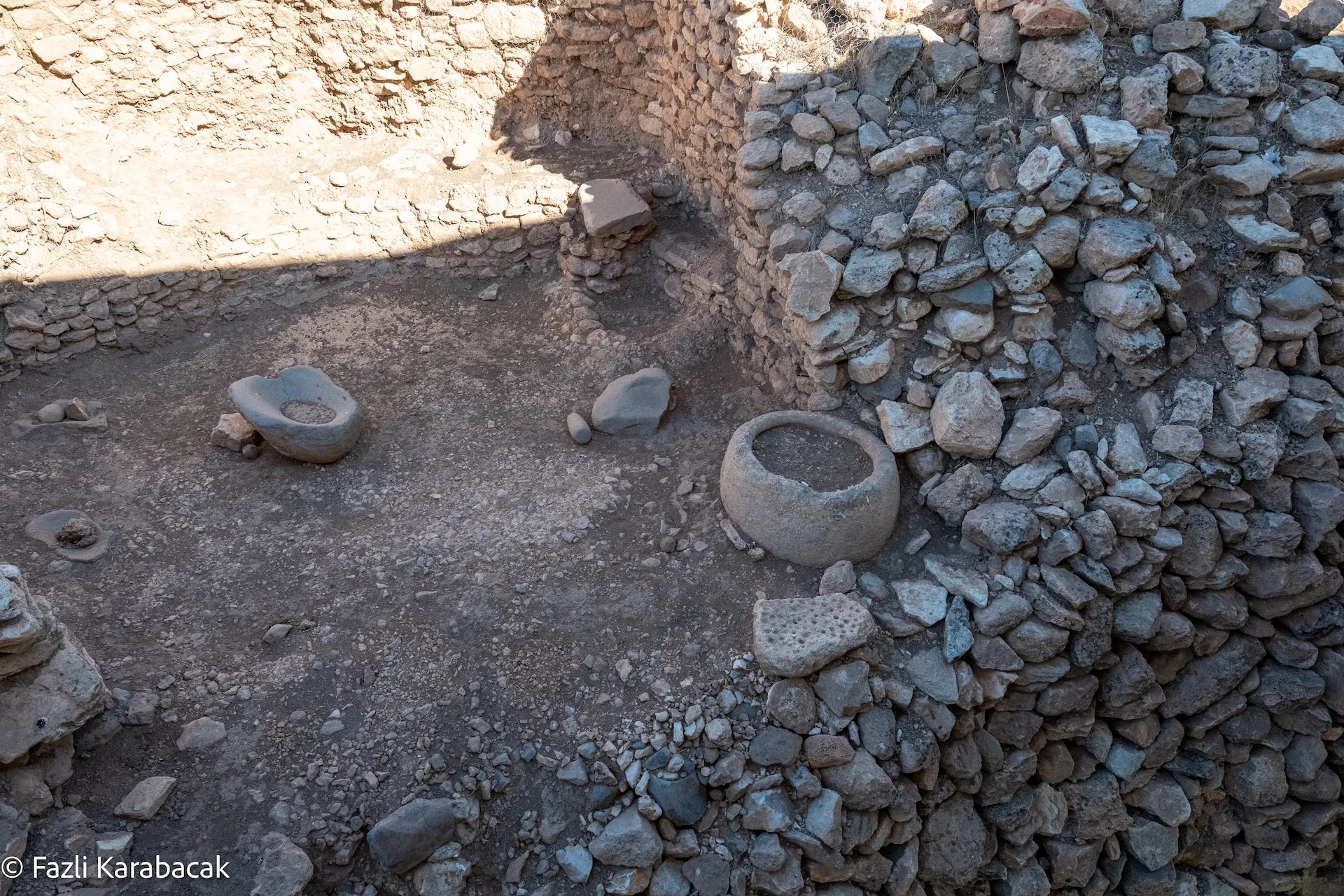
What most visitors to Göbekli Tepe never see — because it is not displayed as dramatically as the carved pillars — is perhaps the site’s most remarkable statistical fact. As Laura Dietrich and colleagues documented in their landmark 2019 study in PLOS ONE, excavations have recovered over 7,268 grinding tools from the site. These include approximately 3,400 handstones, along with grinding bowls, plates, mortars, and pestles, all made from coarse basalt sourced from an outcrop roughly two kilometres away.
To put it in perspective: at Çayönü, one of the best-known early Neolithic settlements in southeastern Turkey, archaeologists found 869 handstones and 479 grinding slabs. At Jerf el Ahmar in northern Syria, the count was around 400 querns. Even at Çatalhöyük — occupied for over a millennium by thousands of people — the contextualised grinding tool assemblage numbers roughly 1,300 pieces. Göbekli Tepe’s total dwarfs them all, and the site has not yet been fully excavated.
The Dietrich team’s analysis — combining formal typology, experimental archaeology, and microscopic use-wear study — demonstrated that the overwhelming majority of these tools were used for a single purpose: processing cereals. Handstones of Types 1 and 2, which together account for 75% of the analysed assemblage, show use-wear patterns consistent with pendular bidirectional grinding motions optimised for crushing grain into flour.
How Do We Know It Was Cereal — Not Nuts or Ochre?
Charred plant remains are scarce at Göbekli Tepe, probably due to site formation processes. But the phytolith evidence leaves no room for doubt. Phytoliths are microscopic silica structures that form within plant cells and survive long after the organic material has decomposed — botanical fingerprints of ancient food processing.
The Dietrich team extracted phytoliths from both sediment samples and directly from the grinding surfaces of selected tools. Grass phytoliths — the category that includes all major cereals — accounted for approximately 81% of the identifiable assemblage. The morphometric analysis identified the presence of Triticum monococcum (einkorn wheat), Hordeum spontaneum (wild barley), and Hordeum vulgare (barley) in both Layer II and Layer III contexts.
Critically, phytolith concentrations on the grinding surfaces were two to three times higher than on the break sides and backs of the same stones — direct evidence that the tools were actively used for processing plant material, not merely contaminated by environmental deposition.
Why Was There No Grain Storage?
Here is where the narrative becomes genuinely fascinating. With thousands of grinding tools confirming large-scale cereal processing, one might expect to find corresponding evidence of grain storage — silos, storage pits, sealed vessels. But at Göbekli Tepe, no large storage facilities have been identified.
The Dietrich team concluded that production was aimed at immediate consumption during seasonal peaks of activity, not at building long-term food reserves. The model that best explains this pattern is the work feast: an event in which communal hospitality is used to orchestrate collective labour. The host group provides food and drink; in return, participants contribute their labour to a shared project.
The construction of Göbekli Tepe’s monumental enclosures required a workforce of hundreds, even by conservative estimates. Quarrying, transporting, and erecting pillars weighing between ten and sixteen tonnes demanded coordinated effort over extended periods. These workers needed to be fed — and the evidence suggests they were fed abundantly.
As I explored in detail in Was Beer Brewed at Göbekli Tepe?, Oliver Dietrich and colleagues also found large stone vessels and oxalate residues consistent with brewing. Some handstones from the 2019 study showed use-wear consistent with circular grinding motions suitable for processing malt. Around 80 sherds of thin-walled stone drinking vessels — some decorated, some repaired — have been recovered from the site.
On the ground: When you visit Göbekli Tepe, one of the most striking moments is standing in the enclosures and imagining what happened there. On our Göbekli Tepe and Karahan Tepe day tour, we explain the grinding tool evidence and bring the invisible archaeology to life — the details that transform a sightseeing stop into a genuine encounter with the deep past.
How Close Was Göbekli Tepe to Where Wheat Was Domesticated?
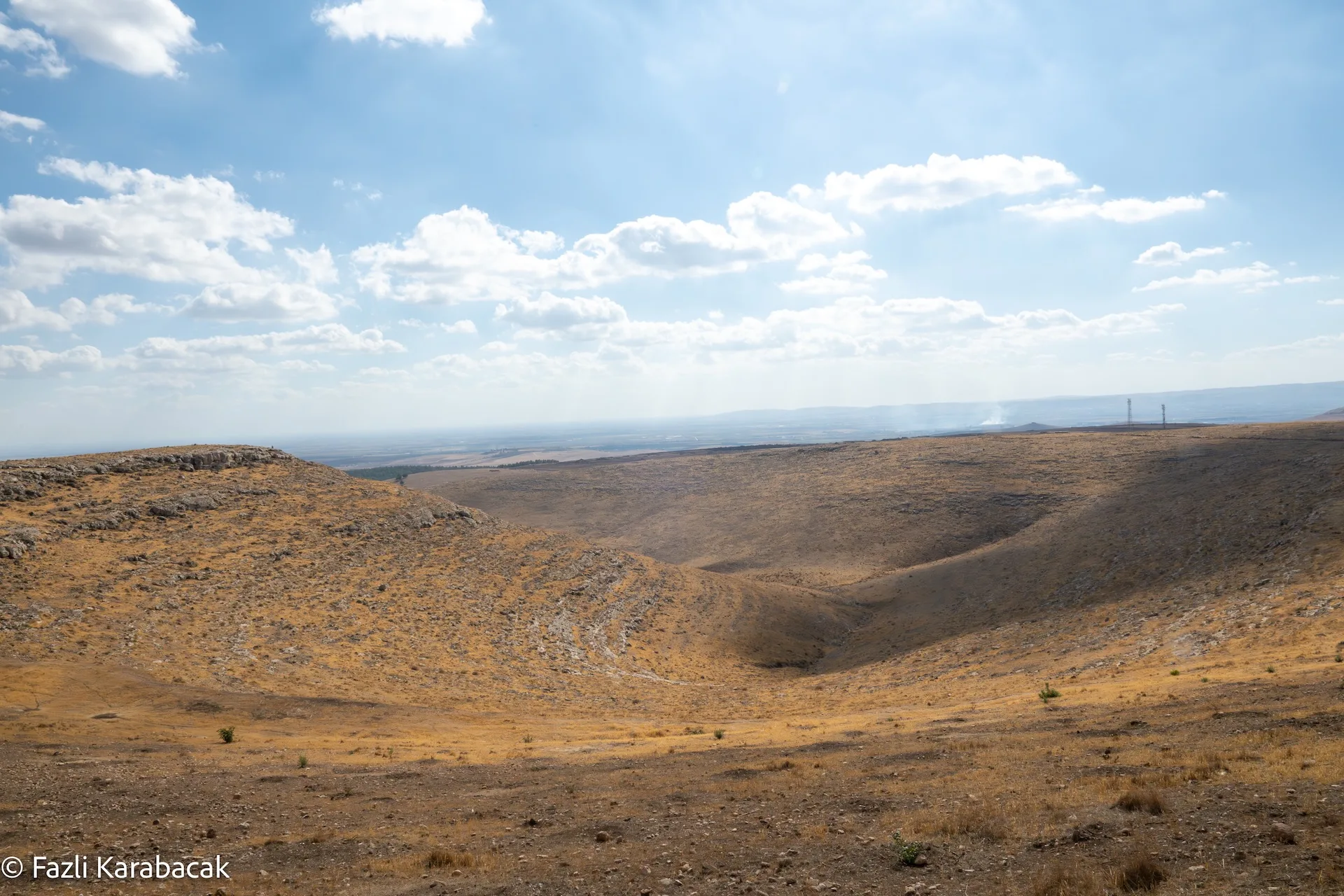
When I guide groups through southeastern Turkey, I always point toward the Karacadağ mountain range, visible to the northeast of Göbekli Tepe. It is one of the most underappreciated landmarks in human history.
In a 1997 study in Science, Manfred Heun and colleagues used DNA fingerprinting to trace the genetic origin of domesticated einkorn wheat (Triticum monococcum). Their analysis identified a population of wild einkorn on the slopes of Karacadağ — roughly 30 kilometres from Göbekli Tepe — as the closest living relative of all cultivated einkorn varieties worldwide. Subsequent work by Hakan Özkan and colleagues confirmed that southeastern Turkey was also the origin point for emmer and hard wheat domestication.
The geographic proximity matters enormously. Göbekli Tepe sits at the very heart of the region where the wild progenitors of the Neolithic founder crops — einkorn, emmer wheat, barley, and several pulse species — overlap in their natural distribution. The people who built and used the site were intimately acquainted with these wild plant resources. They harvested them, transported them, processed them at massive scale — while the plants remained morphologically wild.
The transition from wild harvesting to deliberate cultivation, and eventually to genetic domestication, unfolded over centuries. What Göbekli Tepe provides is a compelling mechanism for why that intensification began: the social and logistical demands of feeding large seasonal gatherings pushed forager communities to manage the wild cereals they had long relied upon.
What Do the Animal Bones Tell Us About Who Was Gathering Here?
The story is not only about plants. The faunal assemblage from Layer III (roughly 9,500–8,700 cal BCE) is dominated by gazelle at approximately 58%, followed by wild cattle (aurochs) at about 18%, with Asiatic wild ass and wild boar making up most of the remainder. Every identified species is wild. There is no evidence of animal domestication at the site.
Gazelle are migratory animals, available in the Şanlıurfa region primarily between midsummer and autumn. The mass of bones recovered suggests large-scale hunting events timed to coincide with seasonal migration — perfectly consistent with the work feast model. Gatherings occurred when both wild cereals and migratory game were naturally abundant, maximising the food supply available for large numbers of people.
The wild cattle component is also significant. As Nadja Pöllath, Oliver Dietrich, and colleagues demonstrated in their 2018 analysis, hunting aurochs required skill, courage, and organisation. These animals provided prestige as well as essential fat reserves, and their images dominate the carved pillars. Hunting large game for hundreds of feast participants was itself a form of social organisation that prefigured the cooperative structures settled agriculture would later require.
The landscape tells the story: On our guided tour, we visit the site during different seasons and explain how the seasonal patterns of gazelle migration, wild cereal ripening, and construction activity all aligned to make this hilltop the gathering point of a world in transition.
Did Göbekli Tepe Function as a Knowledge Hub Between Forager Groups?
One of the most compelling aspects of the Peters and Schmidt model is their characterisation of Göbekli Tepe not merely as a ritual site but as a hub for knowledge exchange between dispersed forager communities. Different groups, each with their own ecological knowledge and subsistence strategies, converged on this hilltop seasonally. The monumental enclosures — each decorated with different emblematic animals, as Notroff, Dietrich, and Schmidt have argued — may have represented distinct social groups or lineages.
In this interpretation, the seasonal gatherings brought together people from across the upper Euphrates and Tigris region, creating opportunities for sharing not only ritual knowledge but also practical information about plant management, animal behaviour, and resource exploitation. The innovations that would eventually produce agriculture — selective harvesting, proto-cultivation, seed management — could have been developed, refined, and disseminated through exactly these kinds of periodic inter-group contacts.
This model helps explain one of the great puzzles of the Neolithic transition: why domestication occurred roughly simultaneously across a broad geographical zone rather than at a single point. If multiple forager communities were converging on sites like Göbekli Tepe and exchanging subsistence knowledge, the techniques that led to domestication would have spread through social networks rather than radiating outward from a single inventor community.
When Did Farming Eventually Replace Feasting?
The chronological evidence completes the picture. Göbekli Tepe’s Layer III — the phase of the great circular enclosures — dates to approximately 9,500–8,700 cal BCE. Layer II, with smaller rectangular buildings, dates to approximately 8,700–8,000 cal BCE. The site was deliberately buried and abandoned around 8,200 cal BCE.
This timeline maps remarkably well onto the broader trajectory of domestication in the region. Ungulate domestication in southeastern and eastern Anatolia began around 8,000 BCE, while climatic conditions were still improving. The abandonment of Göbekli Tepe roughly coincides with the period when gazelle hunting was being replaced by small livestock husbandry across the region.
Göbekli Tepe was active during exactly the transitional centuries when foraging communities were intensifying their relationship with wild plants and animals but had not yet made the full shift to agriculture. The site did not survive the transition it helped catalyse. Once communities became sedentary farmers with domesticated crops and livestock, the social structure that had supported massive seasonal gatherings at a remote hilltop was no longer necessary.
Jacques Cauvin had anticipated something like this in his influential 1994 work Naissance des divinités, Naissance de l’agriculture, arguing that a “revolution in symbols” preceded the economic transformation of the Neolithic. Göbekli Tepe provides the most dramatic archaeological support for his thesis. As Klaus Schmidt concluded in his 2010 excavation report, explicitly endorsing Cauvin: “the factor that allowed the formation of large, permanently co-resident communities was the facility to use symbolic culture.” The excavator of Göbekli Tepe believed symbolic and ritual life was the engine — not the byproduct — of the Neolithic transition.
The people who carved these pillars did not set out to invent agriculture. They set out to build a temple. Agriculture was, in a sense, the unintended consequence — and that, to me, is the most profound lesson this hilltop has to offer.
Key Takeaways
- Göbekli Tepe has yielded over 7,268 grinding tools — far more than any comparable Neolithic site — with use-wear and phytolith analysis confirming large-scale wild cereal processing.
- All plant and animal species identified at the site are wild; there is no evidence of domestication during the site’s occupation (c. 9,500–8,200 cal BCE).
- The absence of grain storage indicates processing was for immediate consumption during seasonal work feasts, not long-term surplus accumulation.
- DNA fingerprinting traces domesticated einkorn wheat to Karacadağ, roughly 30 km from Göbekli Tepe, placing the site at the geographic heart of wheat domestication.
- Göbekli Tepe likely functioned as a knowledge-exchange hub for forager communities, potentially accelerating the spread of proto-agricultural techniques across the Fertile Crescent.
- Klaus Schmidt’s inversion — “first the temple, then the city” — is supported by the convergence of ritual, subsistence, and chronological evidence at the site.
Planning Your Visit
The grinding tool story comes alive at Göbekli Tepe when you look out from the hilltop toward the rolling limestone plateau where wild einkorn still grows — the same landscape those thousands of handstones were harvesting from. It is a connection most visitors walk past without knowing.
Our Göbekli Tepe and Karahan Tepe guided day tour covers both sites with the archaeological context that transforms a hilltop visit into a genuine encounter with the moment humanity first began to change the natural world.
Your Next Read
Suggested path: Was Beer Brewed at Göbekli Tepe? → Did Religion Invent Agriculture? → Why Was Göbekli Tepe Buried? → What Is Göbekli Tepe?. Planning a trip? Start with Plan Your Göbekli Tepe Trip.
Frequently Asked Questions
Did the people who built Göbekli Tepe practice agriculture? No. All plant and animal species identified at Göbekli Tepe are wild. The builders harvested wild einkorn, barley, and emmer wheat, and hunted wild animals — primarily gazelle and aurochs. However, their intensive processing of wild cereals at massive scale may have been a critical step on the path toward domestication.
How do we know cereals were processed at Göbekli Tepe if there are few preserved seeds? Charred plant remains are scarce, likely due to site formation processes. Phytolith analysis — the study of microscopic silica structures within plant cells — confirmed the abundant presence of grass and cereal phytoliths in both soil samples and on the surfaces of grinding tools. Phytolith concentrations on grinding surfaces were two to three times higher than on the backs of the same stones.
What is the connection between Göbekli Tepe and wheat domestication? The wild ancestor of domesticated einkorn wheat has been genetically traced to the slopes of Karacadağ, approximately 30 km from Göbekli Tepe. This places the site at the epicentre of the world’s earliest wheat domestication. While domestication itself occurred after Göbekli Tepe’s main period of use, the intensive wild cereal exploitation documented at the site represents a crucial precursor stage.
What are “work feasts” and how do they explain Göbekli Tepe? Work feasts are events where large quantities of food and drink mobilise collective labour for communal projects. At Göbekli Tepe, the enormous quantity of grinding tools, animal bones, and stone drinking vessels — combined with the absence of grain storage — suggests workers were fed through organised seasonal feasting. The need to supply these feasts may have intensified cereal exploitation and contributed to the eventual development of agriculture.
Why was there no grain storage at Göbekli Tepe? No large storage facilities have been found at Göbekli Tepe. This suggests cereal processing was aimed at immediate consumption during seasonal gathering events, not building long-term food reserves — consistent with the site’s interpretation as a periodically visited ritual and feasting centre rather than a permanent settlement.
Did religion really come before agriculture? The evidence from Göbekli Tepe strongly suggests that complex ritual behaviour and monumental architecture preceded plant and animal domestication in this region. However, the relationship was not simply linear: ritual gatherings created social pressures that intensified resource exploitation, which in turn created conditions for domestication. The two processes were deeply intertwined rather than strictly sequential.
Fazlı Karabacak is a licensed Turkish tour guide with over 25 years of experience and the founder of Serendipity Turkey. He specialises in archaeological and cultural tours across Turkey, with particular expertise in Göbekli Tepe and the Pre-Pottery Neolithic sites of southeastern Anatolia.