Quick Answer
Archaeological evidence strongly suggests altered states of consciousness played a role at Göbekli Tepe. Jutta Dietrich’s 2023 systematic analysis marks drug use evidence as positively present at the site. The region’s native Peganum harmala (Syrian rue) provides a pharmacologically potent candidate substance. The site’s imagery — therianthropic figures, entoptic-like patterns, human-animal transformation scenes — aligns closely with neuropsychological models of trance experience. Chemical confirmation from vessel residues remains the missing piece.
At a Glance
- Key study: Dietrich (2023, Praehistorische Zeitschrift) — systematic shamanic criteria checklist; drug use evidence assessed as positively present (+)
- Candidate substance: Peganum harmala (Syrian rue / üzerlik) — grows wild throughout southeastern Anatolia today
- Active compounds: Harmine, harmaline (beta-carboline MAOIs) — produce vivid dream-like visions; potentiate other compounds
- Scientific confirmation: Tanasi et al. (2023) identified harmel alkaloids in an Egyptian ritual vessel via ancient DNA + metabolomics
- Vessel evidence: 6 large limestone vessels (up to 160L capacity) with calcium oxalate fermentation residues
- What remains unconfirmed: No direct alkaloid residue analysis published from Göbekli Tepe vessels yet
- The imagery: Therianthropic figures, entoptic-like patterns, the 3 bags of Pillar 43 — all consistent with trance states
Why Has This Question Grown So Persistent at Göbekli Tepe?
Of all the questions visitors ask me at Göbekli Tepe, one has grown noticeably more frequent in recent years — usually in a lowered voice, as if the asker suspects they are about to say something inappropriate in front of the ruins: “Were the people who built this place using psychedelic substances?”
It is a fair question, and one that deserves a serious answer rather than either sensationalist enthusiasm or reflexive dismissal. After twenty-five years of guiding at archaeological sites across Turkey and following the scholarly literature closely, I have come to believe that the evidence points toward a meaningful relationship between altered states of consciousness and the rituals performed within these enclosures — though the nature and extent of that relationship remains a subject of legitimate debate.
What I want to offer here is not speculation dressed as certainty, but a careful examination of what the archaeological, botanical, and comparative evidence actually tells us.
What Does the Most Rigorous Recent Study Actually Conclude?
The most rigorous recent assessment comes from Jutta Dietrich’s 2023 study published in Praehistorische Zeitschrift, where she applies a systematic checklist of shamanic indicators to the Göbekli Tepe evidence. Her Table 1 is worth examining carefully, because it represents the most methodical attempt yet to evaluate whether altered states of consciousness were part of ritual life at this site.
Dietrich evaluates multiple categories of evidence and her findings are striking. Under the category of altered states of consciousness, she marks drug use evidence as positively present (+) at Göbekli Tepe. She reaches the same positive assessment for ritual body postures, entoptic phenomena, helper spirit depictions, and bird imagery associated with shamanic flight. Dancing receives a tentatively positive assessment.
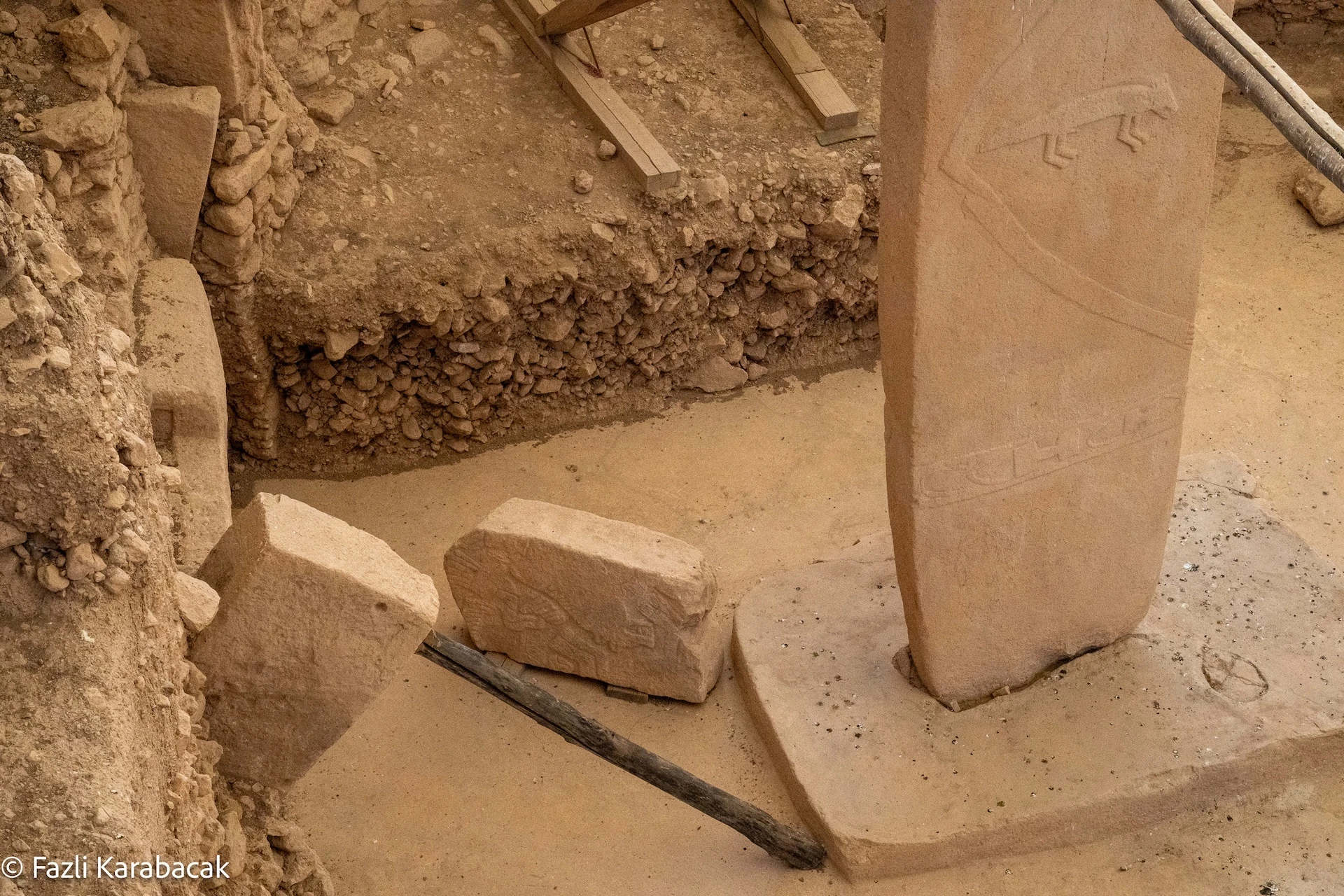
The imagery carved into the pillars provides perhaps the most compelling visual argument. Therianthropic figures — beings that blur the boundary between human and animal — appear across the site. As Dietrich notes, drawing on the theoretical framework of Philippe Descola and Tim Ingold, such imagery reflects what anthropologists call animistic ontologies: worldviews in which the boundary between human and non-human personhood is fundamentally fluid. This fluidity of identity between species is one of the most consistently reported features of altered states of consciousness across cultures, from Siberian shamanic traditions to Amazonian ayahuasca ceremonies.
Then there are the geometric patterns. Certain motifs at Göbekli Tepe bear resemblance to what neuropsychologists call entoptic phenomena — the geometric forms that the human nervous system spontaneously generates during early stages of trance. David Lewis-Williams and Thomas Dowson developed this “trance model” in their studies of southern African and European Palaeolithic rock art. While I always caution visitors against reading too much into any single motif, the clustering of such forms alongside clearly shamanic imagery strengthens the interpretive case.
What Is Peganum harmala and Why Does It Matter Here?
When visitors ask me which psychoactive substance might have been used at Göbekli Tepe, I point them toward the landscape itself. Peganum harmala, known in Turkish as üzerlik and in English as Syrian rue or harmel, grows wild across southeastern Anatolia. It is one of the most widely distributed psychoactive plants in the Near East, and its range encompasses the entire region surrounding Göbekli Tepe. You can still find it growing in the dry, rocky soils of the Harran Plain and along roadsides near Şanlıurfa today.
This is not a plant you need to search for. It thrives in disturbed soils and semi-arid environments — precisely the landscape that characterises the Göbekli Tepe region. Its seeds contain harmine and harmaline, beta-carboline alkaloids that function as monoamine oxidase inhibitors (MAOIs). These compounds produce vivid, dream-like visions at moderate doses and, importantly, they potentiate the effects of other psychoactive compounds when combined. In ethnographic contexts across the Near East, Central Asia, and North Africa, Peganum harmala has been burned as incense, consumed as an infusion, and used in fumigation rituals for millennia.
The chemical signature of harmel use has now been identified in ancient ritual contexts with scientific precision. In a remarkable 2023 study, Davide Tanasi and colleagues applied multimodal analysis — combining proteomics, metabolomics, ancient DNA metabarcoding, and synchrotron micro-FTIR spectroscopy — to the residues inside a Ptolemaic-period Bes-vase from Egypt, dating to the second century BCE. Their findings were extraordinary: the vessel contained traces of Peganum harmala (harmaline, harmine, and vasicine alkaloids), Nymphaea nouchali var. caerulea (the blue water lily, itself a mild psychoactive), and a fermented fruit-based liquid. The ancient DNA analysis identified Nitrariaceae — the harmel family — at sixty-four percent of recovered plant sequences.
Now, I must be clear: the Tanasi study dates to a period roughly nine thousand years after Göbekli Tepe’s construction. I am not suggesting a direct connection. But what it demonstrates is scientifically important: Peganum harmala was deliberately used in ritual contexts in the ancient Near East, its alkaloids are chemically detectable in archaeological residues, and its effects align with the kinds of visionary experiences depicted in ancient ritual art. The plant was there in Neolithic Anatolia. The knowledge of its effects almost certainly was too.
Walking the landscape: Burning üzerlik seeds for protection against the evil eye remains a living tradition in southeastern Turkey today — at weddings, at births, at moments of transition. When I lead tours through this landscape, I explain the ancient roots of this practice and why it tells us something about what happened inside the Göbekli Tepe enclosures. Join us on tour to understand this connection in the field.
Could the Beer at Göbekli Tepe Have Contained Psychoactive Additives?
In my article on beer brewing at Göbekli Tepe, I discussed the six large limestone vessels found at the site — some capable of holding up to 160 litres — with calcium oxalate residues consistent with fermentation. But there is an aspect of those vessels that deserves reconsideration in the context of psychoactive substances.
Fermented beverages in ancient societies were rarely “just beer” in the modern sense. Ethnographic and archaeological evidence consistently shows that ancient brews were frequently enhanced with various botanical additives. Peganum harmala, with its seeds easily added to a fermenting grain preparation, would have served as a potent additive. The harmine and harmaline in the seeds are water-soluble and survive the fermentation process. A beer enhanced with harmel seeds would have produced effects far beyond simple alcohol intoxication — vivid dream-like visions and the dissolution of ordinary perceptual boundaries.
This is precisely what Tanasi and colleagues identified in the Egyptian Bes-vase: a fermented base liquid combined with Peganum harmala and blue water lily. The practice of combining fermented beverages with psychoactive plant additives appears to be ancient, widespread, and deeply embedded in ritual contexts across the Near East. Whether the vessels at Göbekli Tepe contained such enhanced preparations remains unproven, but the possibility is pharmacologically and culturally plausible.
What Do the Three Bags on Pillar 43 Represent?
No discussion of psychoactive substances at Göbekli Tepe is complete without addressing the three mysterious bag-like objects carved along the top of Pillar 43, the famous “Vulture Stone” in Enclosure D. These containers have generated enormous interpretive interest.
What many visitors do not realise is that similar bag or bucket motifs appear across a vast range of ancient Near Eastern art — from Mesopotamian cylinder seals to Assyrian palace reliefs, often carried by divine or semi-divine beings. The motif persists for thousands of years after Göbekli Tepe, suggesting it carried deep cultural significance. Some researchers have connected these containers to the Hittite “kursa” — a sacred animal-skin bag used in temple rituals. Gregory McMahon’s work on the Hittite State Cult describes rituals involving three such bags made from goatskins, sheepskins, or ramskins, sacrificed to tutelary deities.
The question of what these containers might have held remains open. Proposals range from the mundane (food offerings, grain) to the provocative (psychoactive preparations, ritual pigments, sacred objects). Given the ritual context of Pillar 43 — with its complex scene involving vultures, a headless figure, and various symbolic elements — the possibility that these containers held substances used to facilitate altered states cannot be excluded. But I emphasise to visitors: this remains interpretive territory, not established fact.
What Do We Not Yet Know?
I believe in being transparent about the limits of our knowledge. Several crucial pieces of evidence that would strengthen or weaken the case for psychoactive plant use at Göbekli Tepe have not yet been obtained.
First, no chemical residue analysis specifically targeting psychoactive alkaloids has been published from the Göbekli Tepe vessels. The calcium oxalate detected confirms fermentation but does not address botanical additives. Targeted analysis for beta-carboline alkaloids (harmine, harmaline) in the vessel residues would be transformative.
Second, no archaeobotanical identification of Peganum harmala seeds has been reported from the site’s deposits. Given that the plant grows abundantly in the surrounding landscape, systematic flotation and microscopic analysis of enclosure fill could potentially recover such evidence.
Third, the interpretation of imagery as trance-related depends on cross-cultural comparison and theoretical models that, while well-supported, remain debated within archaeology. Alternative interpretations — mythological, cosmological, totemic — remain viable.
The space itself is the evidence: When you descend into the enclosures at Göbekli Tepe, the semi-subterranean architecture, the carved animal imagery at every angle, the acoustic properties — all create a space designed to produce specific psychological states. On our expert-guided tour, we explain the full picture of what these spaces were designed to do.
Key Takeaways
- Dietrich’s 2023 systematic analysis positively marks drug use evidence at Göbekli Tepe, based on the imagery, ritual contexts, and available botanical resources.
- Peganum harmala (Syrian rue / üzerlik), a potent psychoactive plant containing harmine and harmaline, grows wild throughout southeastern Turkey and was demonstrably used in ancient Near Eastern ritual contexts.
- The 2023 Tanasi et al. study identified harmel alkaloids in an Egyptian ritual vessel via ancient DNA and metabolomics — proving the chemical is archaeologically detectable.
- The site’s large limestone fermentation vessels may have held enhanced brews, though no alkaloid analysis has yet been published from Göbekli Tepe specifically.
- The three bags of Pillar 43, therianthropic figures, and entoptic-like geometric motifs all align with neuropsychological models of trance experience.
- What remains missing is direct chemical confirmation from the Göbekli Tepe vessel residues themselves.
Planning Your Visit
The enclosures at Göbekli Tepe are among the few ancient spaces where the architecture itself communicates something about the rituals that took place inside. The narrow entrance passages, the semi-subterranean depth, the acoustic qualities, the towering pillars — none of this is accidental. Understanding it requires context that goes beyond the standard site signage.
On our Göbekli Tepe guided day tour, we explain the ritual landscape — including the pharmacological evidence — and help you understand what these spaces were actually designed to produce.
Your Next Read
Suggested path: Shamanism at Göbekli Tepe → Ancestor Cult and the Skull Cult → Was Beer Brewed at Göbekli Tepe? → The Vulture Stone: Pillar 43. Planning a trip? Start with Plan Your Göbekli Tepe Trip.
Frequently Asked Questions
Were drugs used at Göbekli Tepe? Direct chemical evidence of psychoactive substance use has not yet been recovered from Göbekli Tepe. However, Jutta Dietrich’s 2023 systematic analysis positively marks drug use evidence as present at the site, based on the imagery, ritual contexts, and available botanical resources. Peganum harmala (Syrian rue), a potent psychoactive plant, grows wild throughout southeastern Turkey.
What is Peganum harmala and does it grow near Göbekli Tepe? Peganum harmala, known as Syrian rue, harmel, or üzerlik in Turkish, thrives in the dry, rocky soils of southeastern Anatolia and grows abundantly around Göbekli Tepe and Şanlıurfa today. Its seeds contain beta-carboline alkaloids (harmine and harmaline) that produce vivid dream-like visions and function as monoamine oxidase inhibitors.
What do the three bags on Pillar 43 represent? The three bag or bucket-like objects carved atop Pillar 43 remain among the most debated motifs at Göbekli Tepe. Similar container motifs appear across thousands of years of Near Eastern art. What they contained — food offerings, ritual pigments, psychoactive preparations, or sacred objects — remains an open question.
Is there scientific proof of ancient psychoactive plant use in the Near East? Yes. Tanasi et al. (2023) identified Peganum harmala alkaloids (harmaline and harmine) and blue water lily compounds in a Ptolemaic Egyptian ritual vessel through proteomics, metabolomics, and ancient DNA analysis. While dating to approximately the second century BCE — much later than Göbekli Tepe — it demonstrates that psychoactive plant use in Near Eastern ritual contexts is scientifically verifiable.
What are entoptic phenomena and why do they matter for Göbekli Tepe? Entoptic phenomena are geometric visual patterns (spirals, zigzags, grids, dots) spontaneously generated by the human nervous system during early stages of trance. David Lewis-Williams and Thomas Dowson’s neuropsychological model proposes that such patterns appear cross-culturally in art created by people experiencing altered states. Some geometric motifs at Göbekli Tepe resemble these forms, though alternative interpretations remain possible.
Could the beer at Göbekli Tepe have contained psychoactive additives? This is pharmacologically and culturally plausible. Ancient fermented beverages were commonly enhanced with botanical additives, and Peganum harmala seeds are water-soluble and survive fermentation. The Egyptian Bes-vase studied by Tanasi et al. contained precisely such a combination. However, no chemical analysis of Göbekli Tepe vessel residues has specifically tested for psychoactive alkaloids.
Fazlı Karabacak is a licensed Turkish tour guide with over 25 years of experience and the founder of Serendipity Turkey. He specialises in archaeological and cultural tours across Turkey, with particular expertise in Göbekli Tepe and the Pre-Pottery Neolithic sites of southeastern Anatolia.