Quick Answer
A full-day itinerary combining Göbekli Tepe and Karahan Tepe is ambitious but highly rewarding. Based on the latest official museum listings checked during this review, a more realistic start time is 08:30 AM, beginning at the Şanlıurfa Museum for essential context, then continuing to Göbekli Tepe mid-morning and Karahan Tepe in the early afternoon. The total driving time is roughly two hours across the day. Allow two hours at each site and ninety minutes at the museum. A rental car or guided tour remains the safest planning assumption.
At a Glance
- Best start time: 8:30 AM
- Ideal sequence: Museum → Göbekli Tepe → Karahan Tepe
- Total driving time: About 2 hours across the day
- Total visit time: About 5 to 6 hours
- Best for: Travellers with strong archaeological interest
- Transport: Rental car or guided tour
- Public transport: Not available for this route
- Best seasons: Spring and autumn
After twenty-five years of guiding in southeastern Turkey, I have refined what I consider the perfect day in the Neolithic world. It begins in a museum, moves to the ridge where humanity first built in stone, and ends in a rock-cut chamber where a carved face has been staring upward for eleven thousand years.
This is the itinerary I use with my own guests. I am sharing it here because I believe these two sites — Göbekli Tepe and Karahan Tepe — belong together, and seeing them on the same day creates connections that separate visits cannot replicate.
Before You Go: Logistics
Transport: You will need a vehicle. Limited or irregular local transport options may exist in some cases, but they are not reliable enough for a tightly timed same-day itinerary. A rental car from Şanlıurfa is the most flexible option. Alternatively, book a guided tour with a licensed operator who knows both sites and can provide the archaeological narrative that transforms stone into story.
Tickets: Turkish museum card access is officially noted on current Ministry listings, and broader Museum Pass arrangements may apply for international visitors. If your day depends on bundled access across the museum and sites, confirm current coverage before travel rather than relying on older third-party descriptions.
Season: The best months are March through May and September through November. Summer temperatures in this region regularly exceed 40°C, and both sites are exposed with minimal shade. If you visit in summer, start as early as possible and carry plenty of water.
Fitness level: Both sites involve moderate walking on paved or open paths. Comfortable shoes are essential.
8:30 AM — Şanlıurfa Archaeology Museum
Start your day here, not at the sites. The Şanlıurfa Museum Guide explains why in detail, but the short answer is simple: the museum transforms everything that follows.
The Şanlıurfa Archaeology Museum is one of Turkey’s finest, and its Neolithic galleries are among the most important in the world. The portable finds from both Göbekli Tepe and Karahan Tepe are housed here — carved stone vessels, stone plaquettes with animal imagery, pillar fragments, and modified human skulls that provide evidence for ancestor veneration practices.
The star of the collection is the Urfa Man — the Balıklıgöl Statue — the world’s oldest known life-size human sculpture. Standing before this limestone figure with its haunting obsidian eyes, you encounter the same artistic tradition that produced the pillars at Göbekli Tepe and the carved heads at Karahan Tepe.
Allow ninety minutes. The museum is large, but for this itinerary the Neolithic galleries are the priority.
10:00 AM — Drive to Göbekli Tepe
The drive from the museum to Göbekli Tepe takes roughly twenty to thirty minutes, heading northeast on a well-maintained road.
10:30 AM — Göbekli Tepe
I have written extensively about the experience of visiting Göbekli Tepe in my Göbekli Tepe Visitor Guide, but let me highlight what matters most in a day-tour context.
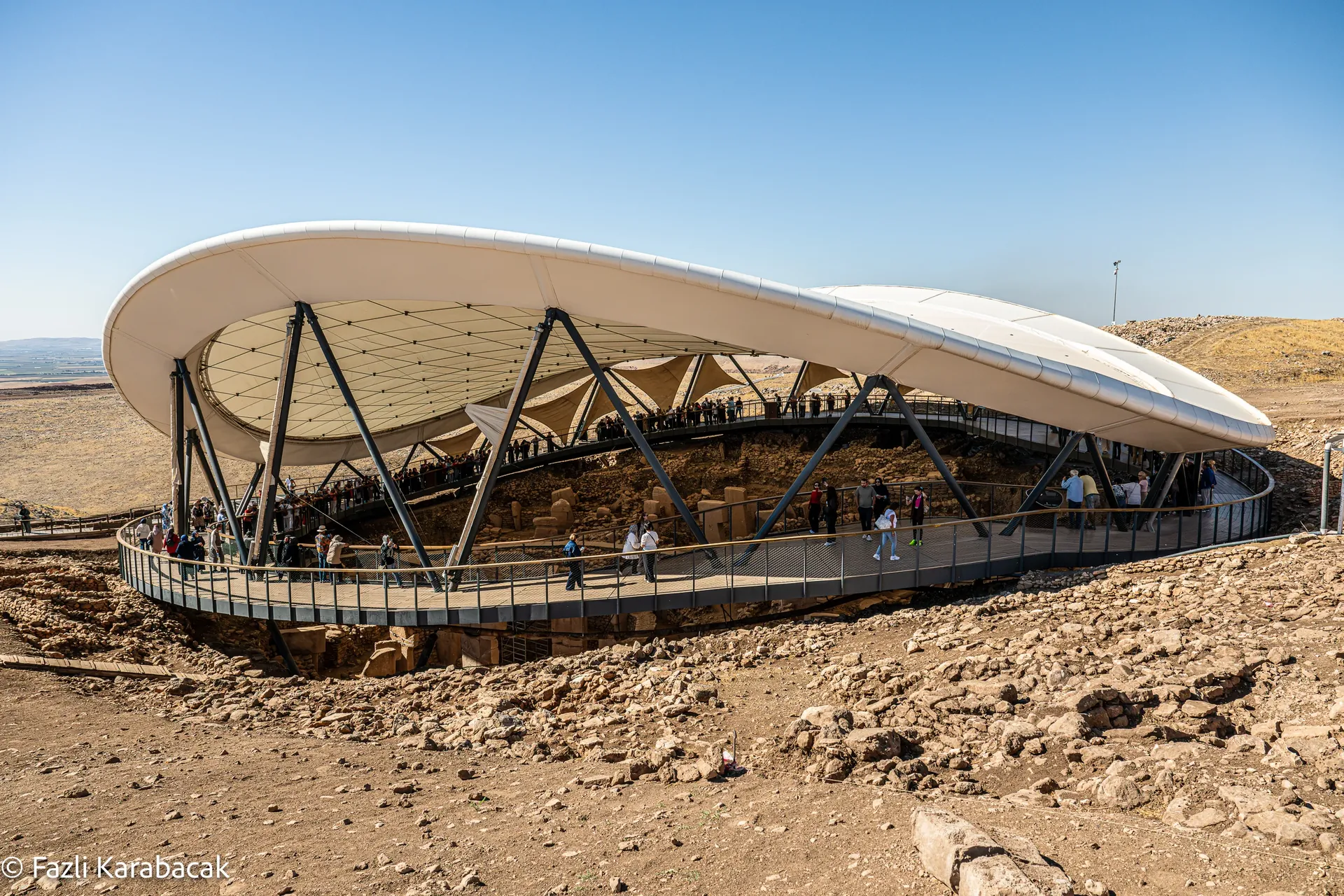
The main enclosures are viewed from elevated walkways beneath a protective canopy. Enclosure D is the showpiece: two central T-shaped pillars face each other across a narrow space, their arms bent at the elbow, hands meeting below the navel. Around them, smaller pillars carry carved foxes, boars, snakes, cranes, and other animals of the late Pleistocene wild world.
Take your time. The carvings reveal themselves gradually, especially in the raking morning light. Binoculars are genuinely useful for examining details from the walkway distance.
Allow a full two hours if you can. Many rushed visits miss what makes the site extraordinary.
12:30 PM — Lunch
You have two realistic options.
Option A: Return briefly to Şanlıurfa for a proper sit-down meal.
Option B: Carry a packed lunch and continue toward Karahan Tepe. This is usually the better option if you want a smoother archaeological day without unnecessary backtracking.
1:30 PM — Drive to Karahan Tepe
The drive from Göbekli Tepe to Karahan Tepe takes approximately one hour through the Tektek Mountains. The route is part of the experience: limestone country, sparse scrub, and a landscape that still feels remote enough to suggest how these ritual centres once sat within a wider Neolithic world.
2:30 PM — Karahan Tepe
If Göbekli Tepe is the more famous site, Karahan Tepe is increasingly the more dramatic one. The excavations here have revealed architectural forms that have no real parallel anywhere else in the Neolithic world.
Where Göbekli Tepe’s most famous spaces are freestanding enclosures, Karahan Tepe often works directly in bedrock. You are walking above rooms carved out of living limestone — a fundamentally different building technique that speaks to a different architectural expression within the same cultural horizon.
The most striking feature is the giant carved stone head rising from the bedrock floor. Even from the walkway above, it is one of the most memorable images in southeastern Anatolian archaeology.
If you want the broader comparison, read Karahan Tepe: Göbekli Tepe’s Sibling or Rival?.
Allow at least ninety minutes, ideally closer to two hours.
4:30 PM — Return to Şanlıurfa
The drive back to Şanlıurfa takes about an hour. If daylight and energy allow, you can still end the day in the old city around Balıklıgöl.
What This Day Teaches You
The real value of combining Göbekli Tepe and Karahan Tepe in a single day is not efficiency — it is comparison.
You see that the T-shaped pillar tradition was not a single-site phenomenon but part of a broader regional network. You see that different communities developed different architectural solutions while sharing a common symbolic vocabulary. And you understand much more clearly that Göbekli Tepe was not an isolated anomaly, but one node in a wider Neolithic world.
Practical Summary
- Total driving time: About two hours across the day
- Total site and museum time: Five to six hours
- Recommended start: 8:30 AM
- Recommended end: Late afternoon back in Şanlıurfa
- Best months: March–May, September–November
- Essentials: Water, sun protection, comfortable shoes, camera, and enough time
Take the Next Step
Two options: Do it yourself using the timing and route above, or let us handle the logistics so you can focus on the archaeology. Either way, the Plan Your Göbekli Tepe Trip page is where to begin. Need more background first? Read What Is Göbekli Tepe? and Karahan Tepe: Sibling or Rival?.
Frequently Asked Questions
Can you realistically visit Göbekli Tepe and Karahan Tepe in one day? Yes. It is ambitious but entirely feasible with an 8:30 AM start, a clear route, and careful time management. The key is beginning at the Şanlıurfa Museum (90 minutes) before visiting Göbekli Tepe (2 hours), then driving to Karahan Tepe (2 hours on site) before returning to Şanlıurfa in late afternoon. The total driving time is about two hours across the day.
How far is Karahan Tepe from Göbekli Tepe, and what’s the drive like? Karahan Tepe is approximately 55 kilometres from Göbekli Tepe by road, roughly one hour’s drive. The roads are paved and reasonably well-maintained, though signage can be unclear. A rental car with a GPS device or a guided tour operator familiar with the route is strongly recommended to avoid getting lost and falling behind schedule.
Do I need a guide for these sites, or can I visit independently? You do not need a guide to access either site, but a knowledgeable guide makes a substantial difference — especially if you want to understand the symbolism, architectural evolution, regional significance, and the relationship between the two sites. Guides licensed by the Turkish Ministry of Culture can interpret what you are seeing and help you ask the right questions.
What is the key difference between Göbekli Tepe and Karahan Tepe architecturally? Göbekli Tepe is famous for its freestanding monumental enclosures with central T-shaped pillars and elaborate animal reliefs. Karahan Tepe, by contrast, is distinguished by rock-cut ritual spaces carved directly into the living rock, unusual sculptural forms including “totem pole” arrangements, and a different architectural vocabulary. Seeing both on the same day reveals how Neolithic communities developed different solutions to the same ritual needs.
Is the day tour exhausting, and what should I prepare for? It is a full day of continuous activity with driving and walking, but not physically demanding if you are reasonably fit. Wear sturdy walking shoes, bring at least 2 litres of water per person, sun protection, and a camera. The sites are exposed; there is limited shade at either location. Plan for a substantial breakfast and lunch; bring snacks or eat in Şanlıurfa between sites.
What are the best months to do this day tour? Spring (March–May) and autumn (September–November) are ideal; the weather is comfortable, and the light is excellent for photography and for seeing carved details. Summer is possible but very hot (often 35–40°C). Winter can be wet and cold, though the sites remain open. Plan accordingly based on your tolerance for heat or cold.
Fazlı Karabacak is a licensed Turkish tour guide with over 25 years of experience and the founder of Serendipity Turkey. He specialises in archaeological and cultural tours across Turkey, with particular expertise in Göbekli Tepe and the Pre-Pottery Neolithic sites of southeastern Anatolia.