Quick Answer
Mircea Eliade’s foundational concepts — hierophany (the manifestation of the sacred), the sacred–profane dichotomy, the axis mundi (world axis), cosmogonic myth, and the eternal return — provide a powerful interpretive framework for understanding Göbekli Tepe. Although Eliade died in 1986, a decade before excavations began, his theoretical vocabulary maps onto the site with remarkable precision: the T-shaped pillars function as hierophanies, the semi-subterranean enclosures create bounded sacred spaces, the central pillars serve as vertical cosmic axes, and the deliberate burial and rebuilding of enclosures mirrors Eliade’s cycle of ritual renewal.
At a Glance
- Who was Eliade: Romanian-born historian of religions (1907–1986), perhaps the most influential theorist of the sacred in the 20th century
- Key works applied here: The Sacred and the Profane (1957), The Myth of the Eternal Return (1954)
- Applied to Göbekli Tepe by: Oliver Dietrich, Jens Notroff, and others in Defining the Sacred (Laneri ed., 2015)
- Core concepts: Hierophany · Sacred space · Axis mundi · Cosmogony · Eternal return
- Limits: Eliade’s universalism has been critiqued; Watkins and Banning emphasise practice over belief
- Why it still matters: Gives us a vocabulary for what twelve-thousand-year-old builders appear to have been doing
There is a book I recommend to nearly every serious visitor who wants to understand what they are about to see at Göbekli Tepe. It is not an archaeology textbook or a travel guide. It is Mircea Eliade’s The Sacred and the Profane, first published in 1957 — almost four decades before Klaus Schmidt broke ground on the limestone ridge northeast of Şanlıurfa. Eliade never saw Göbekli Tepe. He never knew it existed. And yet, reading his work after visiting the site, you might be forgiven for thinking he was describing it.
This is not coincidence. Eliade spent his career identifying what he believed were universal structures of religious experience — patterns that recur across cultures and millennia because they arise from something fundamental in the human encounter with existence. When we look at Göbekli Tepe through his lens, we do not find a perfect match — no theoretical framework survives contact with twelve-thousand-year-old reality without friction — but we find something more valuable: a vocabulary for articulating what the builders of this site appear to have been doing, and why it mattered to them so profoundly.
In my twenty-five years of guiding visitors through Turkey’s archaeological heritage, I have found that the greatest obstacle to understanding Göbekli Tepe is not a lack of information but a lack of categories. Modern visitors arrive with modern assumptions: that religion is separate from daily life, that sacred space is a building you enter on designated days. Eliade’s great contribution was to show that for most of human history, this separation did not exist — and understanding how it did not exist is the key to understanding sites like this one.
Hierophany: When the Sacred Breaks Through
At the heart of Eliade’s thought is a concept he called hierophany — from the Greek hieros (sacred) and phainein (to show, to manifest). A hierophany is any act, object, or event through which the sacred reveals itself within the profane world. It can be a stone, a tree, a spring, a mountain, a carved pillar, a ritual gesture — anything through which the transcendent becomes present.
The concept is deceptively simple, but its implications are radical. A stone that has become a hierophany is still a stone in every physical sense — the same weight, the same mineral composition. But for the person who experiences the hierophany, it is no longer merely a stone. It has become a point of contact between the human world and something beyond it.
I think of this every time I stand before the great T-shaped pillars. These are, literally, shaped pieces of limestone — quarried, carved, transported, and erected through extraordinary human labour. But they are also something else. The pillars are anthropomorphic. They have arms, carved in low relief along their sides. They have hands, with fingers meeting at the front where the belly would be. Many have belts, with elaborate buckles and fox-pelt loincloths. Their T-shaped tops represent stylised heads — faceless, abstract, but unmistakably the heads of beings.
In Eliade’s terms, the pillars are hierophanies — material objects through which something sacred manifests. They are limestone, yes. But they are also presences. Ancestors, spirits, supernatural beings — whatever name we give them, they occupy a category Eliade would have recognised instantly: the sacred made material. For homo religiosus — religious humanity — the sacred is not an abstraction but the most real thing in existence, and giving it material form is not optional but necessary.
Sacred Space: The Enclosures as Bounded Worlds
One of Eliade’s most enduring contributions is his analysis of how sacred space differs from profane space. For modern people, space is essentially homogeneous — one location is, in principle, no different from another. For homo religiosus, space is not homogeneous. It contains ruptures, breaks, points where the sacred has irrupted into the world.
Sacred space, in Eliade’s framework, is always bounded. The boundary may be a wall, a threshold, a circle of stones, a ditch, a change in elevation — but it is always present, because the sacred must be contained and protected from the contamination of the ordinary. To cross the boundary is to leave one mode of being and enter another.
The enclosures at Göbekli Tepe are almost textbook illustrations of this principle. Each is a clearly bounded space — a roughly circular or oval area defined by stone walls, benches, and rings of T-shaped pillars, sunk into the bedrock below the level of the surrounding terrain. To enter an enclosure is to descend — to leave the open hilltop and enter a semi-subterranean world where the sky narrows, the light changes, and the carved pillars close in.
This descent is itself a hierophanic act in Eliade’s sense. The threshold is not merely architectural — it is ontological. It marks the border between two modes of being. Oliver Dietrich and Jens Notroff, writing in Nicola Laneri’s Defining the Sacred (2015), argued convincingly that the enclosures cannot be understood as ordinary structures. Their scale, imagery, labour investment, and architectural distinctiveness all point to spaces that were fundamentally different in kind from the everyday environment of their builders.
On the ground: On our Göbekli Tepe and Karahan Tepe day tour, one of the moments I treasure most is the pause at the rim above Enclosure D. Visitors stand where twelve thousand years ago the profane world ended and the sacred space began. Even now, with walkways and shelters in the way, that threshold still feels like something.
The Axis Mundi: Pillars That Connect Worlds
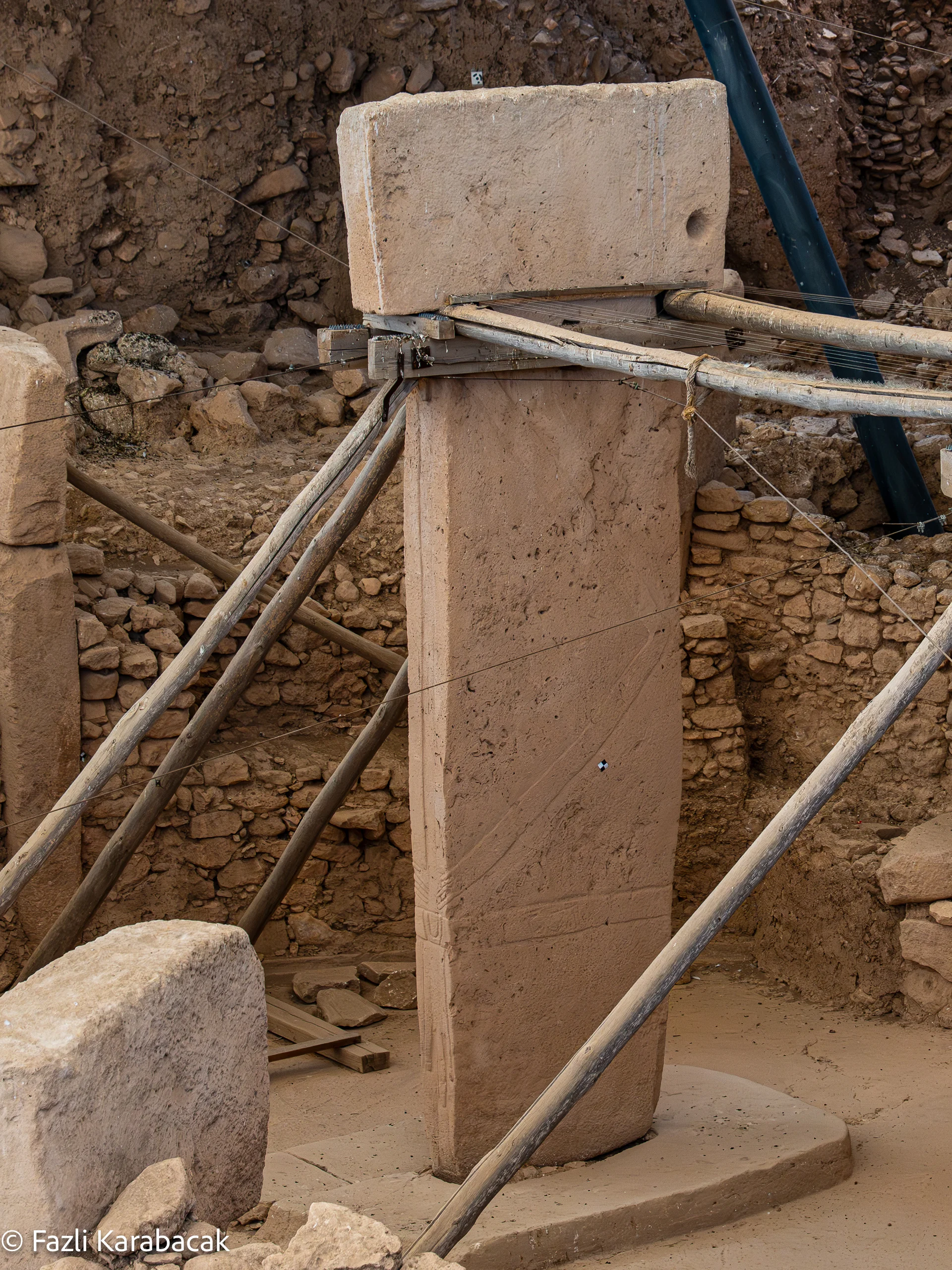
Perhaps the most evocative of Eliade’s concepts, when applied to Göbekli Tepe, is the axis mundi — the world axis, the cosmic pillar, the centre of the world. In Eliade’s comparative study, the axis mundi appears again and again across cultures: as a sacred mountain, a cosmic tree, a temple tower, a totem pole. It is the vertical line that connects the different levels of the cosmos — underworld below, human world in the middle, heavens above.
Now consider the central pillars of Göbekli Tepe’s enclosures. In each major enclosure, two pillars stand at the centre — taller, more elaborately carved, more massive than the peripheral pillars in the surrounding ring. In Enclosure D, Pillars 18 and 31 stand over three metres tall, their T-shaped heads rising above the surrounding architecture.
It is difficult to stand between these pillars and not feel the pull of Eliade’s axis mundi. They are, quite literally, the vertical centre of the space. Oliver Dietrich’s 2023 analysis interpreted the imagery on Pillar 43 — the famous Vulture Stone — as depicting a multi-tiered cosmos: earth, sky, and an underworld realm, stacked vertically on a single pillar surface. If this interpretation holds, the pillars serve not only as hierophanies but as cosmographic instruments — stone mappings of the vertical structure of reality.
Cosmogonic Myth and the Act of Foundation
Eliade argued that for homo religiosus, the founding of a sacred space is never arbitrary. It is always, in some sense, a repetition of the cosmogony — the original act of world-creation. Every temple is a model of the cosmos, and every act of consecration recapitulates the original creative act by which the gods brought the world into being.
The construction of the Göbekli Tepe enclosures demands interpretation along these lines. A community of hunter-gatherers — people without metal tools, without draft animals, without wheels — quarried limestone pillars weighing up to sixteen tonnes. They carved them with flint tools. They transported them, sometimes hundreds of metres, to prepared construction sites. Estimates suggest that the construction of a single major enclosure required the coordinated effort of hundreds of people over extended periods.
What could have motivated this extraordinary investment?
Eliade’s answer would be clear: the creation of sacred space is the most important work possible — more important than shelter, more important than food storage. It is the act by which the world is given structure and meaning. It is the cosmogonic act itself, performed in human hands. Schmidt himself recognised something like this when he proposed his famous formulation: “First came the temple, then the city.” What he meant — and what Eliade would have understood immediately — is that the impulse to create sacred space preceded and motivated the development of settled community, not the other way around.
The Eternal Return: Burial, Renewal, and Ritual Time
One of the most mysterious aspects of Göbekli Tepe is the deliberate burial of the enclosures. At a certain point in their use-life, each major enclosure was intentionally filled with earth, rubble, animal bones, and stone debris. The pillars were not destroyed — they were entombed. In several cases, new enclosures were constructed nearby, beginning the cycle again.
Why bury a temple? Various practical explanations have been proposed. But Eliade offers an interpretive framework that may cut closer to the heart of the matter: the eternal return.
In Eliade’s understanding, archaic societies did not experience time as modern people do — as a linear progression from past to future. Instead, they experienced time cyclically, with sacred time periodically abolishing profane time through ritual re-enactment of the cosmogony. The world is created; it ages, decays, becomes exhausted; it is ritually destroyed; it is created again.
The burial and reconstruction cycle at Göbekli Tepe maps suggestively onto this pattern. An enclosure is created — the cosmogonic act. It is used, inhabited by its carved pillar-beings, filled with ritual activity. Over time, it ages. And then it is buried — not abandoned, not destroyed, but given what several archaeologists have described as a “building funeral.” A new space is created, beginning the cycle again.
Licia Romano’s study of temple lifecycles in early Mesopotamia documented strikingly similar patterns: rituals of construction, restoration, and deliberate destruction of sacred buildings, understood as living entities with their own life cycles. The Mesopotamian evidence is far more detailed, but the structural parallel with Göbekli Tepe’s construction-use-burial cycle is difficult to ignore.
The Limits of Eliade
I would be doing a disservice if I did not also note where Eliade’s framework meets its limits. Eliade has been criticised — with some justice — for constructing a phenomenology of religion that is so abstract and universal it risks flattening the specific, local character of actual historical practices. When we say the central pillars are “like” an axis mundi, we have identified a structural parallel, but we have not explained what the pillars meant to the specific people who carved them.
Trevor Watkins, writing in the same volume, argued for an approach to Neolithic religion that emphasises practice over belief — what people did, rather than what they thought. Religion, in this view, should be understood not as a set of ideas but as a set of practices through which communities created and maintained shared symbolic worlds. The builders of Göbekli Tepe were not philosophers constructing a systematic theology.
Ted Banning’s 2011 critique of the temple-versus-house dichotomy also challenges the framework, though indirectly. Banning argued that the distinction between sacred and domestic space may be a modern imposition. Lee Clare’s 2020 discovery of domestic structures at Göbekli Tepe complicated the picture further.
Eliade would not have been troubled by this, I think. His conception of homo religiosus was precisely that of a being for whom the sacred is not confined to designated spaces but permeates all of existence. A place can be both a home and a temple. The question is not whether sacred and domestic activities can coexist — they obviously can — but whether the builders of Göbekli Tepe experienced their monumental enclosures as qualitatively different from their everyday living spaces. The archaeological evidence — the scale, the imagery, the labour investment, the controlled entrances, the deliberate burial — suggests powerfully that they did.
Why Eliade Still Matters at Göbekli Tepe
When I finish a day of guiding and sit down to read in the evening, I often return to Eliade — not because I think he had all the answers, but because he asked the right questions. What does it mean for a place to be sacred? Why do human beings invest extraordinary effort in creating spaces that serve no immediately practical function? What is the relationship between sacred architecture and the human need for orientation, meaning, and connection to something beyond the everyday?
Standing between the great pillars, in the semi-subterranean hush of the enclosures, visitors experience something no guidebook can fully prepare them for. The space does something to you. It changes the quality of your attention, slows your breathing, makes you quiet. You do not have to believe in Eliade’s ontology of the sacred to feel this — but Eliade gives you a language for what you are feeling. He gives you permission to take the experience seriously, not as a quaint echo of “primitive” thinking but as a glimpse into a dimension of human experience that modernity has obscured but not abolished.
Göbekli Tepe, I sometimes tell my groups, is proof that Eliade was right about at least one thing: the sacred is not an invention of civilisation. It is older than civilisation. It is, perhaps, the very thing that made civilisation possible.
Key Takeaways
- Eliade’s hierophany — the manifestation of the sacred in material objects — frames the T-shaped pillars as more than architecture: they are presences through which the sacred becomes accessible.
- The bounded, semi-subterranean enclosures closely correspond to Eliade’s analysis of sacred space as qualitatively different from profane space.
- The central pillars function as axis mundi — the vertical centre of the cosmos — a reading supported by Dietrich’s identification of multi-tiered cosmic imagery on Pillar 43.
- The deliberate burial and rebuilding of enclosures mirrors Eliade’s concept of the eternal return — cyclical destruction and re-creation through ritual.
- Eliade’s framework has limits: Watkins and Banning emphasise practice over belief and question rigid sacred/domestic dichotomies.
- The core insight remains: the sacred is not an invention of civilisation but a fundamental dimension of human experience — monumentalised in stone at Göbekli Tepe.
Planning Your Visit
The theoretical vocabulary is most useful when you can stand inside the spaces it describes. On our Göbekli Tepe and Karahan Tepe guided day tour, we move slowly through the site, taking time for the thresholds, the axes, and the embodied experience of descending into a bounded sacred space designed twelve thousand years before any book was written about it.
Your Next Read
Suggested path: Was Göbekli Tepe the First Religion? → Was Göbekli Tepe a Temple? → Why Was Göbekli Tepe Buried? → Sound and Acoustics at Göbekli Tepe.
Frequently Asked Questions
Did Mircea Eliade ever write about Göbekli Tepe? No. Eliade died in 1986, nearly a decade before Klaus Schmidt began excavations in 1995. However, his theoretical concepts — developed through comparative study of religions worldwide — apply remarkably well to the site, which is why his work remains essential reading for understanding Neolithic sacred architecture.
What is a hierophany? A hierophany is any manifestation of the sacred in the profane world. The term was coined by Eliade from the Greek words for “sacred” and “to show.” It can be an object, place, person, natural phenomenon, or ritual act through which the transcendent becomes present.
What is the axis mundi? The axis mundi, or world axis, is a universal symbol representing the centre of the world — the vertical line connecting earth, heaven, and underworld. It appears across cultures as a sacred mountain, cosmic tree, temple tower, or standing pillar. The central T-shaped pillars at Göbekli Tepe may have served this function.
What does “the sacred and the profane” mean? In Eliade’s framework, these are the two fundamental modes of being in the world. The sacred is that which is wholly other — powerful, meaningful, real in the deepest sense. The profane is the ordinary, the everyday. For homo religiosus, the goal is to live in proximity to the sacred, which gives structure and meaning to existence.
Is Eliade’s framework accepted by all archaeologists? No. Eliade’s approach has been critiqued for being too universalising and for privileging belief over practice. Scholars like Trevor Watkins emphasise what people did rather than what they believed. Most contemporary archaeologists use Eliade selectively rather than wholesale.
Fazlı Karabacak is a licensed Turkish tour guide with over 25 years of experience and the founder of Serendipity Turkey. He specialises in archaeological and cultural tours across Turkey, with particular expertise in Göbekli Tepe and the Pre-Pottery Neolithic sites of southeastern Anatolia.