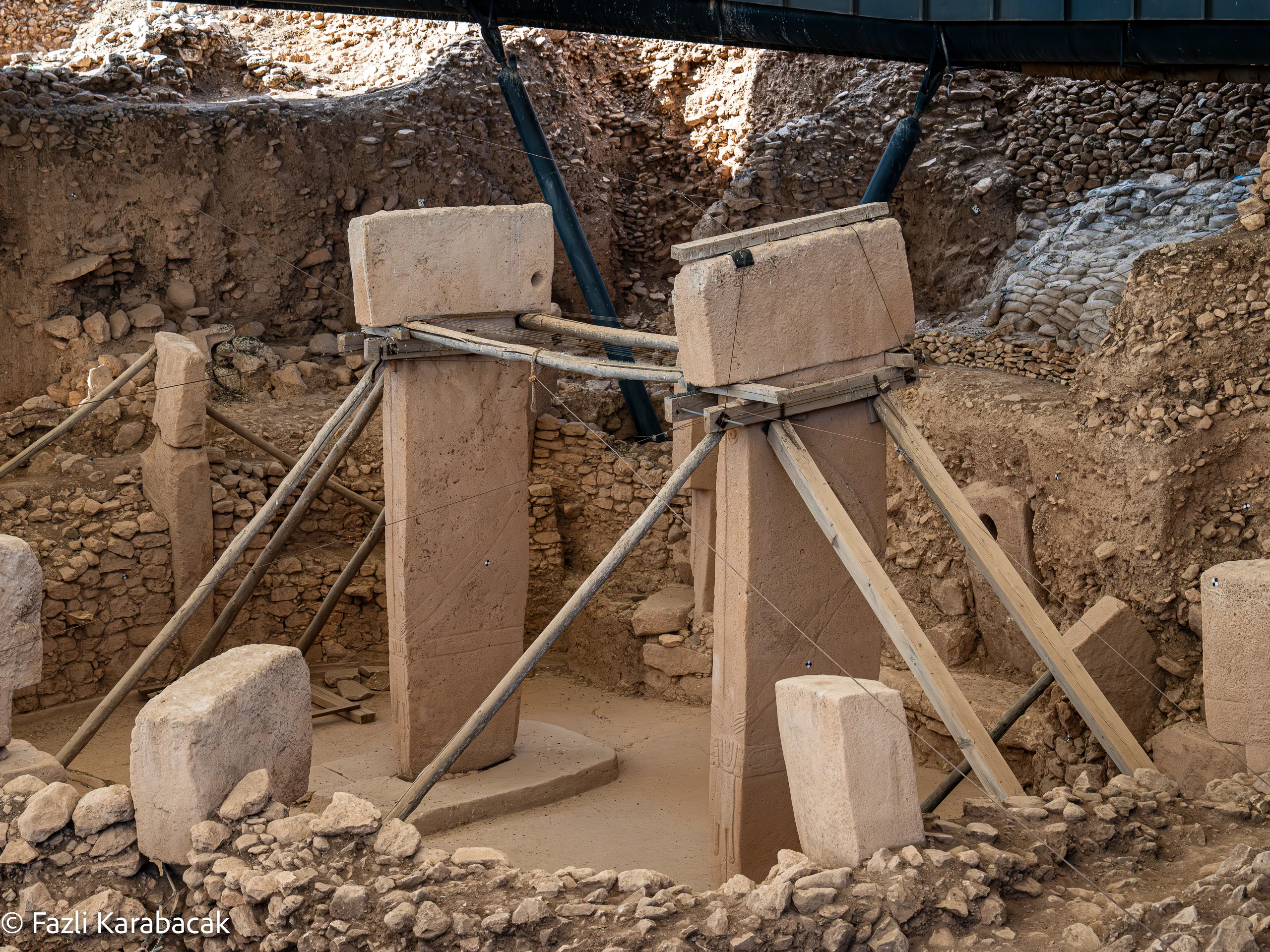
Quick Answer
At least eight distinct academic theories compete to explain Göbekli Tepe’s purpose: sacred sanctuary, hunting-ground ideology, sacrificial violence management, shamanic astronomy, human-nature entanglement, Paleolithic shamanic continuity, cosmic Milky Way shamanism, and totemic clan identity. No single theory has won the debate — and that ongoing conversation is itself one of the most important things about the site.
At a Glance
- Central debate: Was Göbekli Tepe a sacred ritual space or an ideological extension of economic power?
- Number of theories: At least eight distinct academic frameworks
- Key scholars: Klaus Schmidt, Oliver Dietrich, Bahattin Çelik, Orhan Ayaz, Gifford & Antonello, Mark Black, Nicola Laneri, Jiří Kovárník, Rufus Malim
- Time depth: Theories range from those treating the site as a beginning to those seeing it as a milestone in a 30,000-year tradition
- Big takeaway: The quality of the questions matters more than any single answer
Why So Many Theories? A Personal Introduction
The first time I stood on the ridge at Göbekli Tepe was in the spring of 2002. Klaus Schmidt’s excavations were still in their early years, and the site was not yet famous. There were no walkways, no visitor platforms, no UNESCO plaque. Just limestone pillars emerging from the earth like silent witnesses to something none of us fully understood.
Twenty-five years later, I still do not fully understand it — and neither, it turns out, does anyone else. What has changed is the sheer number of competing explanations. When I started guiding tours here, there was essentially one narrative: Schmidt’s vision of a “cathedral on a hill,” a purely ritual site built by hunter-gatherers before they ever planted a seed. That story was elegant. It was also, as Turkish academics would later argue, incomplete.
Today, I count at least eight distinct academic frameworks attempting to explain what happened on this hilltop 11,600 years ago. Some contradict each other. Some overlap in surprising ways. All of them illuminate something real about the site. Let me walk you through each one, in roughly the order I encountered them — because the chronology of the debate is itself part of the story.
Theory 1: The Sacred Sanctuary — The German School
Scholars: Klaus Schmidt, Oliver Dietrich, Jens Notroff, Laura Dietrich (DAI)
This is where it all began, and for most visitors arriving at Göbekli Tepe today, this is still the dominant narrative. The German Archaeological Institute (DAI) has led excavations at the site since 1995, and their interpretation rests on several interlocking arguments.
First, they point out that no domestic structures, no hearths, no sleeping quarters, and no storage facilities have been found at Göbekli Tepe. This absence is their strongest card: if nobody lived here, then the massive labor required to quarry, carve, and erect these T-shaped pillars — some weighing over 10 tons — must have been motivated by something other than daily survival. That something, the German school argues, was ritual.
The T-pillars themselves are understood as stylized human figures. They have arms carved in low relief along their sides and hands meeting at the front, fingers intertwined. The German team interprets them as supernatural beings or deified ancestors, standing silently in circular enclosures that served as stages for initiation rites, communal feasting, and possibly funerary rituals involving the defleshing of the dead (excarnation).
I remember guiding a group of German archaeology students in 2008, and their professor said something that stuck with me: “This place is proof that the human need for meaning came before the human need for bread.” That sentence is essentially the Schmidt thesis in miniature — that ideology drove the Neolithic Revolution, not the other way around. For more on the man who started it all, see Klaus Schmidt and Göbekli Tepe.
“First came the temple, then the city.” — Klaus Schmidt’s famous formulation, which inverted everything we thought we knew about the birth of civilization.
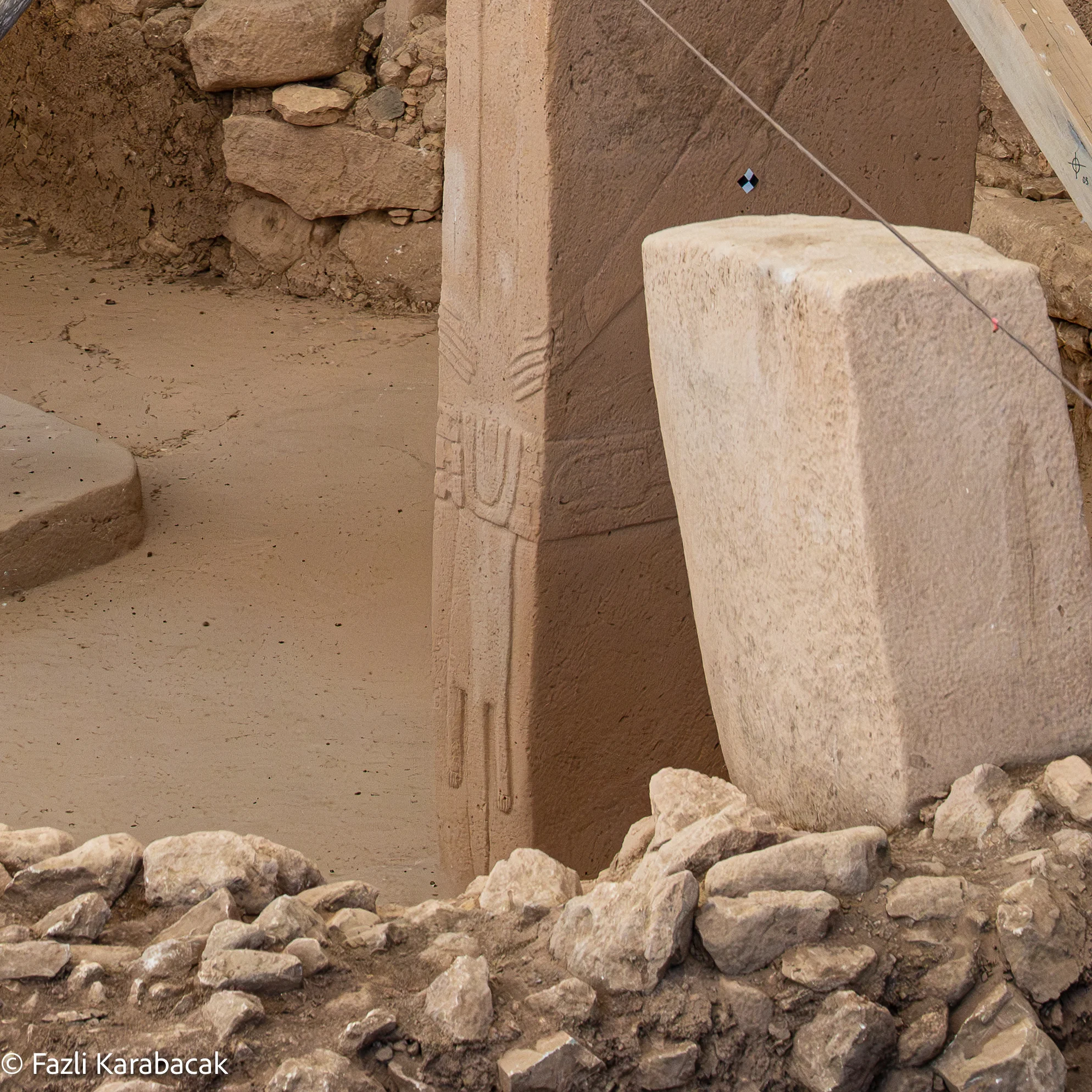 The arms, hands, and belt details on a T-shaped pillar — evidence the German school uses to argue these are stylized human figures.
Theory 2: The Hunting-Ground Economy — The Turkish School
Scholars: Bahattin Çelik, Orhan Ayaz
Starting around 2015, I began hearing a very different interpretation from Turkish academics working in the region. Their argument did not deny the ritual dimension of Göbekli Tepe, but it insisted that ritual could not be separated from economics and power.
Bahattin Çelik, who has excavated extensively at nearby sites like Karahan Tepe and Harbetsuvan, documented vast V-shaped and wing-shaped stone trap systems in the landscape surrounding Göbekli Tepe. These are not small structures. Some enclose areas of 10 to 100 decares — enormous hunting corrals designed to funnel gazelle herds toward kill zones. Çelik’s argument is straightforward: whoever controlled these hunting grounds controlled the food supply for the entire region.
Orhan Ayaz took this further by applying sociologist Max Weber’s concept of “speculative knowledge.” In Weber’s framework, pre-modern power structures are legitimized not by force alone, but by ideology — by a ruling group’s claim to special knowledge about the supernatural. Ayaz argues that the T-pillars and their elaborate animal carvings are not depictions of feared or worshipped creatures. They are representations of animals that these communities physically interacted with through the hunting-ground economy. The ritual space at Göbekli Tepe, in this reading, was an ideological machine: a place where the people who controlled the hunting grounds also controlled the narrative about why they deserved to control them.
Ayaz also offers a strikingly different reading of the T-pillars themselves. Drawing on evidence from Kilisik sculpture, the Urfa Man statue, and especially the ten overtly phallic pillars at Karahan Tepe, he argues the T-shape represents ancestral phalli — symbols of male fertility, lineage authority, and generational power. The recent discovery of a realistic human figure at Sayburç, depicting a man gripping his phallus while flanked by animals, strengthened this interpretation considerably.
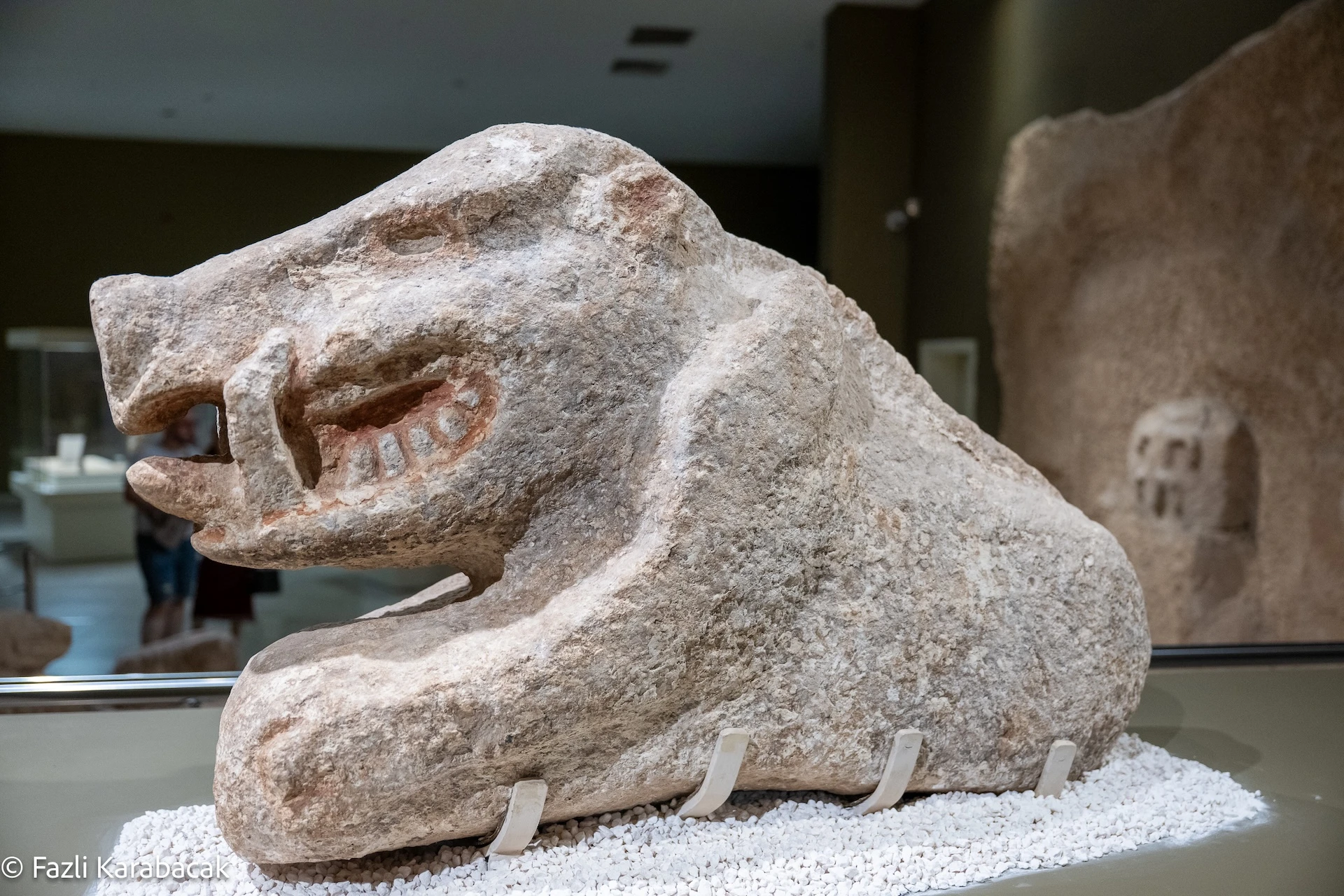 Wild boar imagery at Göbekli Tepe — one of the animals the Turkish school connects to the hunting-ground economy.
Theory 3: Sacrificial Violence and Social Cohesion — The Girardian School
Scholars: Gifford & Antonello
This is the theory that surprised me most when I first encountered it in a conference paper around 2019. It asks a question that neither the German nor the Turkish school fully answers: what psychological mechanism held these pre-agricultural communities together?
Gifford and Antonello apply French philosopher René Girard’s mimetic theory to Göbekli Tepe. The core idea: as human communities grow larger, individuals begin to desire the same things (mimesis), which inevitably generates conflict and violence. Left unchecked, this spiral destroys the group. The solution, Girard argued, is the scapegoat mechanism — the community channels its collective violence onto a single victim, whether human or animal, whose sacrifice restores peace.
Under this lens, Göbekli Tepe is not simply a place of worship. It is the institutional framework for managing violence through ritual sacrifice. The circular enclosures are not temples in the passive sense — they are theaters where the community’s accumulated tensions were discharged through controlled killing. The animal carvings are not decorative; they are records of the sacrificial species, and the headless human figure on Pillar 43 may depict the ultimate sacrifice.
What makes this theory compelling is that it explains something the others struggle with: why hunter-gatherer bands, who had survived for millennia in small groups, suddenly needed monumental architecture. The answer, in Girardian terms, is that growing population density created a crisis of internal violence that demanded a new, more powerful ritual solution.
Theory 4: Zarzian-Natufian Shamanic Astronomy — The Independent Researcher School
Scholar: Mark Black
Mark Black works outside traditional academic institutions, and his theories are the most ambitious — some would say speculative — of any I have encountered. But having read his work carefully, I believe he asks questions that institutional scholars sometimes avoid.
Black’s central argument is that Göbekli Tepe was not built by a single culture. He identifies two distinct groups: the Zarzian culture from the Zagros Mountains (modern-day Iraq/Iran, roughly 12,400–8,500 BCE), whom he considers the master architects, and the Natufian culture from the Levant, whom he sees as a subordinate labor force. His evidence comes from an unexpected source: the three handbag-shaped carvings on the famous Vulture Stone (Pillar 43).
According to Black, these bags are shamanic kits, and their contents can be decoded through the animal figures associated with each one. The combination of power animals — bird, goat, turtle, bee — maps onto specific cultural signatures. The dual sourcing of obsidian found at the site (from both Bingöl in the northeast and sources in southeastern Anatolia) provides physical evidence that two geographically distinct groups were indeed present.
But Black goes further. He argues that the upper register of Pillar 43 is not just a ritual scene — it is a star map. The rectangular “bags” correspond to the Great Square of Pegasus, and the arrangement of figures maps specific constellations visible during rituals conducted at night. In his related work on “Zarzian Solar Snake Shamanism,” he proposes that the snake iconography abundant at the site represents the sun’s earthly counterpart, and that ceremonies were timed to the winter solstice — the moment when the sun “dies and is reborn.”
I have stood at Pillar 43 more times than I can count. Every time I look at those three bags, I think of Black’s interpretation. It is the kind of theory that changes how you see, even if you are not fully convinced.
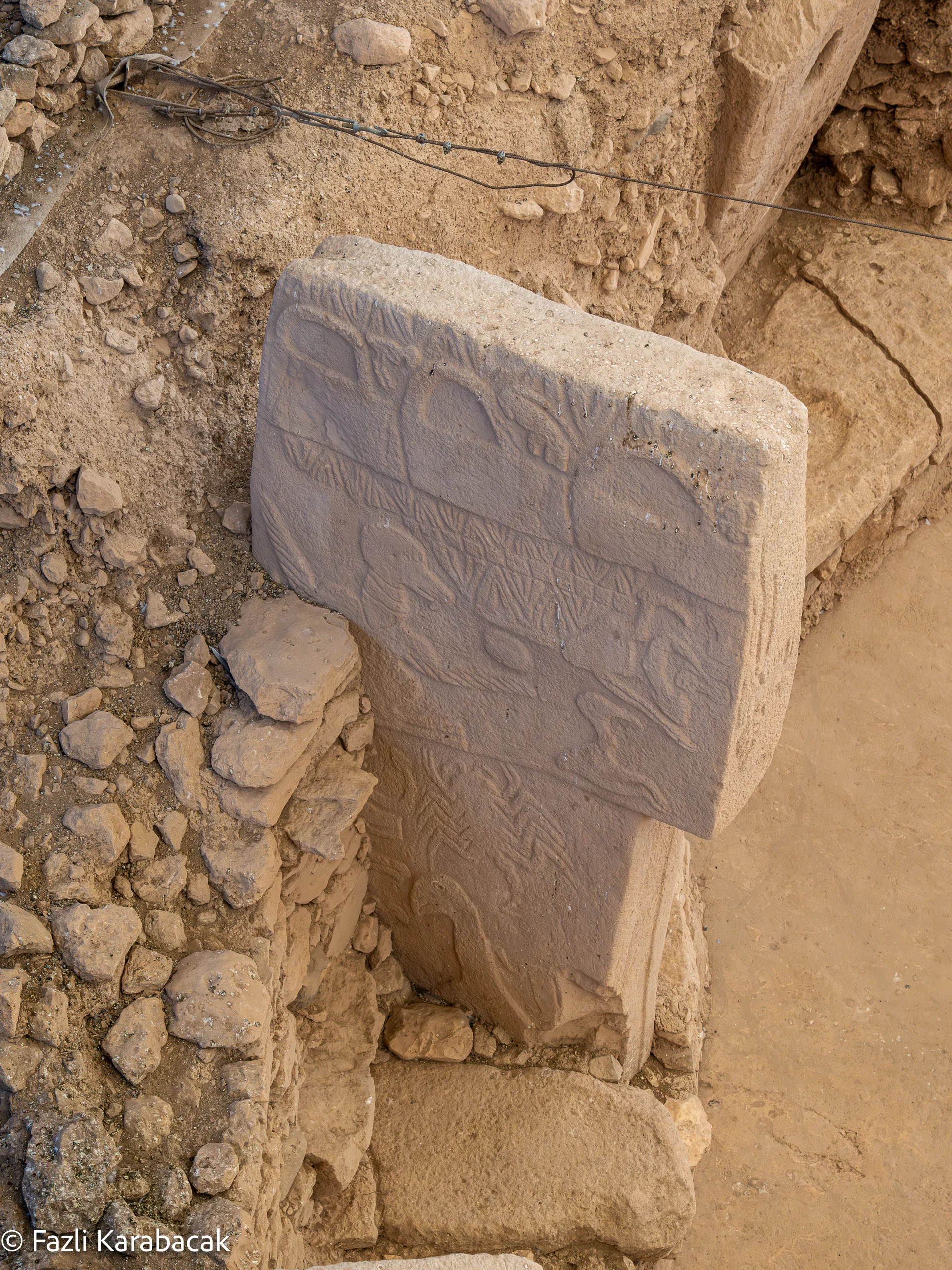 Pillar 43, the Vulture Stone — the most debated carving at Göbekli Tepe. Mark Black reads the upper register as a star map; the Girardian school sees sacrificial imagery.
Theory 5: Human-Nature Entanglement — The Relational Ontology School
Scholar: Nicola Laneri
Nicola Laneri, drawing on his excavations at Hirbemerdon Tepe in the Upper Tigris region, offers perhaps the most philosophically sophisticated framework. He rejects the basic assumption shared by both the German and Turkish schools: that humans and nature are separate categories, with humans acting upon nature either spiritually (the German view) or economically (the Turkish view).
Instead, Laneri proposes an “entanglement” model. In this ontology, humans, animals, and supernatural forces are not distinct entities but overlapping, mutually constitutive layers of being. The animals carved on the pillars are not symbols of something else — they are not “standing for” fear, or power, or economic resources. They are co-participants in a shared reality where the boundaries between human, animal, and spirit are permeable.
This may sound abstract, but it has a concrete archaeological implication. If the builders of Göbekli Tepe did not see themselves as separate from the animals they depicted, then our entire framework of interpretation — “worship,” “hunting magic,” “clan totems” — imposes modern Western categories onto a radically different worldview. Laneri’s theory warns us that the most dangerous assumption in Göbekli Tepe scholarship is that these people thought the way we do.
Theory 6: 30,000 Years of Shamanic Continuity
Scholar: Jiří Kovárník
Most theories treat Göbekli Tepe as a beginning — the dawn of organized religion, the first monumental architecture, the start of something new. Kovárník turns this on its head. In his view, Göbekli Tepe is not a beginning. It is a milestone in a tradition that stretches back at least 30,000 years.
His evidence comes from Paleolithic cave art, particularly the therianthropic figures at Les Combarelles in France (dated to roughly 12,000–17,000 BCE). These half-human, half-animal beings — a man with antlers, a woman with a bison’s body — are widely interpreted as depictions of shamans in trance states, their consciousness merging with animal spirits. Kovárník argues that this tradition of shamanic transformation never stopped. It passed from cave painters to open-air ritualists to, eventually, the builders of Göbekli Tepe.
The T-pillars, in this reading, are three-dimensional versions of what cave walls once displayed in two dimensions. The shift from painted cave to carved stone is not a change in belief — it is a change in medium. The underlying neurology is the same: the human brain’s capacity for trance, hallucination, and identity-shifting has not changed in 30,000 years. Göbekli Tepe is where that ancient practice finally became architecture.
I find this theory particularly moving. It connects this hilltop in southeastern Turkey to cave walls in France, to ritual fires in Africa, to something deep and ancient in the human mind. When I share this perspective with visitors, the pillars seem to grow taller.
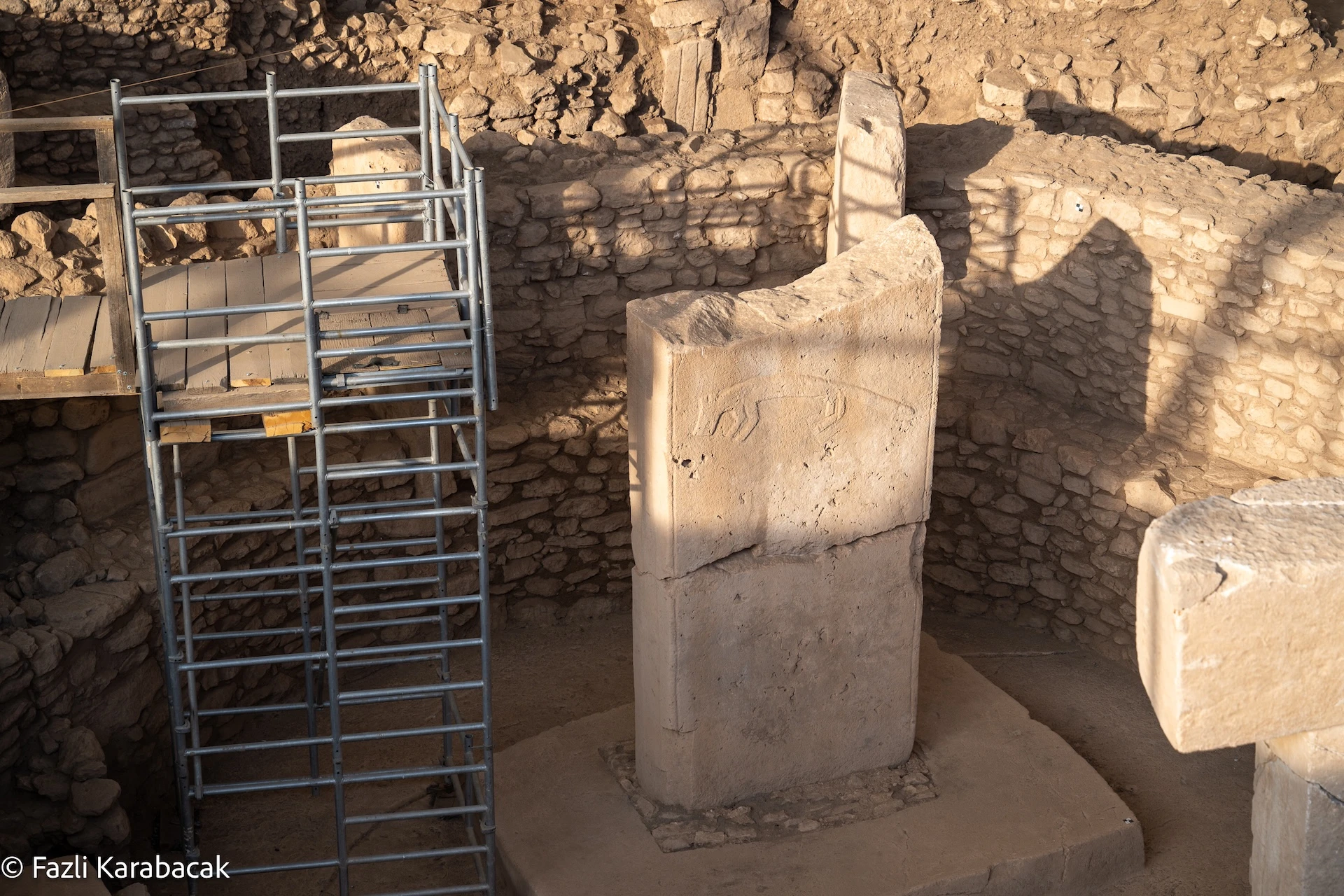 Fox carvings at Göbekli Tepe — the fox appears across multiple enclosures and features in both the shamanic and totemic interpretations.
Theory 7: Cosmic Shamanism and the Milky Way
Source: The Shamanic Chronicles school of interpretation
This school takes the shamanic interpretation further into the cosmos. Its proponents argue that Göbekli Tepe was not merely a local cult site but a crystallization point for a universal shamanic cosmology — one organized around the Milky Way.
The core idea: the builders of Göbekli Tepe were night-sky observers. Their shamanic journeys — the “soul flights” described in ethnographic accounts of shamanism worldwide — followed the path of the Milky Way across the sky. The enclosures, partially submerged below ground level, represented the underworld. Entering them was a symbolic act of death; emerging was rebirth. The ceremonies conducted inside were collective simulations of the shaman’s death-and-return journey.
Supporters of this view point to possible astronomical alignments in the enclosures. Certain pillars, they argue, frame the rising of specific star clusters at solstice and equinox points. If correct, this would mean Göbekli Tepe functioned not only as a spiritual center but also as an observatory — a place where the calendar was read, seasons were predicted, and the cosmos was mapped in stone.
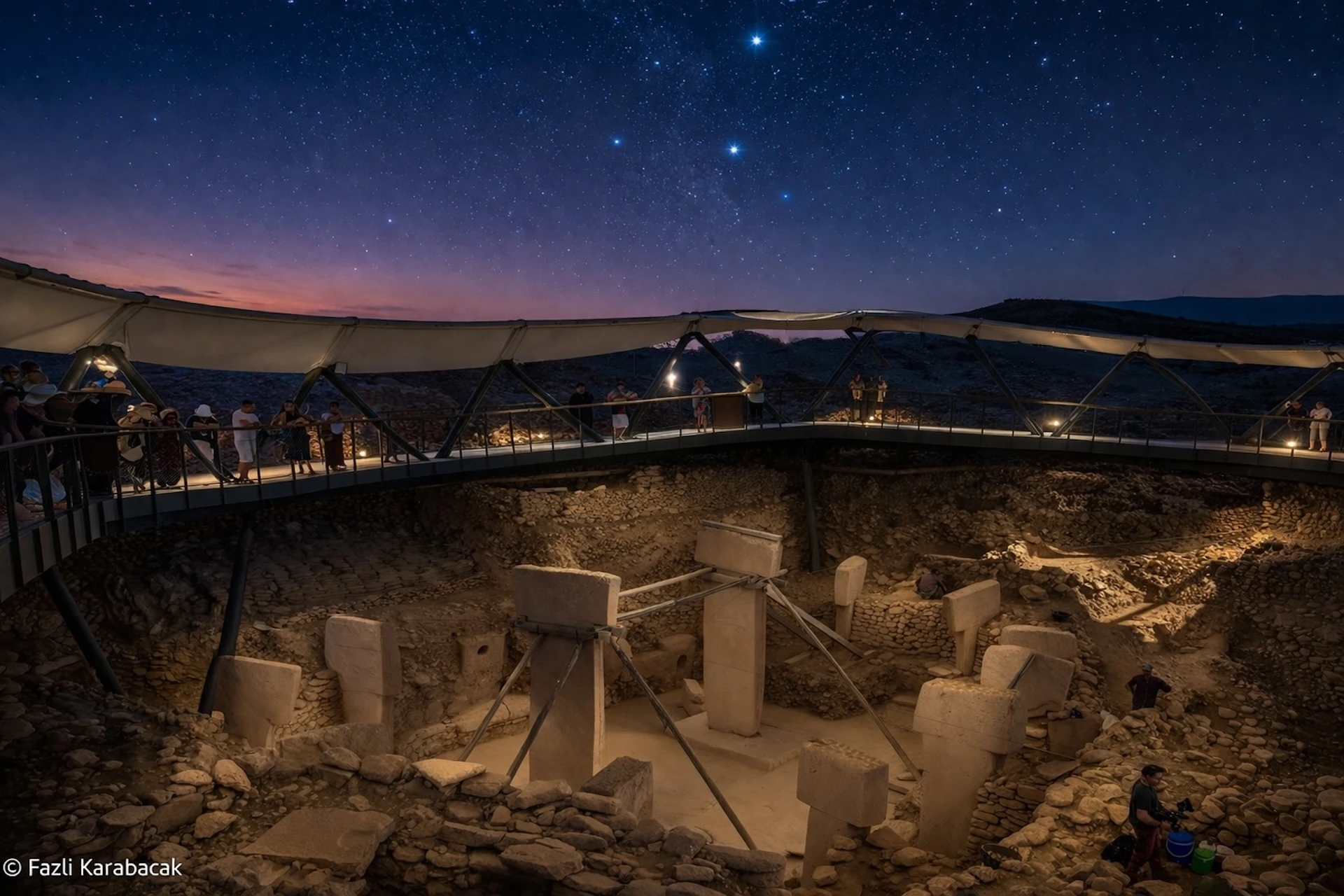 An imaginary night view of Göbekli Tepe — the cosmic shamanism school argues the enclosures were aligned to key celestial events.
Theory 8: Totemic Clan Identity — The Animal-as-Ancestor School
Scholar: Rufus Malim
Rufus Malim approaches the question from a different angle entirely. Working from the analysis of a 12,000-year-old Natufian shaman burial at Hilazon Tachtit in modern-day Israel, he develops a totemic framework that he then applies to Göbekli Tepe.
The Hilazon burial is extraordinary: a woman interred with over 50 tortoise shells, an eagle wing, a wild boar pelvis, a leopard pelvis, and a human foot. Malim reads each animal as a totemic power animal: the tortoise enables underworld travel, the eagle represents sky-realm communication, the marten embodies hunting stealth, and the leopard conveys warrior identity. Crucially, these totems belong not to the individual shaman but to the clan she represents.
Applied to Göbekli Tepe, this framework explains one of the site’s most striking patterns: each enclosure is dominated by a different animal. Enclosure A features foxes prominently. Enclosure B is heavy with wild boar imagery. Enclosure C emphasizes gazelles. Enclosure D is rich with snakes and vultures. If each enclosure belonged to a different clan, and each clan identified with a different animal ancestor, then Göbekli Tepe was not one temple — it was a confederation of clan sanctuaries, each built around its own totemic identity.
This is the theory that resonates most with local people in the Şanlıurfa region. When I share this interpretation with villagers who have lived in the shadow of the site for generations, they nod. The idea that different families would have different sacred animals, and that they would build separate spaces for them — this makes intuitive sense to communities that still organize around extended family and clan structures.
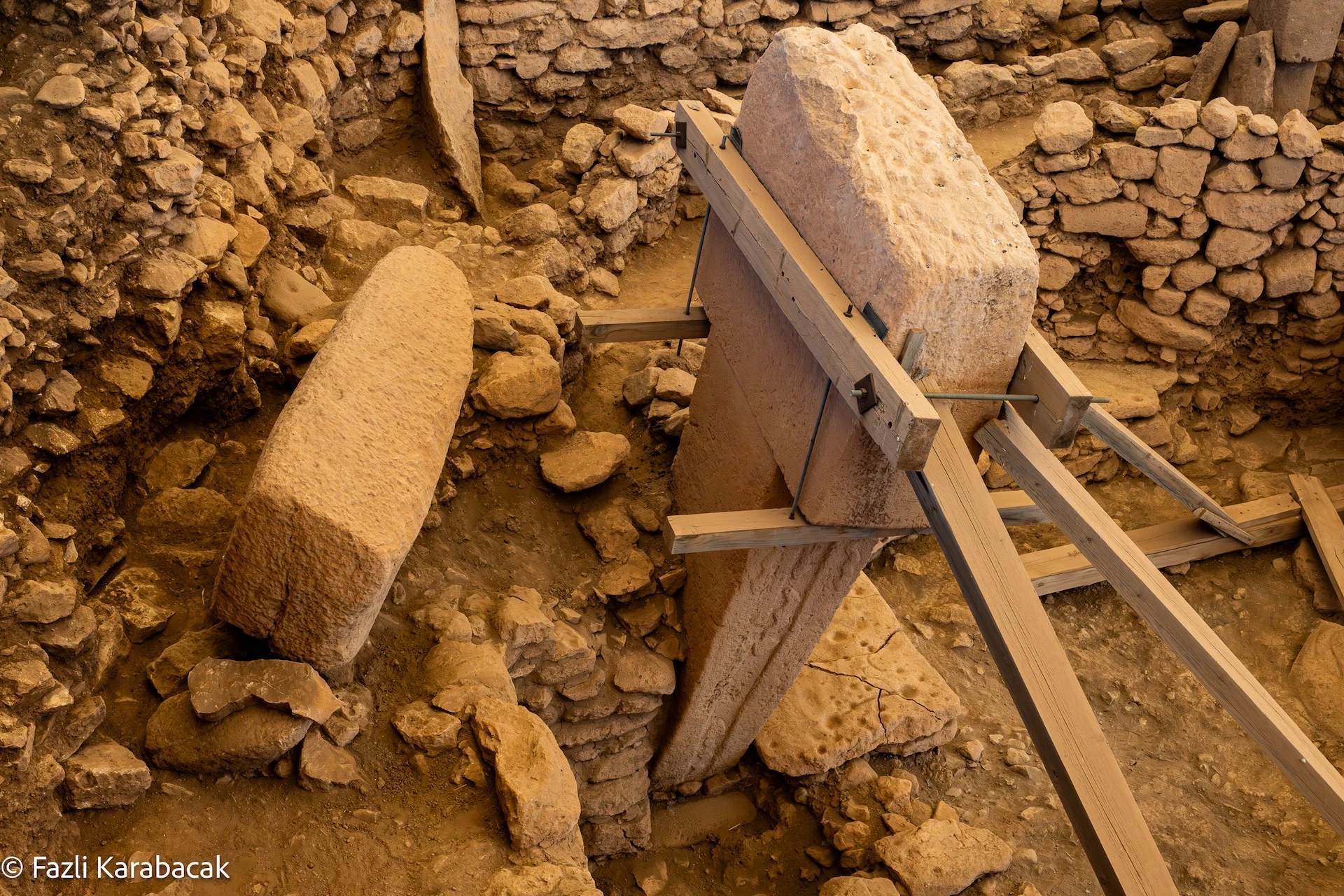 Snake imagery at Göbekli Tepe — snakes dominate Enclosure A, supporting the totemic clan identity theory.
Side-by-Side: What Each Theory Answers
| Theory | Central Question | Core Answer |
|---|---|---|
| German School | What was it for? | Sacred ritual space, male initiation center |
| Turkish School | Why was it built? | Ideological legitimation of hunting-ground control |
| Girardian | How did it hold people together? | Channeling collective violence through ritual sacrifice |
| Mark Black | Who built it and how was it used? | Two cultures; shamanic toolkits + celestial navigation |
| Entanglement | What worldview produced it? | Humans-animals-spirits as one entangled ontology |
| Paleolithic Continuity | Where did it come from? | 30,000-year shamanic tradition, now in stone |
| Cosmic Shamanism | What is the cosmic context? | Milky Way mythology + astronomical death-rebirth rites |
| Totemic | Whose space was it? | Each enclosure = a different clan’s ancestral sanctuary |
What I Tell My Tour Groups
After 25 years of walking this site, after reading dozens of papers and listening to archaeologists argue over lunch in Şanlıurfa, I have come to believe that the debate itself is the most important thing about Göbekli Tepe. Not any single answer, but the quality of the questions.
The German school gave us the first framework and the courage to see a temple where others saw rubble. The Turkish school grounded us in landscape, economy, and the uncomfortable truth that ritual and power are never fully separable. The Girardians reminded us that human communities are held together by mechanisms we prefer not to examine too closely. Mark Black taught us to look up — at the stars, at the bags, at details we had walked past for years. Laneri warned us that our categories might be the biggest obstacle to understanding. Kovárník connected us to the deep past. The cosmic school invited us to experience the site at night. And Malim showed us that the answer might be as close as the clan structures that still define daily life in this region.
When visitors ask me, “So what is Göbekli Tepe, really?” I tell them the truth: nobody knows for certain, and that is exactly what makes it the most important archaeological site on Earth. Every theory reveals a different facet of what it meant to be human at the moment civilization was born. The pillars stand there, arms at their sides, hands clasped — and they are not talking.
But we keep asking. And the asking, I think, is the point.
Ready to Experience These Theories in Person?
Join a guided tour of Göbekli Tepe with Fazli Karabacak, where you will stand in front of every pillar and enclosure discussed in this article — and decide for yourself which theory rings true. Explore Our Göbekli Tepe Tours →
Key Takeaways
- Eight distinct academic frameworks compete to explain Göbekli Tepe — from sacred sanctuary to totemic clan confederation.
- The German school (Schmidt, Dietrich) sees pure ritual; the Turkish school (Çelik, Ayaz) insists on economic-political context.
- The Girardian theory uniquely explains why growing communities needed monumental architecture to manage internal violence.
- Shamanic interpretations connect the site to traditions stretching back 30,000 years — and forward to the Milky Way.
- The totemic clan reading resonates most with local communities still organized around extended family structures.
- Bottom line: Nobody has solved Göbekli Tepe, and the ongoing debate is itself the site’s greatest contribution to human self-understanding.
Where to Go from Here
Start with the big picture: What Is Göbekli Tepe?. Dive into the most debated carving: The Vulture Stone Complete Guide. Explore the animal patterns: Each Enclosure, a Different World. Understand the shamanic evidence: Shamanism at Göbekli Tepe. Planning a visit? See Plan Your Göbekli Tepe Trip.
Frequently Asked Questions
What is the main academic debate about Göbekli Tepe? The central debate is whether Göbekli Tepe was primarily a sacred ritual sanctuary (the German school’s position) or an ideological extension of a practical hunting-ground economy (the Turkish academics’ position). At least six other theoretical approaches also exist.
How many academic theories exist about Göbekli Tepe’s purpose? There are at least eight distinct theories: sacred sanctuary, hunting-ground ideology, Girardian sacrificial violence, Zarzian-Natufian shamanic astronomy, entanglement theory, Paleolithic shamanic continuity, cosmic shamanism, and totemic clan identity.
Was Göbekli Tepe a temple or a practical site? This is the fundamental divide in scholarship. The German school argues it was a purely ritual site with no domestic function. Turkish academics counter that ritual served to legitimize economic power structures. The truth likely involves elements of both.
What do the T-shaped pillars at Göbekli Tepe represent? Interpretations vary widely. The German school sees stylized human figures or supernatural ancestors. Turkish academic Orhan Ayaz argues they are ancestral phalli representing lineage authority. The totemic school views each enclosure’s central pillars as clan ancestors.
Is there a connection between Göbekli Tepe and shamanism? Multiple scholars argue for a shamanic connection. Kovárník traces shamanic practice back 30,000 years through therianthropic cave art. Mark Black identifies shamanic toolkits in the Vulture Stone iconography. The cosmic shamanism school links the site to Milky Way mythology.