Quick Answer
The question of whether Göbekli Tepe was a temple, a settlement, or something else entirely is one of the most actively debated issues in Neolithic archaeology. Klaus Schmidt, the site’s excavator, interpreted it as a hilltop sanctuary — a purely ritual centre built and visited by hunter-gatherer communities who lived elsewhere. Ted Banning later challenged this view, arguing that the structures could be richly decorated domestic buildings rather than sanctuaries, and that imposing a modern sacred/profane divide on Neolithic societies may be methodologically misleading. The current scholarly consensus leans toward interpreting the main enclosures as specialised ritual or communal structures rather than ordinary houses, while also recognising that sacred and domestic life may have been more entangled than modern categories suggest.
Quick Facts
- Short answer: Probably not a temple in the modern sense, but very likely a specialised ritual place
- Main debate: Sanctuary vs settlement
- Most associated scholar: Klaus Schmidt
- Main challenger: Ted Banning
- Current consensus: Ritual or communal structures are more likely than ordinary houses, especially when read alongside What Is Göbekli Tepe?
- Why the debate matters: It changes how we think about religion, daily life, and community in the Neolithic
There is a question I am asked more often than almost any other when guiding at Göbekli Tepe: “So was this a temple?” It sounds simple, but the answer is not.
The site has forced archaeologists to confront the limits of the categories they use. When we ask whether it was a temple, we bring with us modern assumptions about the separation of sacred and secular life — assumptions that may not fit the world of twelve thousand years ago.
Klaus Schmidt’s Original Vision
When Klaus Schmidt began excavating at Göbekli Tepe, he was struck by several things that seemed to point away from ordinary settlement and toward something ceremonial.
First, there was the location. Göbekli Tepe sits on an elevated limestone ridge with commanding views but limited practical advantages for village life. It feels chosen for symbolic and visual reasons, not simply for everyday domestic convenience.
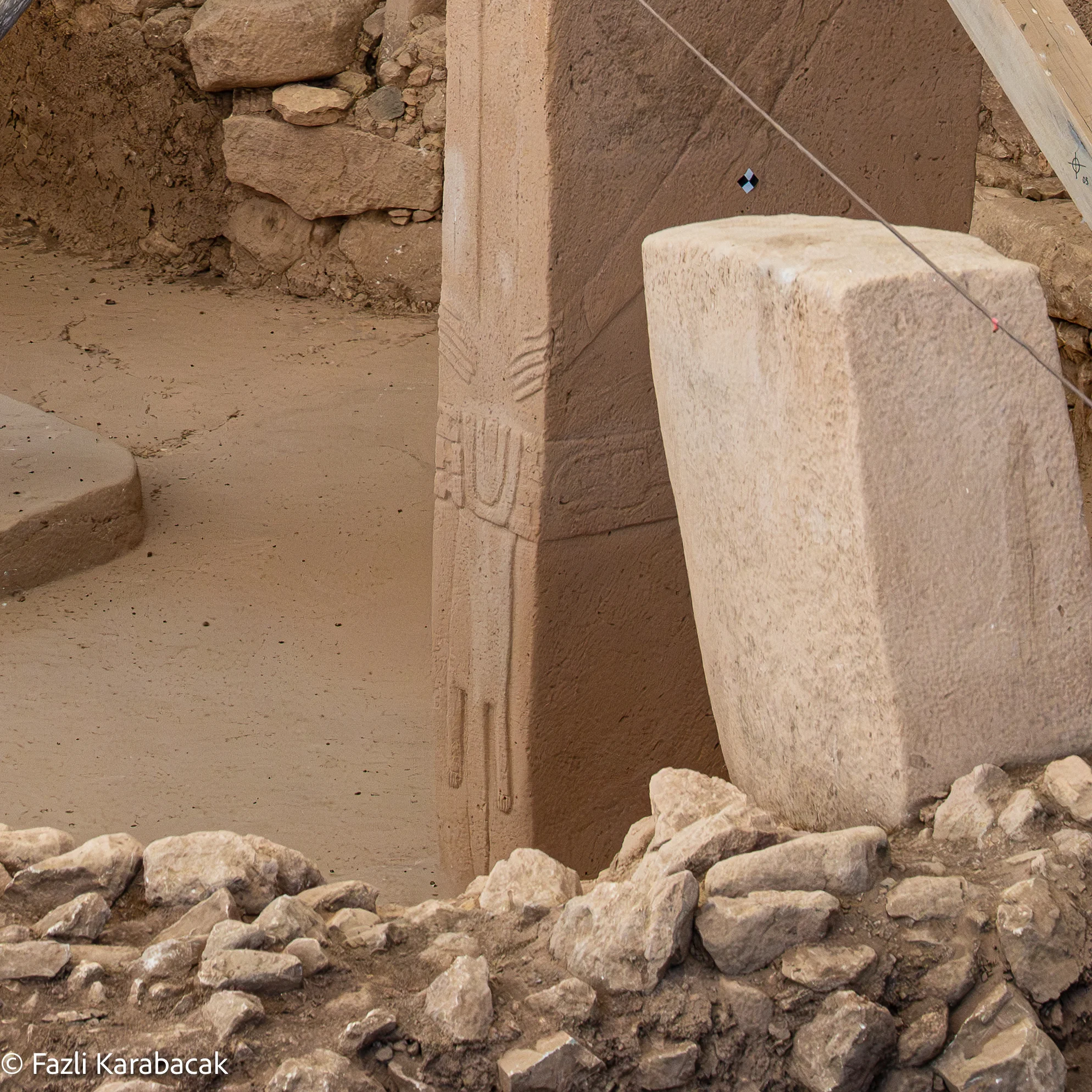
Second, the architecture itself was unlike ordinary residential architecture known from contemporary sites. Instead of standard domestic buildings, Göbekli Tepe revealed monumental enclosures organised around massive T-shaped pillars, benches, and carefully structured space.
Third, many of the features typically associated with normal habitation were either absent or far less visible than expected. Schmidt therefore argued that the site functioned primarily as a ritual centre — a hilltop sanctuary visited by groups who lived elsewhere.
Banning’s Challenge
Ted Banning challenged this interpretation by asking a deeper methodological question: how do we know that ritual and domestic life were sharply separated in the Neolithic at all?
His argument was not that Göbekli Tepe lacked ritual significance. Rather, he suggested that richly symbolic buildings could still have been lived-in or multi-functional spaces. In many cultures, houses themselves carry ritual significance, and the line between sacred and ordinary life is not neatly drawn.
This was an important intervention. It reminded archaeologists that the categories “temple” and “house” are not timeless universal truths.
Why Most Archaeologists Still Lean Ritual
Even after Banning’s intervention, the balance of evidence still pushes many archaeologists toward a ritual or communal interpretation.
The monumental scale of the main enclosures, the T-shaped anthropomorphic pillars, the iconography of dangerous and liminal animals, the evidence for large-scale feasting, and the deliberate burial of structures all point to places that were treated as special.
That does not necessarily mean “temple” in a modern or institutional religious sense. But it does suggest spaces that were not simply ordinary domestic dwellings.
Feasting, Labour, and Gathering
One of the strongest arguments for specialised communal use is the evidence for large-scale feasting.
The site has yielded large limestone vessels and substantial animal bone deposits, pointing to gatherings that went well beyond household consumption. If groups came together here for ritual, labour, and social negotiation, then Göbekli Tepe may have functioned less like a town and more like a periodic ceremonial centre.
This is one reason the architecture matters so much. The engineering story behind the site — explored further in How Was Göbekli Tepe Built? — suggests a level of coordinated communal effort that fits well with ritual gathering and feasting.
Beyond a False Binary
The most important lesson of the debate may be that the choice between “temple” and “settlement” is too narrow.
Göbekli Tepe may have been a place where ritual, social identity, labour, memory, and gathering all intersected. It may have been neither a temple in the later historical sense nor an ordinary village. It may have belonged to a category of early communal architecture that does not map neatly onto modern religious terminology.
That is why this debate matters. It is not just about one label. It is about how we understand the deep structure of Neolithic life.
So, Was Göbekli Tepe a Temple?
If I had to give the shortest careful answer, I would say this:
Göbekli Tepe was probably not a temple in the narrow modern sense, but it was very likely a specialised ritual place rather than an ordinary settlement.
That remains the most balanced reading of the current evidence. The buildings are too unusual, the symbolic programme too strong, and the evidence for communal use too substantial to fit comfortably within an ordinary domestic model.
At the same time, the warning against applying rigid modern categories remains valuable. Göbekli Tepe probably belongs to a world where sacred and everyday life were deeply entangled.
What I Tell My Visitors
When people ask me on site whether Göbekli Tepe was a temple, I usually tell them this: it was a place that clearly mattered in a way ordinary buildings do not.
Whether we call it a sanctuary, a ritual centre, a communal gathering site, or a very early form of sacred architecture matters less than recognising what the archaeological evidence is trying to tell us. The builders treated these structures as special. They invested immense labour in them. They marked them symbolically. And when their use-lives ended, they buried them carefully rather than abandoning them casually.
That is not how people normally treat an ordinary house.
Key Takeaways
- Schmidt said sanctuary. Banning said the sacred/domestic divide is too neat. Most archaeologists now lean toward “specialised ritual space.”
- The strongest evidence — monumental scale, anthropomorphic pillars, feasting debris, symbolic carvings, deliberate burial — points toward something beyond ordinary living quarters.
- Not a temple in the modern sense, but almost certainly a place set apart for communal ritual and gathering.
- Bottom line: The debate is not whether Göbekli Tepe was special, but exactly how to define that specialness.
See It for Yourself
For the full site introduction, read What Is Göbekli Tepe?. For the man behind the first interpretation, read Klaus Schmidt. Travellers building an itinerary can start at Plan Your Göbekli Tepe Trip.
Frequently Asked Questions
Was Göbekli Tepe a settlement or a temple? Most archaeologists now lean toward seeing the main monumental enclosures — Enclosures A, B, C, and D — as specialised ritual or communal structures rather than ordinary domestic buildings. The “pure temple” reading associated with Klaus Schmidt has softened over time as evidence of domestic-scale activity in adjacent areas has grown. The most honest answer today is: specialised, yes; purely sacred in the modern sense, probably not.
Who challenged Schmidt’s temple interpretation, and on what grounds? The best-known challenge came from Ted Banning in a 2011 paper titled “So Fair a House,” which argued that Göbekli Tepe’s enclosures could be read as elaborately decorated domestic buildings of a kind known from other PPN sites. Banning’s wider point was methodological: that imposing a modern sacred/secular divide on Neolithic communities is itself an assumption, and one that may distort what we are actually looking at.
What has the DAI excavation team’s position been in recent years? The German Archaeological Institute team, led after Schmidt’s death by Lee Clare and Jens Notroff, has moved toward a more nuanced reading. They now emphasise that domestic and ritual activity at the site were probably interwoven, that the enclosures almost certainly had seasonally or periodically gathered communities around them, and that “temple” in the modern sense is the wrong word even if specialised ritual use is clearly present.
Did anyone actually live at Göbekli Tepe? This is where the picture has changed most in the last decade. Evidence of domestic-scale buildings, grinding installations, and everyday activity in areas adjacent to the monumental enclosures has grown. Whether these represent permanent residence, seasonal occupation, or the camp of gathered labour forces is still debated, but the old image of a “ritual centre visited by scattered hunter-gatherer groups” has become harder to defend.
What’s the strongest single piece of evidence for specialised use? The deliberate burial of the enclosures — the fact that each major structure was intentionally filled in with stone and debris at the end of its use — is, for me, the most striking single piece of evidence. Ordinary houses are not ceremonially entombed. Combined with the monumental scale, the anthropomorphic pillars, and the animal imagery, the burial suggests these were structures that had a life-cycle meaning beyond simple domestic function.
Why does this debate matter for visitors? Because it changes what you are looking at. If Göbekli Tepe is a temple, you are standing in a sanctuary. If it is a richly decorated settlement, you are standing in a household. If it is something in between — which is where the evidence now points — you are standing in a place that doesn’t fit our modern categories at all. That last option is, to my mind, the most interesting; and it is the one I try to convey when I guide groups here.
Fazlı Karabacak is a licensed Turkish tour guide with over 25 years of experience and the founder of Serendipity Turkey. He specialises in archaeological and cultural tours across Turkey, with particular expertise in Göbekli Tepe and the Pre-Pottery Neolithic sites of southeastern Anatolia.