Quick Answer
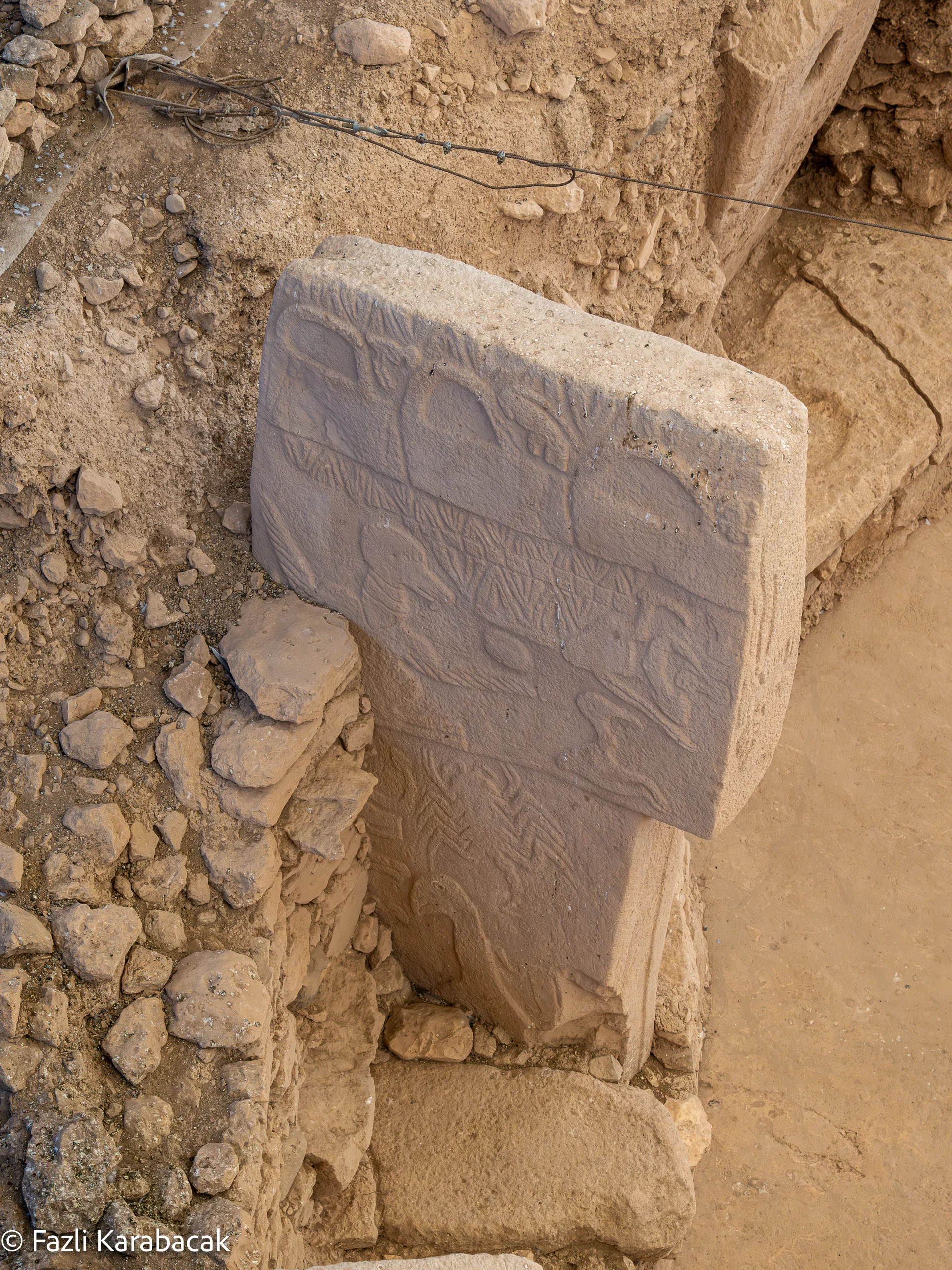
The Vulture Stone, or Pillar 43, is one of the most famous and debated carvings at Göbekli Tepe. Located within one of the main enclosures, it features a striking composition of birds, a headless human figure, a scorpion, and other symbols that have inspired interpretations ranging from funerary imagery to cosmological symbolism and archaeoastronomy. Whatever interpretation one prefers, the Vulture Stone is among the clearest examples of the symbolic sophistication of the Göbekli Tepe world.
At a Glance
- Official name: Pillar 43
- Popular name: The Vulture Stone
- Site: Göbekli Tepe
- Why it matters: It is one of the most debated images in early Neolithic archaeology
- Main themes: Death, symbolism, ritual, cosmology, interpretation
When people first hear about Göbekli Tepe, they often focus on its age. When they stand at the site, they notice the pillars. But when they begin looking more closely, one carving almost always takes over the conversation: Pillar 43, better known as the Vulture Stone.
It is the image that seems to demand interpretation. It is dense, deliberate, and unsettling. And for that reason, it has become one of the most discussed objects not only at Göbekli Tepe, but in all of early Neolithic archaeology.
What Is the Vulture Stone?
The Vulture Stone is the name commonly given to Pillar 43, one of the most visually striking carved pillars at Göbekli Tepe. The name comes from the large bird figure usually identified as a vulture, which dominates part of the composition.
What makes the pillar so compelling is that it does not look like a random collection of motifs. It looks composed. The figures feel arranged with intention, as if they belong to a symbolic programme rather than isolated decoration.
What Appears on the Pillar?
The pillar includes several motifs that have drawn repeated attention:
- a large bird, usually read as a vulture, wings spread, with a round disc or sphere balanced on one wing
- a headless or decapitated human figure — a body without a head, one of the most arresting images at the site
- a scorpion with its tail raised
- additional birds, a snake, and a crane-like bird
- abstract or enigmatic signs near the upper area
- a row of handbag-like shapes across the top — rectangular containers with curved handles that recur on carved stones from ancient Mesopotamia to Mesoamerica, their meaning unknown
- at the base, what appears to be a severed head resting on a surface, reinforcing the theme of decapitation found elsewhere at the site
If you want to focus specifically on those non-figurative marks, see The H Symbol and Abstract Signs at Göbekli Tepe.
Even before interpretation begins, the emotional effect is strong. This is not cheerful decorative art. It belongs to a world of danger, death, transition, and symbolic force.
Why Is It So Important?
Pillar 43 matters because it shows how far symbolic communication had already developed in the early Neolithic.
This was not a simple image scratched into stone. It was a carefully designed composition created by people who were already using visual symbols in ways that appear layered, structured, and meaningful. Whether or not we can decode every part of it, the Vulture Stone proves that Göbekli Tepe’s builders were working with an advanced symbolic imagination.
The Funerary Interpretation
One of the most common interpretations connects the Vulture Stone to death and the treatment of the dead.
The presence of a headless human figure and a large bird has encouraged comparisons with excarnation — the exposure of bodies to birds, especially vultures, in funerary contexts. In several ancient cultures, vultures are associated with the transition between life and death, the body and the sky, flesh and spirit.
This does not prove that the pillar is a literal funerary scene. But it does make the death-related interpretation one of the most enduring and intuitively powerful readings.
The Cosmological Interpretation
Other scholars and interpreters have approached the Vulture Stone through cosmology.
In this reading, the animals and symbols may not represent a single earthly scene, but a broader way of mapping forces, realms, or ideas. The composition could reflect relations between the human world, dangerous animals, birds, the sky, and ritual transformation.
Even if we cannot translate the pillar as if it were text, it may still belong to a symbolic system that was meaningful to the communities who carved and viewed it.
The Shamanic Interpretation
A third perspective focuses on shamanic imagery. The dense composition of animals, the ecstatic posture of certain figures, and the overall visual intensity of the carvings recall what anthropologists have identified as “therianthropic” art — imagery produced in or inspired by altered states of consciousness, where human and animal worlds merge. In this reading, the Vulture Stone may reflect a visionary or ritual experience rather than a literal scene.
The Archaeoastronomy Debate
The most controversial interpretations of the Vulture Stone move into archaeoastronomy.
Some have argued that the figures on the pillar correspond to constellations or celestial events. In the most widely known speculative version of this theory, the carving has even been linked to a distant cosmic catastrophe. If you want the debate broken down carefully, continue with The Star Map on the Vulture Stone and The Vulture Stone: Death, Soul, and Sky Burial.
These readings have attracted major public attention, but they remain heavily debated. The problem is not that ancient people watched the sky — of course they did. The problem is whether the evidence on this specific pillar is strong enough to support such precise astronomical claims.
My view is that this is where caution matters most. The Vulture Stone clearly carried symbolic meaning, but we should not confuse “possible” with “proven.”
Why Interpretation Is So Difficult
Part of what makes Pillar 43 so fascinating is also what makes it so frustrating: we do not have the cultural key.
There is no inscription explaining the image. There is no Neolithic text telling us what each figure means. We are trying to understand a symbolic composition from a world twelve thousand years distant, with only archaeology, comparison, and careful interpretation to guide us.
That does not make interpretation pointless. It just means humility is essential.
What the Vulture Stone Reveals About Göbekli Tepe
Even if we set aside the most ambitious claims, the Vulture Stone still tells us something profound.
It tells us that Göbekli Tepe was a place where symbolic carving mattered deeply. These pillars were not merely structural or decorative. They were carriers of meaning. They were part of a visual and conceptual system that helped organise how people thought about animals, humans, danger, ritual, and perhaps death itself.
In that sense, the Vulture Stone is not an isolated curiosity. It is a concentrated expression of the larger symbolic world of Göbekli Tepe.
How to See It as a Visitor
If you visit Göbekli Tepe, the most important thing is not to rush past the pillar as if it were just one more “famous detail.”
Slow down. Look at the composition as a whole before trying to decode individual figures. Notice how unsettling it feels. Notice how different it is from the kind of narrative imagery most visitors expect from later historical periods.
And if possible, pair the visit with the Şanlıurfa Museum Guide and the broader What Is Göbekli Tepe? overview. Pillar 43 makes most sense when seen as part of a much larger symbolic landscape.
The Real Importance of the Vulture Stone
The Vulture Stone matters not because we have solved it, but because we have not.
Its power lies in the way it compresses so many of the central mysteries of Göbekli Tepe into one image: death, ritual, symbolism, narrative, cosmology, and the limits of interpretation. It reminds us that the builders of Göbekli Tepe were not just moving heavy stones. They were thinking in symbols with extraordinary intensity.
Key Takeaways
- Vulture, headless figure, scorpion, handbag shapes, severed head — Pillar 43 compresses more symbolic content into one stone than almost anything else from the ancient world.
- Three main readings compete: funerary ritual, cosmological narrative, and archaeoastronomical star map. None has won the debate outright.
- The astronomical theories attract the most headlines but face the strongest archaeological pushback.
- Bottom line: Whatever the Vulture Stone means, it proves that Göbekli Tepe’s builders were thinking in narratives, not just images.
Ready to Visit?
For practical trip details, see the Göbekli Tepe Visitor Guide. For the death-and-ritual reading of this pillar, read Death, Soul, and Sky Burial. Shape your full route at Plan Your Göbekli Tepe Trip.
Frequently Asked Questions
What is the Vulture Stone, and where is it located at Göbekli Tepe? The Vulture Stone is the popular name for Pillar 43, one of the most symbolically complex carvings at Göbekli Tepe. It is located in Enclosure D, one of the main ritual spaces at the site. Pillar 43 features a composition of animals (primarily vultures and birds), a headless human figure, a scorpion, handbag-like shapes, and other symbolic motifs arranged on the shaft of the pillar.
Which interpretations dominate the scholarly reading of Pillar 43? Three main interpretations compete: (1) A funerary or death-related scene, based on the headless figure and vulture imagery; (2) A cosmological narrative showing different realms or levels of existence; and (3) An archaeoastronomy theory linking the figures to celestial events or constellations. None has achieved consensus, and most scholars treat the third interpretation as highly speculative compared to the first two.
What is the evidence for the funerary interpretation of the Vulture Stone? The most compelling evidence is the headless human figure — one of the most striking and unsettling images at Göbekli Tepe. This connects to the broader Neolithic practice of excarnation (exposing bodies to scavengers) and the treatment of skulls found at Göbekli Tepe and other early Neolithic sites. The presence of a large vulture makes sense in this context, as vultures were associated with the transition of the dead.
Is the astronomical interpretation of the Vulture Stone accepted by mainstream archaeology? No. While the theory has attracted popular attention and considerable online discussion, most DAI (German Archaeological Institute) researchers and mainstream archaeologists view the astronomical interpretation as speculative and not supported by strong evidence. The funerary and cosmological readings are considered far more grounded in the archaeological context.
Can visitors see the original Vulture Stone at Göbekli Tepe? The original Pillar 43 is currently covered and not accessible to general visitors at the site itself. This is partly for preservation purposes and partly due to excavation and conservation logistics. However, a detailed replica of the Vulture Stone is on display at the Şanlıurfa Archaeology Museum, where you can examine the imagery and details far more clearly than you would at the weathered original.
Is the Vulture Stone the most important artifact at Göbekli Tepe? It is certainly one of the most famous and symbolically intense. However, its importance lies not in being “the answer” to what Göbekli Tepe was, but in how it concentrates multiple big questions — death, ritual, symbolism, cosmology, narrative thinking — into a single stone. Understanding Pillar 43 requires understanding the broader site, not the reverse.
Fazlı Karabacak is a licensed Turkish tour guide with over 25 years of experience and the founder of Serendipity Turkey. He specialises in archaeological and cultural tours across Turkey, with particular expertise in Göbekli Tepe and the Pre-Pottery Neolithic sites of southeastern Anatolia.