Quick Answer
Göbekli Tepe is famous for its animal carvings, but some of its most intriguing imagery is abstract rather than figurative. H-shapes, crescents, V-marks, circles, and other geometric signs appear on important pillars and remain among the least understood elements of the site. They suggest a sophisticated symbolic vocabulary that we can recognise, but not yet truly read.
At a Glance
- Main focus: abstract signs at Göbekli Tepe
- Best-known example: the H-symbol
- Other recurring forms: crescents, V-marks, circles, and geometric marks
- Why they matter: they point to a symbolic system beyond animal imagery alone
- Main question: Were these signs cosmological, ritual, social, or some combination of all three?
When people imagine Göbekli Tepe, they usually picture foxes, vultures, snakes, boars, and the great T-shaped pillars. But the site contains another layer that is just as important: abstract signs that do not correspond neatly to any obvious animal or human figure.
These markings are among the most tantalising features of the entire site because they look meaningful in a direct, deliberate way — yet their meaning remains unresolved.
More Than Animal Carvings
The abstract signs matter because they show that Göbekli Tepe’s visual world was not limited to recognisable creatures.
Alongside the animal reliefs, the builders also used a non-figurative symbolic language. That alone tells us something important. They were not only depicting beings from the surrounding world. They were also working with abstract forms — signs capable of carrying meaning in a more compressed and coded way.
That is one reason these symbols feel so modern to us. We immediately sense that they are signs, even if we cannot read them.
The H-Symbol
The best-known of these forms is the H-symbol.
It appears on major pillars and has attracted disproportionate attention because of its clarity and repetition. Scholars have proposed multiple ways of thinking about it: as a ritual sign, as a schematic representation connected to pillar space, as part of a wider cosmological grammar, or as something related to celestial interpretation.
The problem is that we do not have the key to decode it with confidence.
So while the H-symbol is real, prominent, and important, its exact meaning remains open.
Crescents, V-Marks, and Other Forms
The H-symbol is not alone.
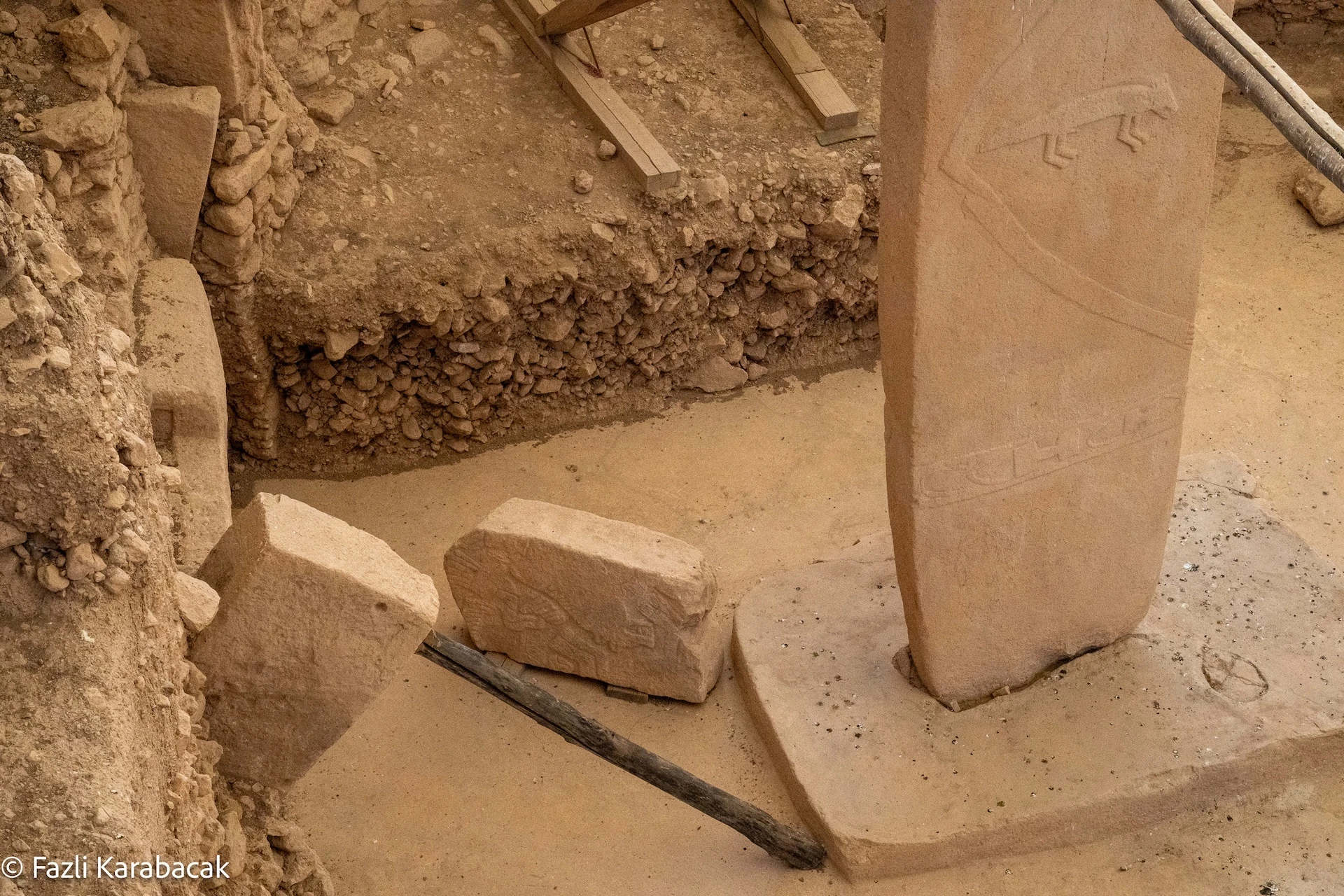
Göbekli Tepe also includes crescents, V-shaped marks, circles, and other abstract elements. Some of these have encouraged astronomical or calendrical readings, especially when they appear in carefully structured arrangements.
Those readings are interesting and worth knowing about. But they must be handled with discipline.
It is one thing to say that certain symbols may have cosmological significance. It is another to claim that a complete calendar or star map has been definitively decoded. The evidence does not support that kind of certainty.
Why Caution Matters
This is one of the places where Göbekli Tepe invites both fascination and overreach.
Abstract symbols naturally attract projection. People want to solve them. They want the sign to mean one exact thing. But archaeology rarely works that cleanly, especially at a site this old.
So the best approach is a careful one:
- some of these signs may be cosmological
- some may be ritual
- some may express enclosure or group identity
- some may operate on multiple levels at once
The honest answer is that we do not yet know enough to force a single master explanation.
Signs Without a Dictionary
That uncertainty is part of what makes the abstract signs so powerful.
We can see that they belong to an intentional symbolic system, but we do not have the equivalent of a dictionary or bilingual key that would let us decode them securely. In that sense, Göbekli Tepe’s abstract imagery sits in a fascinating middle ground: clearly meaningful, but not linguistically readable in the way later writing systems are.
This does not make the signs less important. If anything, it makes them more revealing. They show that the builders of Göbekli Tepe were capable of sustained abstract thought and non-figurative symbolic expression on a monumental scale.
The Relation to the Pillars
Placement matters here too. If you want to see one of the clearest contexts where abstract signs become especially important, pair this article with The Vulture Stone at Göbekli Tepe. If you want the enclosure-wide animal framework around those signs, read Each Enclosure, a Different World.
Placement matters here too.
These signs are not randomly scattered. They appear on important pillars, in visible positions, often in relationship to other highly charged imagery. That means they are part of the overall symbolic design of the site, not incidental scratches.
The H-symbol and related marks belong to the same serious visual language as the animals, the anthropomorphic pillar bodies, and the enclosure-specific programmes.
Why These Signs Matter So Much
In some ways, the abstract signs may be the most intellectually demanding part of Göbekli Tepe.
A fox is still recognisable as a fox. A vulture is still recognisable as a bird. But an H-shape is pure symbol. Its importance lies not in resemblance to the world, but in the meaning assigned to it by the people who carved it.
That makes the abstract signs especially valuable. They reveal a level of conceptual thinking that is easy to underestimate when people speak too casually about “Stone Age” societies.
What the Abstract Signs Tell Us About Göbekli Tepe
The abstract signs tell us that Göbekli Tepe was not only a place of animal symbolism and monumental architecture. It was also a place of coded thought.
The builders were using signs that condensed meaning into geometric form. We may not yet understand that code, but we can clearly see that it existed.
And that alone makes the abstract signs central to any serious reading of the site.
Key Takeaways
- Below the animal carvings lies a second symbolic layer: H-shapes, crescents, V-marks, circles, and other geometric signs.
- The H-symbol is the most discussed of these motifs — and still one of the least understood.
- These are not random marks. They form a structured visual language we can recognise but cannot yet read.
- Bottom line: The abstract signs prove Göbekli Tepe’s builders were working with concepts, not just images of animals.
From Research to Route
For more on the site’s symbolic depth, pair this with The Vulture Stone and The T-Shaped Pillars. For the full introduction, read What Is Göbekli Tepe?. Ready to see the carvings in person? Start at Plan Your Göbekli Tepe Trip.
Frequently Asked Questions
What is the H-symbol at Göbekli Tepe, and where does it appear? The H-symbol is one of the most discussed abstract signs at the site, appearing on several important pillars across different enclosures. It takes the form of two vertical lines connected by a horizontal bar — pure geometry, with no obvious resemblance to an object in the natural world. Its meaning is one of the great unsolved puzzles of Göbekli Tepe archaeology.
What other abstract signs appear at the site besides the H? Alongside the H, Göbekli Tepe features crescents, V-shaped marks, circles, handbag-like shapes, and other geometric forms. These appear scattered across pillars and carved stones, sometimes alongside animal imagery and sometimes in isolation. Collectively, they form what appears to be a structured, intentional symbolic system that remains largely undeciphered.
Do these abstract signs prove that Göbekli Tepe had a form of writing? Not in the formal sense. Writing typically involves a system where marks represent sounds or words in a spoken language, and no evidence suggests the H-symbols worked that way. However, the signs clearly formed a structured symbolic language — a coded system of meaning-making. Whether that constitutes “writing” depends on how strictly you define the term.
Have archaeologists proposed theories about what the H-symbol means? Many theories have been suggested: astronomical alignments, architectural plans, mathematical concepts, ritual symbols, or references to spirits or sacred beings. None has achieved consensus. The more honest answer is that while the H-symbol is unmistakably intentional and meaningful, we do not yet have a secure interpretation of what it communicates.
Are the abstract signs definitely astronomical, as some popular accounts suggest? Possibly in some cases, but astronomical readings remain contested and should not be treated as proven. Some researchers have proposed connections to stars, constellations, or celestial events, but these interpretations are speculative. The site’s architectural alignments are worth studying, but visible geometric signs on pillars should not be confused with astronomical maps.
Can visitors see the H-symbols and abstract signs at Göbekli Tepe itself? Some H-symbols remain visible on pillars at the site, though weathering and exposure have made them less distinct than they once were. The Şanlıurfa Archaeology Museum houses many examples of carved stones featuring the H-symbol and other abstract signs, where they can be studied under controlled conditions with good lighting. Visiting the museum before the site greatly enriches your ability to spot and understand these signs.
Fazlı Karabacak is a licensed Turkish tour guide with over 25 years of experience and the founder of Serendipity Turkey. He specialises in archaeological and cultural tours across Turkey, with particular expertise in Göbekli Tepe and the Pre-Pottery Neolithic sites of southeastern Anatolia.